

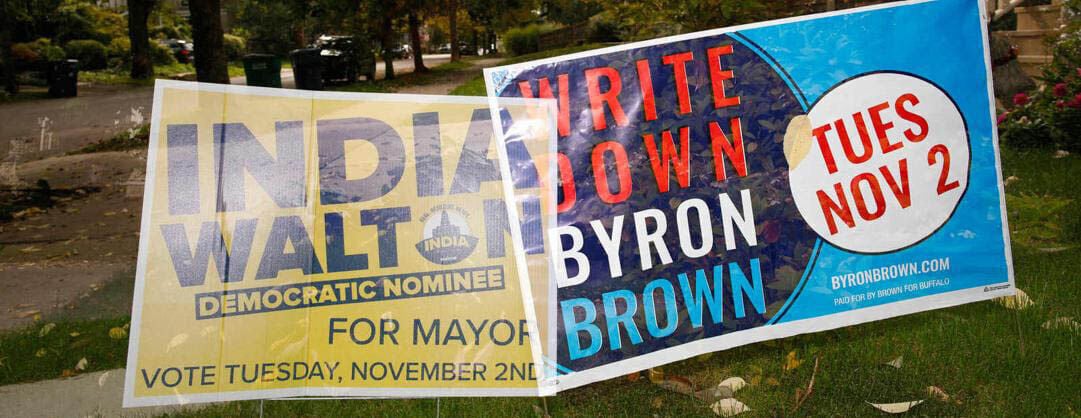
In 2017, when Byron Brown last ran for mayor of Buffalo, it seemed politicians across New York couldn’t wait to support his bid for a fourth term.
Twenty-five of them contributed about $24,000 to his 2017 campaign, state Board of Elections records show.
It’s a different story in 2021.
While 11 politicians chipped in $10,200 before his June 22 Democratic primary defeat to India Walton, similar contributions have since slowed to a trickle.

India B. Walton, left, and Mayor Byron W. Brown disagree on whether Buffalo should be a "sanctuary city."
Brown, seeking a fifth term as a write-in candidate, took in a mere $1,800 from only four fellow office seekers, according to the latest financial disclosures.
Overall, he raised $831,279 between July 12 and Sept. 27.
The situation differs little over at Walton headquarters. The former community organizer who stunned Brown in the primary reports only nine contributions from politicians totaling $7,900 – with $5,000 of that total stemming from the “do-over” by Erie County Democrats after originally backing Brown. She took in $441,669 during the same reporting period.
People are also reading…
It’s a far cry from the traditional stampede of politicians locally and across the state to scratch each others’ backs at campaign time. Walton's primary victory, Brown's write-in challenge, and the resulting passions on both sides all prompt many candidates or their committees to sit out this year's mayoral contest, said campaign veteran Stephen T. Banko III.
"Vested self-interest is the first rule of any politician," said Banko, a Brown supporter who managed citywide elections for former Mayor Anthony M. Masiello. "Is what's good for him [or her] good for me?"
Read the full story from News Staff Reporter Robert J. McCarthy
Banko noted that Brown – who previously served as state Democratic chairman – has always been viewed as a Democrat, and he would normally attract significant support from other Democratic officeholders. But Walton is now the official party nominee, all part of this year's more complicated situation.
"A lot of these people don't want to take the risk and have their credentials as a Democrat questioned," he said. "They don't want it thrown in their face the next time they want the endorsement."
The Walton campaign agrees the unique circumstances of the 2021 election has resulted in different donation results. Spokesman Jesse Myerson said many officeholders have not even made an endorsement let alone a donation.
"That's inordinate, but everything about this race is inordinate," he said.
Myerson also said many potential donors fear "retribution" by a mayor at the helm of a vast government.
"Lots of people don't want to be on the mayor's bad side," he said.
The Brown campaign chalks up the different sources of contributions to a different kind of campaign. Normal sources of Democratic support for Brown do not participate this year because he is not the Democratic nominee, they say.
And they point out the mayor has raised more than $831,000 since losing the primary from more than 2,600 contributors, with 60% stemming from city voters and 80% from throughout Western New York.
"There's been a tremendous outpouring of support," said campaign manager Conor Hurley, who offered no comment on the lack of politician contributions.
Money from developers
The latest campaign finance reports also highlight a recurring theme in the race: Brown's reliance on the business and development community and Walton's resulting criticism.
According to Board of Elections data, Brown has benefited from business interests, especially developers dealing with the city. The 43x79 political action committee, an amalgamation of city business people, leads the list with $13,100 in contributions. Douglas Jemal, the Washington developer who has taken Buffalo by storm with a host of redevelopment projects, is next with $12,700.
Other top contributors include developer Paul Ciminelli ($11,200), the Committee for Economic Growth associated with the Buffalo Niagara Partnership ($10,600), developer Samuel J. Savarino ($10,281), the Barclay Damon legal firm ($10,000) and Norstar Building Corp. ($10,000). Several other developers and associated firms constitute the upper echelons of Brown donors.
For most of her campaign, Walton has criticized the mayor's alleged coziness with the development community, saying last month "they get lots of preferential treatment from the mayor." Private developers will have to do more to ensure equity and affordability in the City of Buffalo, she said, demanding robust community benefits agreements in return for public funding of projects.
"It's clear that Byron Brown's approach to economic development ... results in windfall profits for developers," Myerson said. He also said the significant contributions from developers represent fears of "a shift in paradigm" from Brown's record of dealing with developers.
"India has said she is pro-development," Myerson said. "She's just against development that causes displacement. They may be afraid of that but it's not a fear grounded in her actual program.
"The way development is done will change," he added.
Hurley said contributions from developers constitute only part of Brown's overall list of donors.
"Support for the mayor is not defined by any one group but by the overall support for another four years for Byron Brown," he said.
Brown outraises Walton
In total, Brown has raised $1.5 million since Jan. 1 – twice as much as Walton.
In their overall fundraising, Brown and Walton reported roughly even results through the first five months of the year. But in the middle of May, after one big surge, Brown’s coffers neared $200,000 – triple that of Walton’s. And since then, Brown’s cumulative fundraising has consistently been two to three times that of his opponent.

Walton’s primary upset in June attracted the attention of The New York Times, CNN, Fox News and other national media, given the historic nature of her victory, as it had been 60 years since a socialist was elected mayor of a large American city.
The media attention initially appeared to translate to dollars for Walton. In the three weeks following the primary, she received $175,000 from supporters – more than she received through the first six months of the year.
Among the larger contributions from around the country: $1,000 from actress and former gubernatorial candidate Cynthia Nixon. Farhad Ebrahimi, a Boston philanthropist with far-left leanings, sent more than $5,000. Silicon Valley activist Karla Jurvetson sent her third – and by far, biggest – donation of the year to Walton: $7,800.
During those same three post-primary weeks, Brown raised a paltry $26,000. But it wasn’t long before his fundraising ratcheted up – and Walton’s slowed. In the following three weeks, from mid-July to early August, Brown raised $131,570 – nearly three times as much as Walton did during the same period.
Checks flowed into Brown from developers and business leaders, including $5,000 from Nick Sinatra, $5,200 from Savarino and $7,700 from Sentient Science CEO Thomas Ward.
And the contributions continued for Brown. In August and September, he raised twice as much as Walton – again, much of it from the business community. Throughout his campaign this year, in fact, more than half of the money Brown received has come in the form of checks of more than $1,000 each.
According to the paperwork Walton filed with the state Board of Elections, more than half of her money, on the other hand, has come in the form of contributions of $250 or less.
But there’s no way to know exactly who most of that money came from. Walton did not itemize one-third of her contributions, leaving $254,000 of unknown origin. That’s within her rights under state law, as candidates do not have to disclose the names of individual donors who gave $99 or less.
Brown itemized all but $12,500 of his contributions.


