The Tucson City Council voted 6-1 to adopt one of the city's strictest zoning frameworks for hyperscale data centers.

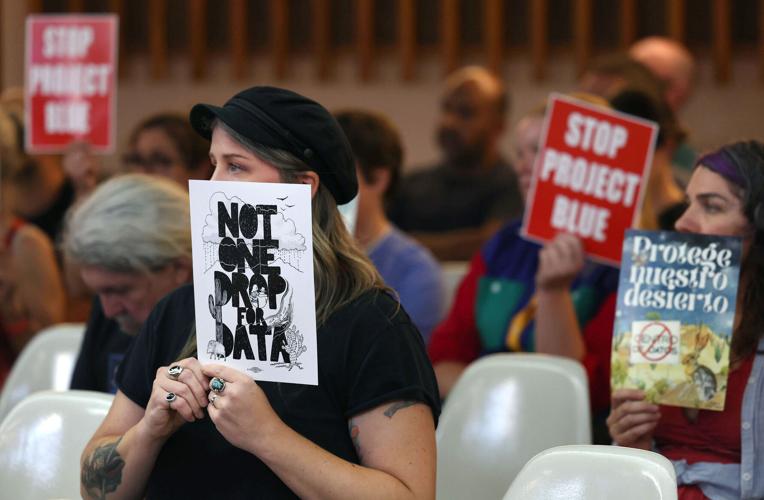
Kielly Lewis holds up a sign at a public hearing on data centers during a Tucson City Council meeting Wednesday night. The council voted 6–1 to adopt one of the city’s strictest zoning frameworks for hyperscale data centers.
The vote Wednesday night came after a yearlong process that began after the council's rejection of the controversial Project Blue data center proposal last August. Council Member Nikki Lee cast the dissenting vote, saying she wanted more time to weigh public testimony before deciding.
The ordinance does not permit data centers outright anywhere in the city. Instead, any proposed facility exceeding 25,000 square feet or 20 megawatts of energy use must go through a Planned Area Development or Planned Community Development rezoning — the same high-level review reserved for power plants — requiring a neighborhood meeting, a zoning examiner hearing and a final vote by the mayor and council.
People are also reading…
"This would make data centers one of the most highly regulated land uses in our development code," said Koren Manning, director of city planning and development services, who presented the proposal.
Other requirements include:
Large-scale data centers must be built at least half a mile from houses and schools, and 1,000 feet from commercial development.
Cannot be taller than 50 feet.
Need a noise study and must muffle generators.
Backup generators can only run during power outages or scheduled tests, not whenever companies want.
Can't use drinking water for cooling unless they qualify under the city's water rules and sign a formal water agreement.
Only 40% of the land can be built on — the rest must stay natural space, or companies must pay to protect land elsewhere.
City attorney Roi Lusk told the council the city's options were constrained by state law. An outright ban, he said, risks conflicting with Proposition 207, the Arizona Private Property Rights Protection Act, which allows property owners to sue if a previously legal land use is banned and their property value suffers.
The Planning Commission, an advisory board, had forwarded the item without a formal recommendation after a 6-2 vote fell one vote short of the seven needed for recommendation under its rules. Manning said the two dissenting commissioners were concerned the proposal over-regulated the industry, not that it was too lenient.
Public testimony ran overwhelmingly against the ordinance. More than a dozen speakers addressed the council, and those who spoke were almost unanimous in wanting either a full ban or significantly stricter terms than what was written.
Tucson resident Roma Lamor said no set of regulations would protect nearby property values or reassure residents that companies will comply.
"I don't think the companies will follow them anyway," she said, pointing to what she described as the industry's past attempts to work around commitments made during the Project Blue proposal.

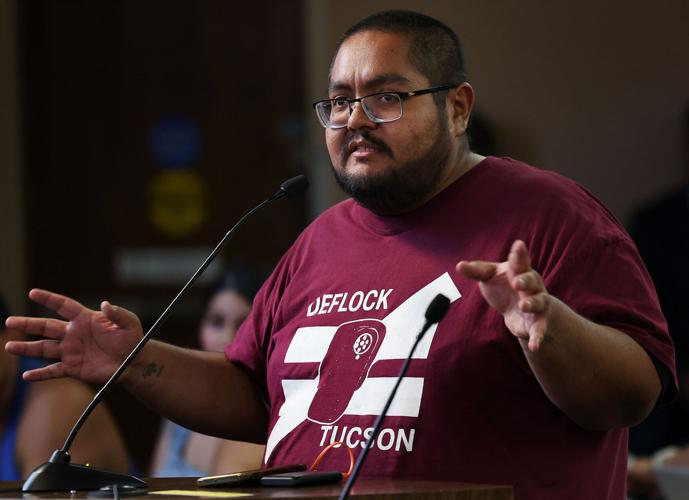
Vivek Bharathan, of No Desert Data Centers coalition, speaks at a public hearing on data centers during a Tucson City Council meeting Wednesday night.
Vivek Bharathan, representing No Desert Data Centers coalition, argued the rules still leave much of the city's south side and areas near the Tohono O'odham San Xavier district open to development, calling the siting pattern an example of environmental racism.
“According to this map, we're talking about brown folks who live out there. We're talking about the border with the San Xavier district or the Tohono O’odham nation,” he said, referring to a geospatial analysis of sites outside of proposed separation distances attached to Tuesday’s meeting agenda.
Bharathan urged the council to direct staff to study a ban grounded in a public health and safety exception written into Proposition 207.
“I am calling on you to direct staff to bring a plan to ban large-scale data centers by framing them as a public health and safety issue,” he said. “Because there's so much evidence from communities that have these monsters that residents around them suffer.”
Reyes Suarez criticized the city's community-engagement meetings as condescending and said the technical advisory committee that helped shape the rules included no one opposed to data centers on principle.
“It just kind of seems that there’s an active agenda to reduce public agency within this meeting,” Suarez said. “It’s like you don’t want to hear from us; you just want to talk at us to get your point of view.”

Reyes Suarez speaks at a public hearing on data centers during the Tucson City Council meeting Wednesday night.
During the following council discussion, several members said they personally oppose hyperscale data centers but viewed the ordinance as necessary protection in the absence of any current standards. City manager's staff confirmed that without the ordinance, a developer could apply for a data center under an existing zoning determination with none of the proposed safeguards in place.
"If a data center developer comes sniffing around tomorrow, this mayor and council has the final say, which is not a protection we currently have," said Council Member Miranda Schubert. Schubert also introduced a floor amendment that was adopted without objection, directing staff to continue researching a legal pathway toward an outright ban.
Councilmember Selina Barajas raised concerns about the concentration of eligible sites in Ward 5 and parts of Ward 4, areas she said already carry a disproportionate burden of heat and legacy environmental contamination, and asked staff to add future requirements for decommissioning plans and site reclamation.
Councilmember Paul Cunningham said he backed the ordinance's safeguards but suggested the council could eventually consider allowing small-scale, adaptive reuse projects in existing buildings, citing vacant structures near the airport, as a way to retain some local control rather than pushing all development to neighboring jurisdictions with fewer protections.
No Desert Data Center’s Bharathan told the Star after the meeting he was pleased with the council’s decision to explore a total ban.
“This is what we've been asking for for months, and I'm really grateful to Councilmember Schubert for making sure that got included,” he said. “We'll be sticking with it and making sure that they take it seriously.”
The motion approved Wednesday also directs staff to return within one year with a review of the ordinance's implementation, though city manager's staff said any needed adjustments could be brought back sooner. The new regulations are effective immediately.


 Tucson business halts water sales to Project Blue contractor