


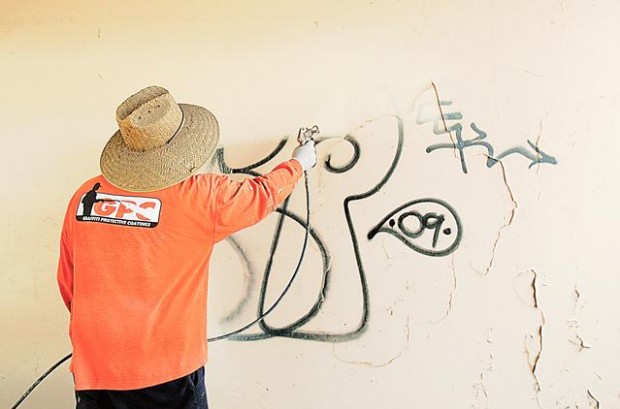
Get ready to look at unsightly graffiti longer than you used to.
Pima County will be moving a lot slower to remove it from public property and, with a few exceptions, won't be cleaning up private property that's been tagged at all.
The county is cutting its graffiti-abatement budget in half — one of many services being trimmed to make up for anticipated lower state revenues this year.
That leaves $125,000 to cover graffiti removal from all the parks and walls along roads, washes, bridges and other public facilities, which isn't likely to leave much to spend on removal on private property, said Julie Simon, county coordinator for the graffiti-abatement program, called Taking Action Against Graffiti.
Simon said the county will "try to provide assistance on extensive damage to private property."
People are also reading…
The county employs one person part time to log complaints and check out graffiti to see what kind of abatement is necessary, said Priscilla Cornelio, transportation director. With half the budget, that position can be funded only for six months of this fiscal year, she said.
If state gas taxes and other transportation funding come in higher than expected later in the year, the county could use some of that money to keep the position longer, she said. Projections for Highway User Revenue Funding, made up of various transportation taxes including the state gas tax, have been low, and the Legislature may yet use some of the counties' transportation funds to pay for other state services.
Deciding where to cut back was hard, especially because the county gets a lot of positive feedback about graffiti cleanup, Simon said.
"When we started out, the program was geared toward public property, and it was extended to private property with the funding we had. With the budget cuts, we have to do the more extensive damage on public property sites," she said.
Don Walling, 48, said he used to own a painting company and was often hired to cover up graffiti. He also would paint over graffiti for free if the property owner bought the paint, he said.
"I think the people who do the graffiti should have to clean it up," he said. "They should clean up their own mess."
He'd also like to see a lot more free labor from the community.
"When I had to do community service, I wish they would have let me paint over graffiti," he said.
Graffiti removal wasn't something historically funded by the county, but in better budget years, the Board of Supervisors decided to spend $250,000 to handle graffiti removal, said Chuck Huckel-berry, county administrator.
The removal is done by contracted crews and some juvenile crews, made up of kids who are fulfilling a community-service requirement or who have been ordered to pay restitution to the court for crimes.
The contract crews have a quicker turnaround and can handle a variety of types of removal, including painting, water blasting, soda blasting and chemical cleaning, Simon said.
The juvenile crews are cheaper but are generally used only in areas where they can simply paint over the graffiti, where the work isn't as visible and it matters less if the paint isn't an exact match, Simon said. That includes diversion channels, washes and some tunnels.
The Transportation Department is preparing for a 50 percent cut, but Huckelberry warns that state budget decisions could further reduce the graffiti spending.
Instead of using the money for graffiti cleanup, the county will use the money for justice and law-enforcement programs "as county revenues for these purposes become more critical," Huckelberry wrote in a mid-July memo to the county Department of Transportation.
While he thinks graffiti is ugly and destructive, cutting abatement funds is better than reducing money for other important services, including education and public-health programs, Walling said.
"I'd rather not see all of that go," he said.
The cutbacks mean fewer crews — the contracted type and the juvenile type — out on county property.
"I think it's unfortunate that we have to reduce the graffiti program, because the public appreciates it, and they like to see us cleaning it all up.
"It's unfortunate, but I think it's a sign of the times," Cornelio said.
Where to call
To report graffiti in unincorporated areas of Pima County, call 792-TAAG (792-8224).
If the graffiti is in Tucson, call 792-CITY (792-2489).


