

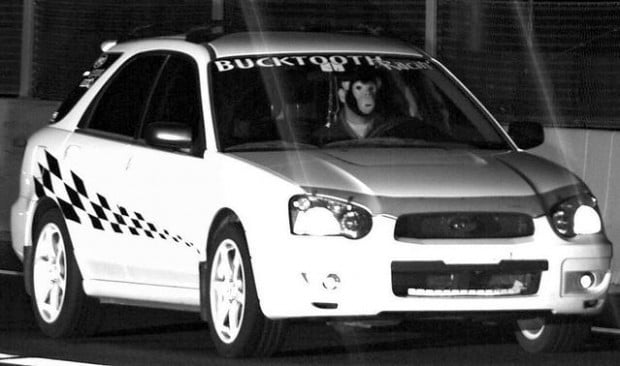
I thought the state was in a budget crisis with a $1.4 billion deficit.
I thought the Department of Public Safety was saved from cuts because the Legislature pulled $100 million from transportation departments in order to pay the highway patrol, leaving roads to continue crumbling in the wake of the money transfer.
Then last week, the DPS announced it had figured out who has been driving around on Interstate 17 (in the Phoenix area) with a monkey mask on, speeding past highway photo radar.
How did it figure out who this person was? By doing surveillance on the vehicle and driver? Staking him out? How many officers were tied up? How much time and money?
In the wake of the state's financial situation, don't we have more important priorities?
Even though this happened north of the Gila River, it's important to Pima County taxpayers.
People are also reading…
Spending time doing whatever surveillance they did is a waste of money. The time put into the detective work could have been more than the cost of the tickets the guy hasn't paid. And even if it's less, this is one guy, not a statewide outbreak of masked photo-radar bandits.
The DPS says it's all in the name of safety, that this guy shows blatant disregard for driving safety. Maybe he does, but how many others consistently risk public safety in their driving, except when they drive by a camera?
If the DPS is going to use our road-building and road-fixing money to look for a monkey-masked driver, I'd like to request some of it back to fix our washboard East Fort Lowell Road, or stretches of South Mission Road, or pick another of several local roads in bad shape. These and so many other roads need resurfacing, and all they get are pothole patches. Bumping over a pothole patch this week and down into a new pothole next to it in a few weeks does not constitute a fixed road.
The local transportation departments cry poverty while not fixing these roads, and part of the reason is that the DPS keeps getting a big chunk of money, which is supposed to go to these departments. The road funding transfers have been going on since 1982 — other high years were $106 million in 2006 and $92 million in 2003.
It's money we pay in gas taxes, vehicle license taxes and driving-related fees. It's specifically designated to be used on roads, but some of it is regularly sidelined for the Department of Public Safety instead.
There are better ways to make the roads safer, and one of those ways is fixing them with transportation funding.
RoadQ
Question: "Moving here from another state, it took me a while to understand that left-turn green arrows followed the through lights. My confusion now lies in the fact that the delay between the stoplight and the green left-turn light varies dramatically at almost every intersection. Sometimes it's immediate, and sometimes it's three to five seconds after the through stoplight activates. How about some consistency?" Dennis Briels wrote.
Answer: Depending on the approach speed, the slope of the approaching roads and the size of the intersection, the city will use delays. If there is a delay, the lights will be red in all directions for two seconds, said Michael Graham, spokesman for the Tucson Department of Transportation. However, at lower speed and at smaller intersections, there is no delay. The green left-turn arrow immediately follows the yellow light, coming on at the same time as the solid red light for through traffic, Graham said.
In the county, that delay is also two seconds, unless there is a red turn arrow, said Albert Letzkus, the county's traffic engineering division manager.
With the delay, the driver sees the solid green light for through traffic, then the solid yellow light, then the solid red light for two seconds. Then the green arrow comes on. The delay is to allow vehicles in the intersection to get through it before other cars enter the intersection, Letzkus said.


