

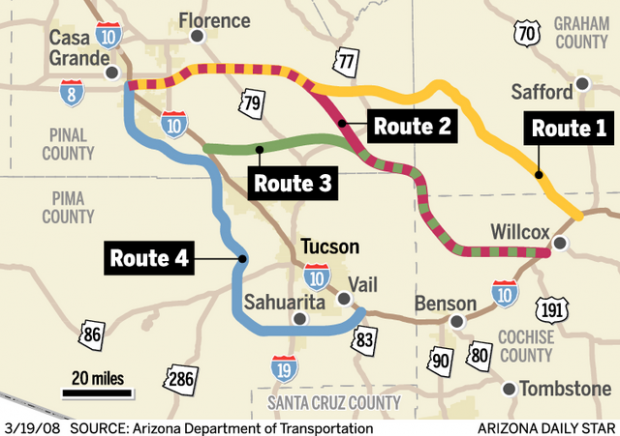
A bypass is needed to take traffic off Interstate 10 in Tucson and Phoenix, according to an Arizona Department of Transportation study.
While the study put the road's cost at $6 billion to $8 billion, figuring out where the money will come from remains a major mystery.
"The bypass cannot be constructed with current funding levels," the study says. "It would take a 10-cent increase in both the federal fuel tax … and the Arizona fuel tax and to devote the entire amount of both increases to construct the complete bypass."
The yearlong study of whether the road is needed and possible routes was done by URS Corp., a planning and engineering firm with offices in Phoenix and Tucson. It will be discussed at a State Transportation Board meeting in Tucson Friday.
Traffic projections show planned freeways in Phoenix will all be at capacity by 2030. By then, traffic on I-10 in Tucson will be twice what it was in 2005, according to Pima and Maricopa county estimates.
People are also reading…
The I-10 widening project now under way in Tucson is the last that can be done here within the right of way, the ADOT has said. With eight lanes through Tucson, I-10 will be able to handle up to 196,000 vehicles per day. Estimates say 2030 traffic could exceed 300,000 vehicles per day.
The study also projects Arizona's population will increase from 6.2 million in 2006 to 10.3 million in 2030.
The study was proposed by Tucson board member Si Schorr.
"It was evident to me that as we go forward we are going to have significant problems improving I-10 the extent it would be necessary to be improved to take care of the flow of traffic," Schorr said.
Schorr didn't assert a bypass is the solution, but that it should be looked at as an option for handling increased traffic in the metropolitan areas.
"You can never get hurt planning for the future. You can get hurt if you fail to plan for the future," Schorr said.
Four proposed routes are included in the study for taking traffic off I-10 in Tucson:
● Divert westbound traffic off I-10 near Willcox, northwest through the Aravaipa Valley and then west toward Casa Grande where it would meet again with I-10.
● Take westbound traffic off I-10 near Willcox, then west toward the Rincon Mountains, turning northwest through the San Pedro Valley, then curving west north of the Santa Catalina Mountains.
● Much the same as the second route, but connecting with I-10 closer to the Pima-Pinal county line, south of Eloy.
● Take westbound traffic off I-10 near Vail, directing it south and west through the Green Valley and Sahuarita area, crossing Interstate 19 before heading north through Avra Valley. It would connect with I-10 near Casa Grande.
The routes that leave I-10 near Willcox would reduce traffic by 7 percent to 10 percent during the 2030-to-2050 period, the study says.
The route through Avra Valley would take more vehicles off I-10 because it would also funnel traffic from I-19 around the Tucson metro area. It is projected to reduce traffic by 17 percent to 37 percent from 2030 to 2050, the study says.
One of the goals for a bypass would be to make trips shorter and faster for traffic that doesn't need to go through Tucson or Phoenix, which the routes that take traffic east and north of Tucson do.
The route that takes traffic south and west of Tucson is both longer in mileage and driving time, but would reduce congestion here more, the study shows.
Besides tax increases to pay for the construction, the prospect of a toll road was also looked at. But the study says it would be difficult to come up with that much money from tolls because many drivers would continue using the free route rather than pay.
If a bypass is constructed, it would need multiple funding sources, the study says.
Public meetings have included vocal opposition to routes through the sensitive San Pedro and Aravaipa valleys east of Tucson and through Avra Valley and the Saguaro National Park and Tucson Mountain district to the west.
The study acknowledges several of the routes go through environmentally sensitive areas.
While the other counties affected by the proposed bypass plans support it, the Pima County Board of Supervisors voted to oppose any bypass in Pima County, and the Cochise County Board of Supervisors voted to oppose a bypass through the San Pedro Valley.
The Arizona Trucking Association, the Sky Island Alliance, the Arizona Game and Fish Department, the Nature Conservancy, the Cascabel Working Group, the Defenders of Wildlife and other environmental groups also expressed opposition.
Just because the study says a bypass is needed doesn't mean it is the only option for reducing traffic, said Randy Serraglio, San Pedro campaign manager for the Center for Biological Diversity.
"What's really necessary is to look at multimodal options and congestion in Tucson on its own, and look at much more forward-thinking solutions," Serraglio said.
Beyond the environmental concerns, the proposed routes aren't worth the cost, he said, calling traffic reductions as low as 7 percent "virtually nothing" at a huge cost.
The study results will be presented and discussed at the State Transportation Board meeting in Tucson Friday. It begins at 9 a.m. at Tucson City Council chambers, 255 W. Alameda St. The board could take action on the item.
On StarNet: Star transportation reporter Andrea Kelly posts updates on I-10 lane and exit closures, as well as other snarl- inducing road work, in her blog at go.azstarnet.com/gridlocked.


