

PHOENIX — A hearing touted by legislative Republicans as an examination of how Big Tech, government officials and others manipulate the public kicked off with blockbuster testimony from a psychologist who claimed Google is responsible for Republican Kari Lake’s loss in the 2022 Arizona governor’s election.
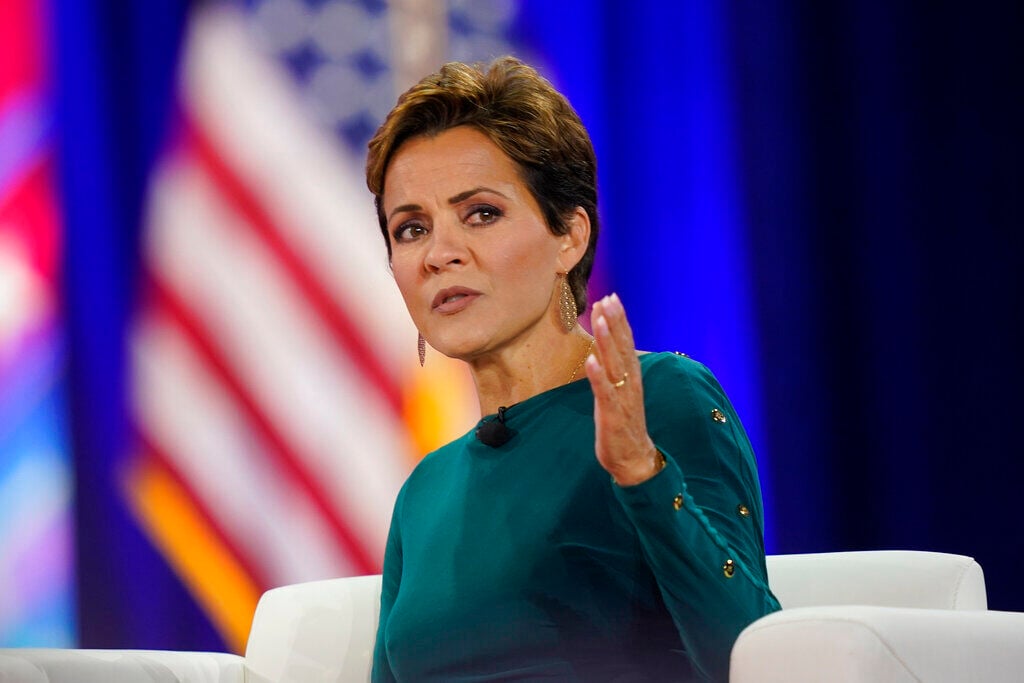
Lake herself also showed up at the hearing Tuesday to put an exclamation point on the whole thing, asserting yet again that Democratic Gov. Katie Hobbs should not be in office despite winning the election.
But the star witness who has spent the past decade touting Google’s manipulation, Dr. Robert Epstein, has been broadly debunked for years.
Republican Rep. Alexander Kolodin, who was appointed by GOP House Speaker Ben Toma to call the series of hearings, said it’s not his responsibility to invite Google, the world’s largest search engine company, to respond to Epstein’s claims, nor to question their accuracy.
People are also reading…
“If Google were to make a request to testify before the committee, we would evaluate that request,’’ Kolodin told Capitol Media Services.
Maybe Rep. Cesar Aguilar, the lone Democrat on the committee, can invite Google, Kolodin suggested.
Google, for its part, was ready with reams of evidence it says show it does not do what Epstein says — manipulate its search engine results to put its thumb on the scale in elections.
“This individual has continued to make deeply misleading claims that have been widely debunked, including for omitting data that would have changed his finding,’’ a company spokesman wrote in a statement. “Any allegations that Google deliberately designed search algorithms or intervened with the intent of swaying voters are categorically false.’’
Google pointed to studies from researchers at Stanford University and The Economist magazine that found no evidence the search engine has partisan leanings.
‘Absolutely guaranteed’ he claims
Epstein, however, said his research finds that the company’s search engine algorithms favor Democrats in elections and that polling numbers that make it into newspapers, TV and onto the internet are influenced by Google’s biased results.
He told lawmakers he’s learned how to exactly determine how much Google’s results sway what he called “vulnerable’’ voters, meaning moderate Republicans.
“We know how to calculate now, calculate that precisely,’’ Epstein told the committee. “So in that race ... Kari Lake would have won. Hands down. Absolutely guaranteed. If you took Google out of that picture, Kari Lake would have won.’’
Hobbs scoffed, saying she was “absolutely not’’ victorious because of Google.
“I think most of the disinformation that was spewed yesterday has been debunked over and over and over again,’’ she said the day after the hearing.
Asking companies to remove posts
The second half of the hearing focused on a more legitimate issue: Whether government officials violate the First Amendment when they ask social media companies to remove posts that, while false, are the opinion of the person posting them.
Hobbs sought to do that while secretary of state following the 2020 election, including for posts claiming “Sharpies’’ used to mark ballots could bleed through a ballot and improperly cause a vote on a race on the back side of the ballot.
Maricopa County election officials said that could not happen because of the design of the ballots, with races on the back side deliberately offset from those on the front side.
The attorney general at the time, Republican Mark Brnovich, investigated the claims and ultimately conceded that what Hobbs and election officials said was in fact the case.
The legislative panel also heard last week from an attorney with the conservative Mountain States Legal Foundation who litigates cases he described as “defending against governmental assaults on Americans’ free speech rights.’’
James Kerwin told the committee that what Hobbs and her staff did in asking social media companies to remove what they called “disinformation’’ came close in some cases to violating the First Amendment. He said a company might feel compelled to take down a post after receiving a request from a government official because it worried about retaliation if it did not.
Kerwin suggested the Legislature could enact laws that bar state officials from making those requests to social media companies.
First Amendment arguments
Courts may make that a moot point. Several cases directly addressing the issue are on the U.S. Supreme Court’s docket and may clarify if actions like those taken by Hobbs as secretary of state are legal.
The Biden administration has been fighting a federal judge’s order saying the federal government is completely barred from communicating with social media companies after seeking to remove “disinformation” about COVID-19. The court said the U.S. government was coercing the companies to act, and likely violating the First Amendment.
On Friday, Sept. 8, an appeals court greatly narrowed the reach of that order, but the 5th U.S. Circuit Court of Appeals kept in place a bar on several agencies — including the White House, the Centers for Disease Control and Prevention, and the FBI — from asking social media companies like X (formerly Twitter) to take down posts.
The Biden administration defended its actions in a press statement and said it was reviewing the ruling.
“This administration has promoted responsible actions to protect public health, safety and security when confronted by challenges like a deadly pandemic and foreign attacks on our elections,’’ the White House said in a statement. “Our consistent view remains that social media platforms have a critical responsibility to take account of the effects their platforms are having on the American people but make independent choices about the information they present.’’
Hobbs makes a similar argument. Last week, she said that, as secretary of state, her office reported “misinformation’’ as many other secretaries of state did.
“People were spewing all kinds of misinformation about election administration about the integrity of our elections,’’ Hobbs said. “And it was our job to fight against that.’’
She rejected the premise that her actions tread on First Amendment rights.
“Absolutely not,’’ Hobbs said. “We had in the Secretary of State’s Office a job to uphold the integrity of our elections, tell voters the truth about our elections, and that’s what we did.’’
Fundraising off the research
For his part, Kolodin said that kind of complaint from a government official to a social media company should never happen. He plans to call Josh Sauer, who represented the state of Louisiana in the case the appeals court ruled upon Friday, at his next committee hearing set for Oct. 16.
“It is wrong for a government official and their official capacity to ever ask that speech that they don’t like be taken down,’’ he said. “It’s not for the government to be the arbiter of truth. That’s terrifying.’’
Kolodin said the committee’s goal is to examine what existing laws allow and look for potential legislation to protect First Amendment rights.
He said he did find what Epstein presented about Google “credible,” although he added, “I don’t know that the point of this committee is to put Google on trial. It’s more about understanding the problem. That’s all we’re trying to do.’’
However, Aguilar, the committee’s one Democrat, noted that Epstein was working with Lake and had backed numerous Republicans.
“It seems his research fundraises off of Republicans,’’ he said.
Indeed: Epstein spoke at the hearing about the need for more funding to pursue his research.
Get your morning recap of today's local news and read the full stories here: tucne.ws/morning


