

At an outreach meeting over tacos and tortilla chips in Vail, 20 miles outside Tucson, the nonprofit Save the Scenic Santa Ritas had an urgent message for its dozens of attendees.
Later this month, a U.S. Senate vote on a bill could topple all the organization’s hard work to oppose a behemoth mine that was moving into southern Arizona. Group leaders urged participants to call their representatives.
“It’s a disaster,” said the organization’s executive director, John Dougherty. “We need to stop this law from passing ... I can't emphasize how important that is into our long-term success here on this.”
The bill in question is the Bipartisan American Affordability and Jobs Act, more colloquially known as BAAJA or the permitting reform measure. It’s billed as a way to speed approval of transmission projects on public lands.
People are also reading…
On the surface, the proposal seems like a win for utility-scale renewable energy projects. Transmission lines are an essential part of the renewables infrastructure as they help carry power from wind and solar farms in remote rural corners to urban centers.
But many environmental organizations warn it’s much more, calling it a massive deregulation of public lands oversight. In a letter to the Senate, 215 groups raised concerns over the bill’s dismantling of the environmental review process and the restriction of legislative avenues to appeal permitting decisions.
To streamline the approval process, the bill essentially obliterates many of the safeguards that ensure large-scale public land projects are carried out with sensitivity to people and place.
The blanket loosening of guardrails and public input requirements won’t just make it easier for transmission projects, opponents say, but will also open the floodgates to other more extractive uses.
As a first hurdle, the permitting reform bill is awaiting a Senate vote on Nov. 9. Save the Scenic Santa Ritas hopes to convince legislators to stop the bill from progressing there and then.
For Save the Scenic Santa Ritas, the passage of the bill would undo a key legal victory in their three-decade fight to slow down Copper World. It would allow the mine’s owners, Hudbay Minerals, to expand onto public lands, a move that a federal judge had ruled against in 2019.
“If this thing becomes law, (Hudbay) can basically do what they want, where they want,” Dougherty said. “And there's nothing we can do to stop it.”

SunZia Transmission Towers will transport renewable energy from New Mexico to parts of Arizona and California. The towers were constructed despite pushback and legal challenges from community groups, environmentalists and tribes.
Bipartisan permitting reform bill: A clean energy win?
Environmental reviews are a requirement for all development proposals on public land. It ensures that projects adhere to environmental and historical preservation laws.
This bureaucratic procedure — as well as the lawsuits that allege violations — has created a drag for investors. Transmission projects take an average of 6.5 years to clear the red tape, some as long as 10 years.
In 2023, the energy industry added 33,800 MW of clean energy to the grid. But more than 60,000 MW of capacity was held up, partly due to permitting roadblocks.
The bipartisan bill would slash the waiting time to, at most, two years. According to analyses by the White House, that could boost investment, raising tax revenue up to $28 billion every year and suppressing electric bills by $251 per household.
Several clean energy titans have voiced support for the proposed legislation. The right-leaning Breakthrough Institute and the nonpartisan Citizen’s Climate Lobby have praised the bill, highlighting the benefits to transmission projects that could potentially boost renewables.
But many grassroots advocacy organizations disagree. What’s couched as a transmission bill would throw open the door to projects beyond transmission, and effectively break down that door for good.
“It would also enable all types of energy development, including fossil fuel generation,” said Mayane Barudin, the executive director and founder of the tribal advocacy organization Sovereign Energy. “It's hard to understand the logic of how this contributes to decarbonization when it's simultaneously allowing more carbon to be released.”
Tucked in the bill text are nods to data centers and mining. Even President Donald Trump’s 250-foot triumphal arch in Washington, D.C., would now encounter no legal blocks under the bill — the bill sets a looser standard on who can challenge federal authorizations in court.
For the possibility of spurring clean energy, the bipartisan permitting reform bill would extract a high price. It grants second chances to projects that violate environmental laws, ties local authorities’ hands to block projects that run afoul of the Clean Water Act, skirts tribal consultations and offers generous exemptions from the Endangered Species Act.
Experts can’t say whether the bill will accelerate the clean energy movement or hurt it. A modeling study by the Center for Energy and Environmental Analysis shows that the bill might bring modest clean energy benefits in the best-case scenario, but will more likely unleash greater emissions from a fossil fuel buildout.
The climate outcome depends on the ideology of the federal government, whether it leans toward renewables or favors fossil fuels. Either way, critics say, it’ll offer carte blanche to harness public lands for its energy agenda.
It’s a gamble that many environmental groups don’t want to make.
The Democratic cosponsors of the bill have touted that the legislation would “level the playing field" for all energy sources. Brett Hartl, the government affairs director at the Center of Biological Diversity, said that’s not necessarily a good thing.
"I think that that's right — in that we are obliterating the playing field and excavating into the rubble of the basement and leveling it out there, such that there is no playing field.”
A gateway for data center buildout
Critics warn that data centers are poised to win big if the bipartisan permitting reform act goes through.
The first gain is expanded options for siting. Data center proposals near residential areas have drawn explosive community opposition, so developers are already turning their gaze toward federally managed grounds. A bill like the Permitting Reform Act will only hasten that encroachment, opponents say.
It’s unclear whether data center construction constitutes a permissible use of public lands under the Federal Land Policy and Management Act. But the new bill will lock in existing data center approvals on public lands and make it harder for dissenters to pause or challenge those decisions.
“It’s a two-year blank check for (Interior secretary Doug Burgum) to cut corners while he approves data centers on public lands, which is something he says he’s desperate to do,” said Aaron Weiss, the executive director of the Center for Western Priorities. “There’s a reason folks call him ‘Data Center Doug’.”
Already, data centers are eating into public lands. A map by the Center for Western Priorities shows 35 projects in the American West that are eyeing Bureau of Land Management grounds. In Arizona, at least six are seeking federal authorization.
The new bill will also accelerate the energy infrastructure for data centers to hook onto the grid. The flurry of transmission construction tends to benefit large and far-flung users like hyperscalers more than local communities, given that large-scale grid projects are often geared toward export.
Legislators and bill proponents cite a common example to justify a bill like this one. They point toward the snail-paced permitting of the 550-mile SunZia transmission line, built in part to meet the energy demands of data centers, as an example of the need for faster authorization.
Proposed in 2006, SunZia encountered multiple permitting delays and legal pushback from tribes before it opened for business 20 years later.
The Tohono O’odham Nation has decried the project, saying developers failed to conduct meaningful tribal consultation from the get-go. It alleges that the project cuts through sacred grounds in the San Pedro Valley, including archeologically important sites.
SunZia may be held as a warning against languishing permitting, but tribal groups say that it’s the exception to the rule rather than proves it.
“It's still important to remember that a very, very small minority of projects actually ever reach a phase of litigation. And usually there is good reason why,” Barudin said.
Indigenous groups have emerged as some of the loudest opponents of the proposed legislation.
“Tribes are not the enemies of this bill,” Barudin added. “While we do understand the need for permitting reform, we do not believe it should be at the expense of tribal consultation and the bedrock environmental protection bills that are essential to all of our survival.”
The case of Copper World
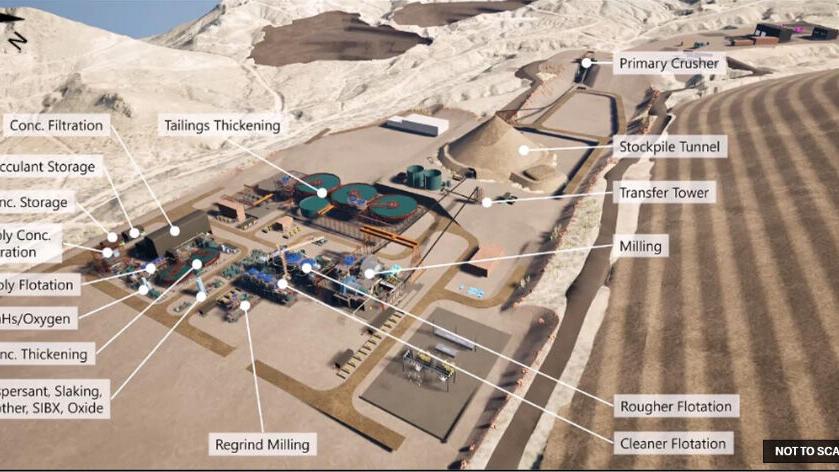
Copper World is slated to become the country’s third-largest open-pit copper mine. But it has one mammoth-sized hiccup: It doesn’t have enough space for dumping its tailings, projected to be over 1 billion tons.
Company documents show that the mine plans to park its waste rock on private land on the west side of the Santa Rita Mountains for this purpose, to the chagrin of the exurban residents there. But these private parcels can only accommodate 15 years of operation. The availability of real estate will make or break company ambitions to extend the mine’s lifespan to 37 years.
In 2019, the federal court overturned a permit for disposing of tailings on the Coronado National Forest on the eastern face of the Santa Ritas. The presiding judge ruled that the 1872 General Mining Act granted the right to mine on public lands, but not necessarily the right to dump mining’s byproducts on it.
Going forward, the bipartisan permitting reform bill would automatically greenlight public land use for tailings disposal. It would also apply to the storage of nuclear waste from reactors.
Copper World opponents fear that the passage of the bill could tip them back to square one in their fight.
“It's absolutely essential to stop this legislation on Nov. 9,” Dougherty said. “Nov. 3 is the election, but who knows what's going to happen right after that? We cannot act like everything is fine, even though it's not.”
The fate of the bill
On Nov. 9, the U.S. Senate will vote on whether the bipartisan permitting reform bill can proceed to the floor; 60 votes are needed.
Dougherty expects the bill will receive 55 votes, from all 53 Republicans and the two Democrats who co-sponsored it. At least one other Democratic senator has also indicated that he's for it.
That’s too close for comfort, and Dougherty is worried that a critical mass of Democrats will help push the bill to the next stage, where, in the Republican dominated congress, it’ll likely meet an easier path to passage.
In response to questions from The Republic, Arizona Sens. Mark Kelly and Ruben Gallego, both Democrats, said they're reviewing the bill language and engaged in discussions with Arizonans to understand the impacts. Both have declined to share how they plan to vote.
Longtime anti–public lands legislator, Utah Sen. Mike Lee, a Republican, is a bill co-sponsor.
“The fact that Mike Lee is a sponsor of this thing should raise a lot of alarm bells on the other side of the aisle that this might not be really good for conservation and renewable energy projects,” Dougherty said.
Dougherty isn’t taking any chances that the bill will stumble if it survives its first challenge. His strategy is to nip it now.
Save the Scenic Santa Ritas is conducting a full-board press on Kelly and Gallego to sway them toward opposing the bill. Meanwhile, concerned citizens can also reach out to their representatives to share thoughts about the proposal.

 'Made in America' copper plans change at Hudbay mine near Tucson


