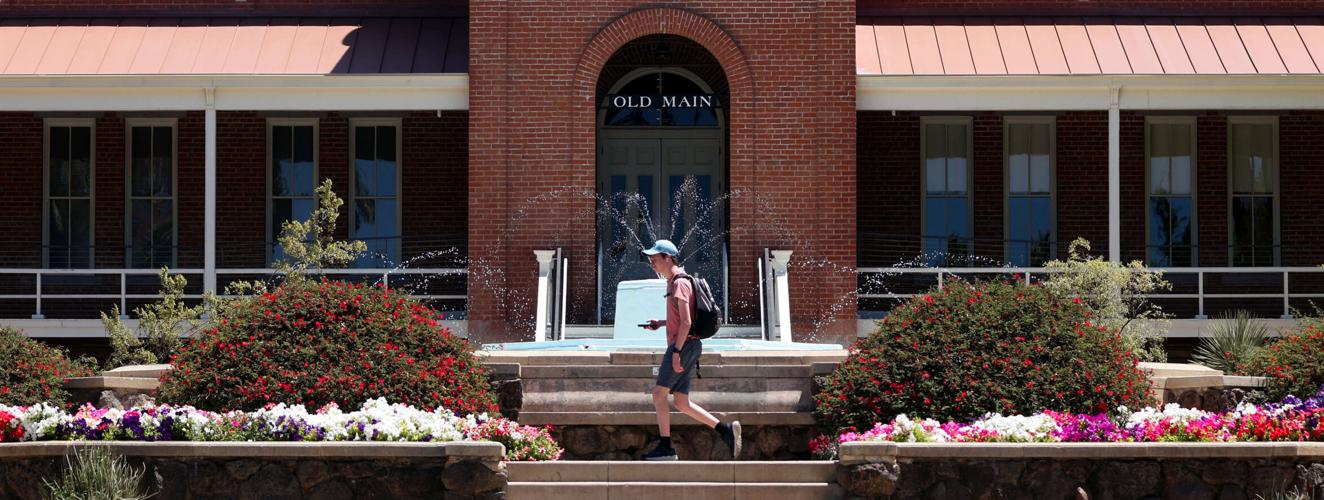
A University of Arizona faculty leader says ICE should have “no place on our campus” and that she likes the idea of the university becoming a “sanctuary campus” as a safe space for all, local or international and from all kinds of statuses, origins and identities.
UA Faculty Chair Leila Hudson was reacting to a campaign by UA Resist, a coalition of students, staff and faculty that supports diversity, equity, inclusion and accessibility initiatives at the UA, to designate the university a “sanctuary campus,” which traditionally indicates a college or university has instituted policies to protect undocumented students from deportation.
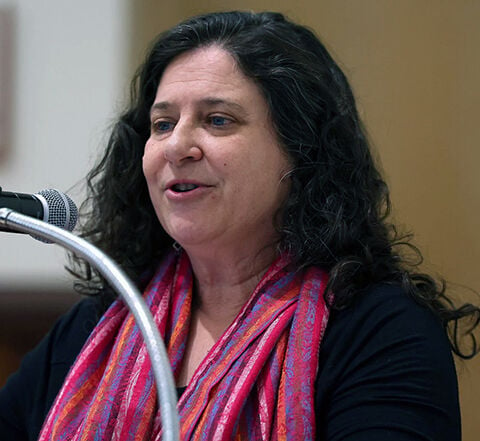
Leila Hudson, University of Arizona faculty chair.
In an interview with the Arizona Daily Star, Hudson said U.S. Immigration and Customs Enforcement is “an unaccountable, poorly trained, undisciplined paramilitary organization recruited with partisan loyalties, which abducts, feeds the for-profit prison system, terrorizes, attacks and kills members of our communities.” She said such an organization “has no place on our campus or in our constitutional republic.”
People are also reading…
“Until such time as a lawful immigration policy supports all of our rights, dignity and labor, I call for our university administration and local law enforcement to use all the means at their disposal to protect our diverse and precious community,” Hudson said.
Asked for response, UA spokesperson Mitch Zak did not comment on UA Resist advocating for a sanctuary campus or on Hudson’s personal endorsement of the concept. Zak also didn’t answer the Star’s questions on whether the UA administration believes there is a need for such steps in the current political climate, and if declaring the UA to be a sanctuary campus would actually forbid or attempt to bar federal enforcement agents from coming to campus.
Mark Stegeman, a UA associate professor of economics, said Arizona has “strict statutes barring substantive interference with federal immigration enforcement, including on university campuses.” Therefore, he said, any declaration of the UA being a sanctuary campus would be “mostly performative” or would create legal risks for the university and its faculty.
“By drawing federal ire, such a declaration would probably hurt more students than it would help,” Stegeman told the Star in an email Wednesday. “Most faculty members support vigorous defense of free speech and academic freedom, principles with stronger legal foundations, but on immigration, it makes more sense simply to help and support students who feel targeted.”
Representatives of UA Resist could not be reached for comment during the summer break from classes.
Hudson said this is a “timely topic” and she would “certainly endorse the spirit and goals of that personally,” as would other faculty representatives, she said.
However, she said that as a public and publicly funded institution, the UA is “hardly a fortress able to seal ourselves from the outside world,” and shouldn’t want to be that.
She said a realistic plan would be to pursue “a variety of governance and policy steps that seek to always enhance transparency, communication, collaboration, so that we have a realistic idea of how exposed we are to that outside landscape.”
As of now, the Faculty Senate does not have agenda items for the academic year starting Aug. 24 that specifically pertain to calling for a sanctuary campus, Hudson said.
But she said faculty leaders are working on an agenda item related to surveillance at the UA. She said they are trying to assess the impact of security surveillance and the resulting collection, storage and sharing of data.
Hudson specifically referenced UA’s contract with Flock Safety, a license-plate reader company that has been criticized for sharing data it collects with law enforcement officials across the country, some of whom used it for immigration-related searches.
The UA’s five-year contract with Flock Safety began on Feb. 25, 2025. The UA has 62 Flock Safety license plate reader products, and the cost of the cameras totals $800,000 over the five years.
Hudson said, as far as the Faculty Senate or faculty governance goes, any effort towards designating a sanctuary campus will go hand-in-hand with their exploration of surveillance systems on campus. She said that's because there are many UA members who would love the assurance that information about community members, or people passing through the community, won’t be shared or “trafficked” to “hostile outside forces,” the state or ICE.
“And before we can even aspire to that, we need to understand the surveillance mechanisms that are already becoming entrenched and normalized,” Hudson said.
However, Hudson said, the surveillance committee’s focus has singularly been to prepare to “inform the University of Arizona community about current surveillance practices and technologies in use or contemplated.” She said policy recommendations, next steps or endorsement of any policy have not been part of the committee’s first phase of work.
“I want to make it unequivocally clear that my First Amendment-protected personal speech and views do not represent those of the Ad Hoc General Faculty Committee on Surveillance,” said Hudson. “No member of the Committee was consulted or has endorsed, contributed to, or should be understood to share the views I expressed. …Similarly, the views I expressed are not those of any other faculty governance body nor the University of Arizona or its Office of Public Safety.”
What are sanctuary campuses?
Luz Rodriguez is director of campus engagement with the Presidents’ Alliance on Higher Education and Immigration, an alliance of American college and university leaders “dedicated to increasing public understanding of how immigration policies and practices impact our students, campuses and communities."
“Calls for sanctuary protections often reflect genuine fears and a desire for institutions to make clear commitments to protecting and supporting immigrant students," Rodriguez said. “Those concerns should not be dismissed."
Rodriguez said “sanctuary campus” or “safe campus” isn’t a legal designation and there’s no uniform definition or set of policies attached to the phrase.
“Sanctuary exists on a spectrum, and a declaration itself does not have legal effect. Two institutions may have similar protections in place even if only one uses the sanctuary label,” Rodriguez said in an email to the Star. “The Presidents’ Alliance generally does not encourage use of the term ‘sanctuary campus’ because it has no consistent legal definition and may create confusion or unrealistic expectations about what an institution can legally and practically do.”
The important thing is to note whether a college or university has adopted “concrete, lawful, and well communicated procedures,” not whether it uses the sanctuary campus label itself, she said.
According to an Avery Review article in January 2017, after immigration enforcement hard-liner Donald Trump’s first presidential win in 2016, thousands of students, faculty and staff at more than 190 U.S. schools, colleges and universities called on their administrations to declare their campuses “sanctuaries.”
Universities including Portland State University, Morehouse College in Georgia, Wesleyan University in Connecticut, the California State University and University of California systems and Long Beach City College in California have all either adopted the official “sanctuary campus” or “safe campus” designation, or implemented policies and features of being a sanctuary but shied away from the label, according to a Campus Reform article in 2025.
Rodriguez said a university declaring itself a sanctuary campus doesn’t mean that it can refuse to comply with all federal and legal immigration authorities, since they still have to follow state and federal laws and respond to valid warrants, court orders, subpoenas and other legally enforceable requests. However, this status can mean that such requests are to be reviewed by the appropriate legal or administrative personnel before any information is disclosed, she said.
However, Rodriguez said colleges and universities have more control in deciding access to places on campus that aren’t public.
“A sanctuary declaration does not prevent federal officials from entering areas open to the public or exercising their lawful enforcement authority,” she said.
Specific practices of a sanctuary campus, Rodriguez said, include:
Protecting student information and not disclosing it voluntarily until legally required;
Limiting access to campus spaces which aren’t public;
Establishing that campus police don't independently enforce federal civil immigration law;
Training faculty, staff and campus safety personnel on how to respond to immigration-enforcement requests;
Giving students accurate information, legal referrals, counseling, emergency assistance and other support; and,
Having plans in place to respond when a student or university member is detained or has any other engagement or is affected by immigration enforcement.
Sonja Taylor, an associate professor at Portland State University, which was among the first universities to declare itself a sanctuary campus in 2016, said at PSU, “we have specific guidance to call our legal counsel if immigration enforcement shows up in our classroom.” She said they aren’t supposed to deal with officers directly or share information about any students.
Taylor told the Star last week that since PSU was declared a sanctuary campus, she hadn’t heard of immigration enforcement coming to campus, but there could’ve been an incident she doesn’t know about. In an event where officers do show up on campus, she said the university’s legal counsel will be able to give specific advice but generally, providing “clear guidance and creating a culture of belonging are important.”
Rodriguez said if immigration officials come to campus, a college or university with established protocols “may direct the request to designated legal counsel or senior administrators, review any warrant or other legal document presented, determine whether officials are seeking access to a public or nonpublic space, and disclose information only when legally required or otherwise authorized.”
“Campus personnel should follow established procedures, avoid interfering with lawful enforcement activity, document what occurs, and connect affected students and community members with appropriate legal and support resources,” she said.
Rodriguez said certain precautionary measures universities can take include:
Establishing and regularly updating protocols on how to respond to immigration enforcement activity;
Having a designated person to review any warrants, subpoenas, and requests for information or access;
Clearly distinguishing between public and non-public spaces on campus and establishing clear protocols for access;
Avoiding collecting or retaining immigration-related information that’s not required for institutional purposes; and,
Conducting drills so campus personnel know what to do if an immigration-related event occurs.
Hudson said she thinks the idea of a sanctuary campus will grow organically at UA.
“But the challenge for faculty governance is to get there step by step, in an inclusive manner, to really question every step along the way, whether privacy (and) constitutional rights, academic freedom and responsibility are being curtailed by the outside political climate,” she said. “So, it’s going to be a long slog.”
The campaign for the UA to be a sanctuary campus comes in the midst of the Trump administration’s crackdown on immigration that has affected international students across the country. In the spring of 2025, the elimination of student visa statuses left some international students vulnerable to arrest by ICE, detention and deportation.
A “handful” of international students were affected by this at the UA, while ASU saw an estimated 100 students whose visas were revoked. Nationally, more than 1,800 international students lost their F-1 or J-1 student status.
In spring 2026, UA law students could have possibly had more direct interaction with ICE as the agency opened recruitment opportunities with the James E. Rogers College of Law. in March, UA students and organizations urged the law school to stop ICE recruitment, contending the agency’s then actions in Minneapolis and elsewhere showed disregard for the rule of law and constitutional provisions that law students are taught to uphold.
While UA officials said ICE wasn’t going to have a physical presence on campus, they said to bar ICE recruitment would be a political decision that violates free speech and that the UA doesn’t limit employment opportunities for students.
“As a public institution, the University of Arizona does not limit participation in career fairs based on an employer’s mission,” UA spokesperson Zak said at the time. “These events connect students with a wide range of employment opportunities and support informed career decision-making.”

The University of Arizona campus.
Reporter Prerana Sannappanavar covers higher education for the Arizona Daily Star and Tucson.com. Contact her at psannappa1@tucson.com or DM her on Twitter.

Prerana Sannappanavar
Higher Education Reporter


 U of A acceptance rate rises to 90% as applications plunge