WASHINGTON — President Donald Trump threatened to deploy ground troops to seize critical oil infrastructure on Iran's Kharg Island, a military gambit that experts say would risk American lives and could still fail to end the war.
If Trump wants to hobble Iran's oil industry for leverage in negotiations, a better option might be setting up a blockade at sea against ships that have filled up at Kharg Island's oil terminals, the experts said.
The island — located on the other side of the Persian Gulf from U.S. bases in Kuwait and Saudi Arabia — is the beating heart of Iran's oil industry, through which 90% of its exports pass. It is important because Iran's coastline is mostly too shallow for tanker ships to dock.
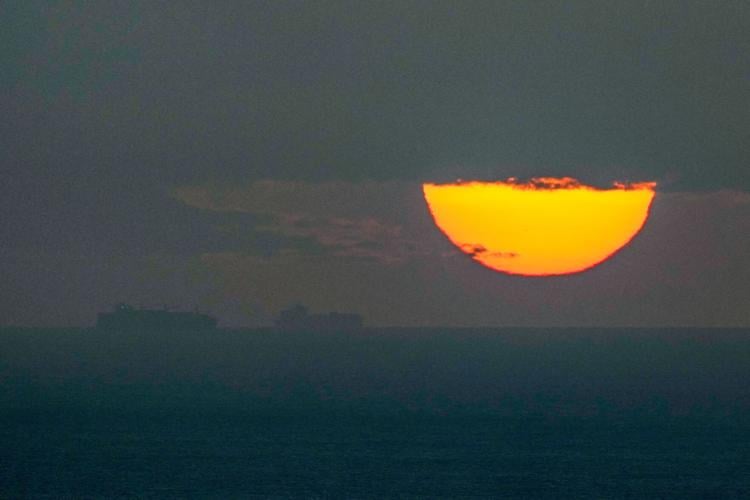
Ships sail through the Arabian Gulf toward the Strait of Hormuz on March 23 as the sun sets in the United Arab Emirates.
"Putting people on the ground might be the most psychologically compelling way of striking a blow at Iran," said Michael Eisenstadt, a former U.S. military analyst who now directs the Military and Security Studies Program at the Washington Institute for Near East Policy.
People are also reading…
"On the other hand, you're putting your own troops at jeopardy," said Eisenstadt, a retired Army reserve officer who served in Iraq. "It's not far from the mainland. So they can potentially rain a lot of destruction on the island, if they're willing to inflict damage on their own infrastructure."
Seizing Kharg Island could escalate the conflict, said Danny Citrinowicz, an Iran expert at Israel's Institute for National Security Studies.
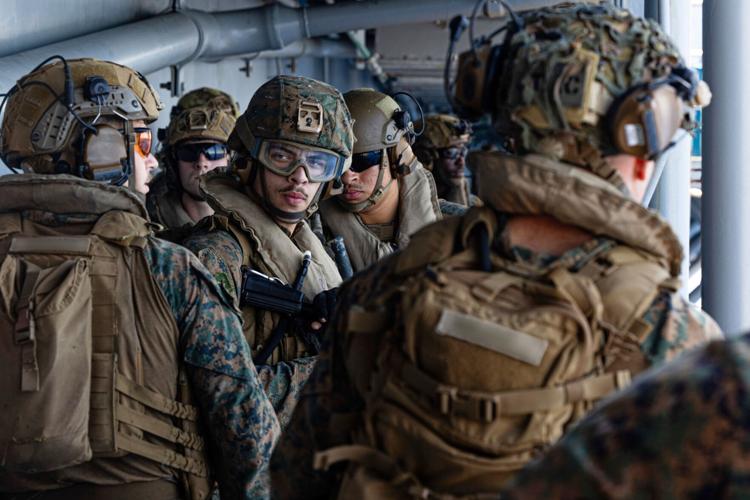
This image from video shows U.S. troops aboard USS Tripoli arriving Friday in the U.S. Central Command area of responsibility.
He said Iran and its proxies — including Yemen's Houthi rebels — could intensify their retaliation, including by laying mines in the Strait of Hormuz or striking targets with drones across the Arabian Peninsula, from the Persian Gulf to the Red Sea.
Commodities researchers and investment banks warn major retaliation could have lasting implications for energy prices and the global economy.
"It will be hard to take. It will be hard to hold," Citrinowicz said of Kharg Island. "And it might damage the economy, but not in a way that will force the Iranians to capitulate."
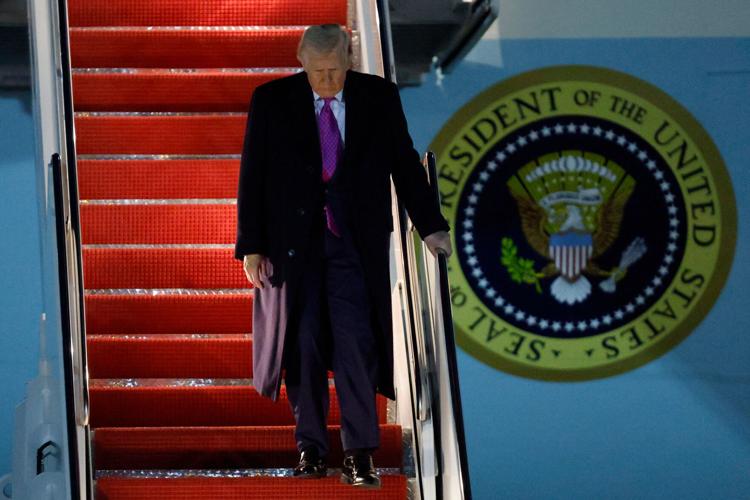
President Donald Trump walks down the stairs of Air Force One on Sunday on his arrival at Joint Base Andrews, Md.
Trump statements
Trump is under growing pressure to end the monthlong conflict with Iran, which retaliated with attacks on U.S. bases and allies in the region.
Iran also largely closed the Strait of Hormuz, a narrow chokepoint through which 20% of the world's oil normally flows, causing fuel prices to soar and other economic tumult.
Trump claimed in a social media post Monday that "great progress is being made" in talks with Iran to end military operations. But he said if a deal is not reached "shortly" and the strait is not immediately reopened, the U.S. would obliterate power plants, oil wells, Kharg Island and possibly even desalination plants.
Trump has raised the idea of American forces seizing Kharg Island.
"Maybe we take Kharg Island, maybe we don't. We have a lot of options," Trump told the Financial Times. "It would also mean we had to be there (on Kharg Island) for a while."
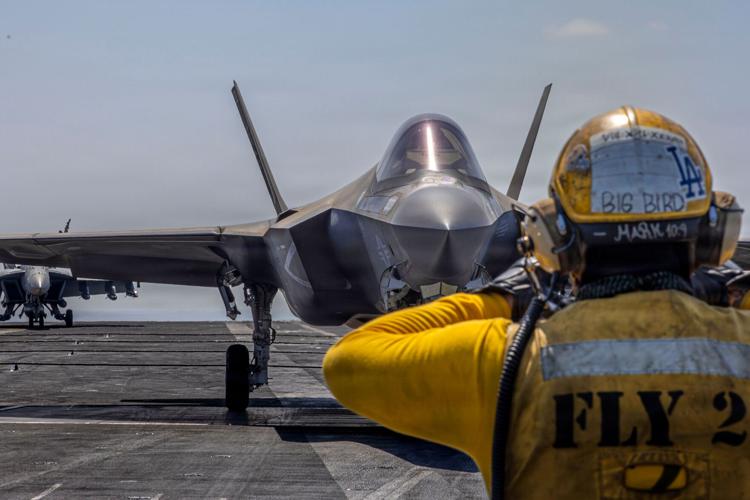
An F-35C Lightning II prepares for launch March 2 on the flight deck of the USS Abraham Lincoln in support of the war in Iran.
Asked about Iranian defenses there, he said: "I don't think they have any defense. We could take it very easily."
Secretary of State Marco Rubio said Friday claimed ground troops would not be needed to achieve the Trump administration's goals. He did not repeat that assertion Monday after being asked about plans for U.S. ground troops, saying "the president has several options at his disposal."
"Now, they are making threats about controlling the Hormuz Strait in perpetuity, creating a tolling system and the like," Rubio told ABC's "Good Morning America." "That's not going to be allowed to happen. And the president has a number of options available to him, if he so chooses, to prevent that from happening."
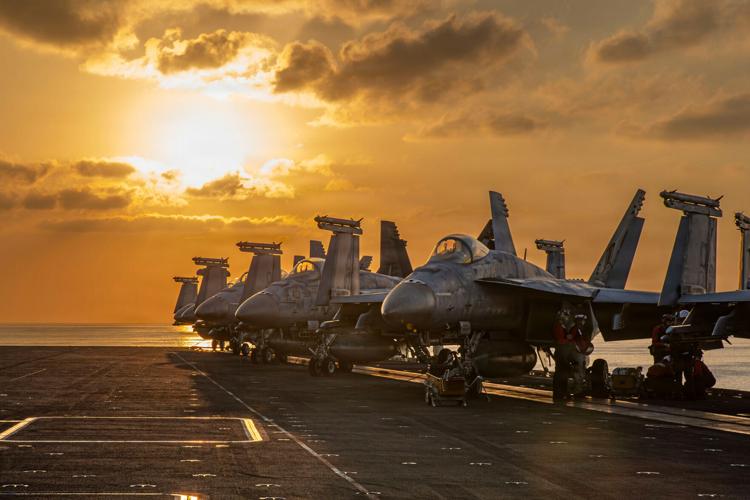
Aircraft sit on the flight deck of the USS Abraham Lincoln on March 3 in support of the war in Iran.
US troops
A U.S. Navy ship carrying about 2,500 Marines recently arrived in the Middle East, while at least 1,000 troops from the 82nd Airborne Division are expected soon. Another 2,500 Marines are being deployed from California.
The Trump administration has not said what all those troops will do, but the 82nd Airborne is trained to parachute into hostile or contested territory to secure key territory and airfields.
One of the reasons American troops would be vulnerable on Kharg Island is its close proximity — about 21 miles — to the Iranian mainland, from which missiles, drones and artillery could be fired. Despite continued U.S. and Israeli strikes, the Islamic Republic is still attacking targets across the region, including a Saudi air base hundreds of miles away where more than two dozen American troops were injured last week.
Even with American ships and planes providing support, there would still be a relatively short window of time to shoot down every drone or missile launched from the mainland at the island, Eisenstadt said.
"The coast tends to be mountainous, so the drones can come in through mountain passes where it's hard for our radar to pick up," he said. "And we don't have the warning time."
Eisenstadt says a sea blockade against ships carrying Iranian oil would be a safer strategy and achieve the same goal of controlling most of Iran's oil industry.
"Throw up a quarantine that seeks to seize Iranian oil shipments that are exiting the Gulf," agreed Clayton Seigle, an energy security expert at the Center for Strategic and International Studies. It could be done at a distance "outside the range of the lion's share of Iran's weapon systems."
Seigle argued against destroying Kharg Island's oil infrastructure, which Trump also suggested.
"We were supposed to be coming to the rescue of the people that had been rising up and protesting for a better future," Seigle said. "So to cripple Iran's revenue-generating potential for many years to come would definitely not work in that direction."
Photos from the Mideast in the 4th week of the Iran war
A man takes cover as air raid sirens sound, warning of rockets launched from Lebanon toward Israel, in Kiryat Shmona, northern Israel, Monday, March 23, 2026. (AP Photo/Ariel Schalit)
Israeli security forces and rescue team respond at the site of an Iranian missile strike in Tel Aviv, Israel, Tuesday, March 24, 2026. (AP Photo/Ohad Zwigenberg)
Relatives grieve in Baghdad, Iraq, Tuesday, March 24, 2026, during a funeral of members of the Popular Mobilization Forces who were killed in a U.S. airstrike in Anbar, Iraq. (AP Photo/Hadi Mizban)
Israeli soldiers secure the site where an Iranian missile wreckage landed in the West Bank village of Kifl Haris Tuesday, March 24, 2026. (AP Photo/Majdi Mohammed)
An Israeli soldier jumps from a tank in northern Israel near the border with Lebanon, Saturday, March 21, 2026. (AP Photo/Ariel Schalit)
Israeli security forces and rescue teams work at the site struck by an Iranian missile in Arad, southern Israel, Sunday, March 22, 2026. (AP Photo/Ohad Zwigenberg)
Israeli security forces survey the site that was struck by an Iranian missile in Dimona, southern Israel, Sunday, March 22, 2026. (AP Photo/Ariel Schalit)
Smoke and flames rise from an Israeli airstrike that hit the Qasmiyeh Bridge near the coastal city of Tyre, Lebanon, Sunday, March 22, 2026. (AP Photo/Mohammad Zaatari)
Rescue workers and first responders work at a residential building hit in an earlier U.S.-Israeli strike in Tehran, Iran, Monday, March 23, 2026. (AP Photo/Vahid Salemi)
Children play beside a fragment of an Iranian ballistic missile that landed in a schoolyard in the Israeli settlement of Peduel in the West Bank Monday, March 23, 2026. (AP Photo/Ohad Zwigenberg)
People follow a truck carrying the flag draped coffins of Gen. Ali Mohammad Naeini, a spokesperson for Iran’s paramilitary Revolutionary Guard and one of his comrades Amir Hossein Bidi , during their funeral procession in Tehran, Iran, Saturday, March 21, 2026. (AP Photo/Vahid Salemi)
Iranian worshippers perform Eid al-Fitr prayers marking the end of the holy fasting month of Ramadan as one of them wears an Iranian flag at the Imam Khomeini Grand Mosque in Tehran, Iran, Saturday, March 21, 2026. (AP Photo/Vahid Salemi)
A displaced woman who fled Israeli airstrikes in southern Lebanon, carries her belonging as she moves to a better spot to shelter from the rain, past an Arabic anti-war poster that reads, "Sacrificing for whom? Lebanon does not need war," in Beirut, Saturday, March 21, 2026.(AP Photo/Hussein Malla)
Iranian Kurdish Mariam crosses the Haji Omeran border crossing on foot between Iran and the autonomous Kurdistan Region of Iraq (KRI), Iraq, Sunday, March 15, 2026, as the border remains open. (AP Photo/Leo Correa)
A man cleans debris from his apartment damaged when a nearby police station was hit Friday in a U.S.-Israeli strike in Tehran, Iran, Sunday, March 15, 2026. (AP Photo/Vahid Salemi)
The shattered structure of a police station is seen after it was hit Friday in a U.S.-Israeli strike in Tehran, Iran, Sunday, March 15, 2026. (AP Photo/Vahid Salemi)
A FlyDubai plane is parked at Dubai International Airport as smoke rises in the background after a drone struck a fuel tank early morning, forcing the temporary suspension of flights, in Dubai, United Arab Emirates, Monday, March 16, 2026. (AP Photo)
A member of the armed wing of the Kurdish-Iranian opposition group Organization of Iranian Kurdistan Struggle, known as Khabat, stands in front of a shrapnel pockmarked wall that allegedly was damaged in strike by Iranian-backed militias in Iraq last week at a military base on the outskirts of Irbil, Iraq, Monday, March 16, 2026. (AP Photo/Leo Correa)
Israeli security forces inspect a house in east Jerusalem where a fragment of an Iranian missile crashed onto the rooftop, Monday, March 16, 2026. (AP Photo/Mahmoud Illean)
Israeli soldiers operate next to their mobile artillery unit on the border with Lebanon in northern Israel, Monday, March 16, 2026. (AP Photo/Ariel Schalit)
Nofar Eliash holds her dog as she takes shelter with others while air raid sirens warn of incoming Iranian and Hezbollah missile strikes in Kiryat Shmona, northern Israel, Monday, March 16, 2026. (AP Photo/Ariel Schalit)
A man runs past a bulldozer clearing debris from a building damaged in an Israeli airstrike in Dahiyeh, Beirut's southern suburbs, Lebanon, Tuesday, March 17, 2026. (AP Photo/Hassan Ammar)
Residents inspect a house damaged yesterday by a projectiles launched from Lebanon in Nahariya, northern Israel, Tuesday, March 17, 2026. (AP Photo/Ariel Schalit)
Israeli air defense system fires to intercept missiles during an Iranian attack over Tel Aviv, Israel, early Sunday, March 15, 2026. (AP Photo/Ohad Zwigenberg)
Volunteers clean debris from a residential building damaged when a nearby police station was hit Friday in a U.S.-Israeli strike in Tehran, Iran, Sunday, March 15, 2026. (AP Photo/Vahid Salemi)
People walk past tents sheltering people displaced by Israeli airstrikes at a public space along the Beirut waterfront at sunset in Beirut, Lebanon, Sunday, March 15, 2026. (AP Photo/Hassan Ammar)
Fire and plumes of smoke rise after a drone struck a fuel tank forcing the temporary suspension of flights. near Dubai International Airport, in United Arab Emirates, early Monday, March 16, 2026. (AP Photo)