SEOUL, South Korea — An American soldier who had served nearly two months in a South Korean prison, fled across the heavily armed border into North Korea, U.S. officials said Tuesday, becoming the first American detained in the North in nearly five years.
Private 2nd Class Travis King had been held on assault charges and was released on July 10 after serving his time. He was being sent home to Fort Bliss, Texas, on Monday, where he could have faced additional military disciplinary actions and discharge from the service.
According to officials, King, 23, was taken to the airport and escorted as far as customs. But instead of getting on the plane, he left the airport and later joined a tour of the Korean border village of Panmunjom. He bolted across the border, which is lined with guards and often crowded with tourists, on Tuesday afternoon local time in Korea.
People are also reading…

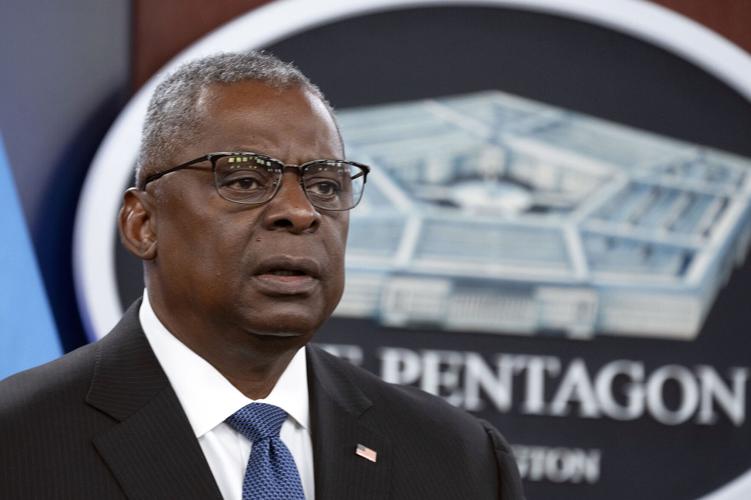
Secretary of Defense Lloyd Austin speaks Tuesday during a news conference with Chairman of the Joint Chiefs of Staff Gen. Mark Milley at the Pentagon in Washington.
At a Pentagon news conference Tuesday, Defense Secretary Lloyd Austin confirmed that a U.S. service member was likely now in North Korean custody.
"We're closely monitoring and investigating the situation," Austin said, noting he was foremost concerned about the troop member's well-being. "This will develop in the next several days and hours, and we'll keep you posted."
The Army released his name and limited information after King's family was notified of the incident. But a number of U.S. officials provided additional details on condition of anonymity because of the sensitivity of the matter. It wasn't clear how he got to the border or how he spent the hours between leaving the airport on Monday and crossing the border a day later.
The American-led U.N. Command said he is believed to be in North Korean custody and the command is working with its North Korean counterparts to resolve the incident. North Korea's state media didn't immediately report on the border crossing.
Cases of Americans or South Koreans defecting to North Korea are rare, though more than 30,000 North Koreans have fled to South Korea to avoid political oppression and economic difficulties since the end of the 1950-53 Korean War.

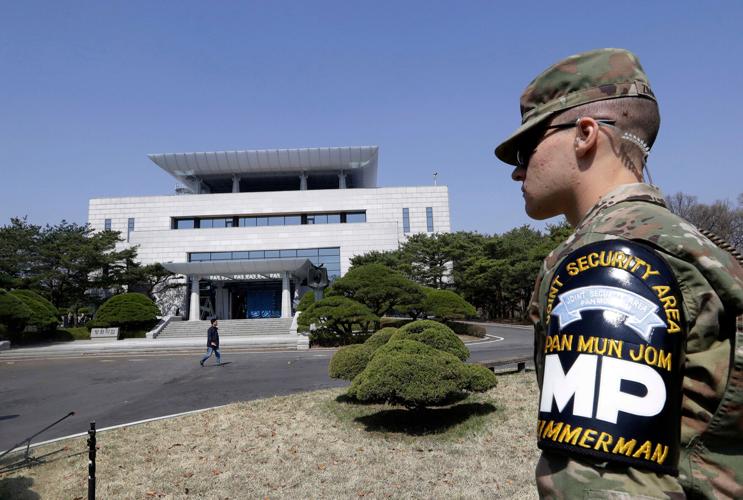
A U.S. soldier stands April 18, 2018, outside of the Peace House during a media tour at the southern side of the Panmunjom in the Demilitarized Zone, South Korea.
Panmunjom, located inside the 154-mile-long Demilitarized Zone, has been jointly overseen by the U.N. Command and North Korea since its creation at the close of the war. Bloodshed and gunfire have occasionally occurred there, but it has also been a venue for numerous talks.
Known for its blue huts straddling concrete slabs that form the demarcation line, Panmunjom draws visitors from both sides who want to see the Cold War's last frontier. No civilians live at Panmunjom. In the past, North and South Korean soldiers faced off within yards of each other.
Tours to the southern side of the village reportedly drew about 100,000 visitors a year before the coronavirus pandemic, when South Korea restricted gatherings to slow the spread of COVID-19. The tours resumed fully last year.
During a short-lived period of inter-Korean engagement in 2018, Panmunjom was one of the border sites that underwent mine-clearing operations by North and South Korean army engineers as the Koreas vowed to turn the village into a "peace zone" where tourists from both sides could move around with more freedom.
In November 2017, North Korean soldiers fired 40 rounds as one of their colleagues raced toward the South. The soldier was hit five times before he was found beneath a pile of leaves on the southern side of Panmunjom. He survived and is now in South Korea.
The most famous incident at Panmunjom happened in August 1976, when two American army officers were killed by ax-wielding North Korean soldiers. The U.S. officers were sent to trim a 40-foot tree that obstructed the view from a checkpoint. The attack prompted Washington to fly nuclear-capable B-52 bombers toward the DMZ to intimidate North Korea.
Panmunjom also is where the armistice that ended the Korean War was signed. That armistice has yet to be replaced with a peace treaty, leaving the Korean Peninsula technically in a state of war. The United States still stations about 28,000 troops in South Korea.

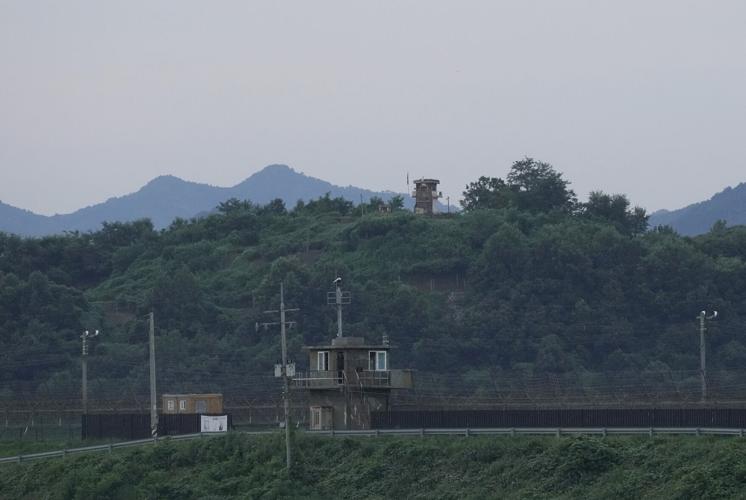
A North Korean military guard post, rear, and South Korean post, bottom, are seen Tuesday in Paju near the border in South Korea.
There have been a small number of U.S. soldiers who went to North Korea during the Cold War, including Charles Jenkins, who deserted his army post in South Korea in 1965 and fled across the DMZ. He appeared in North Korean propaganda films and married a Japanese nursing student who was abducted from Japan by North Korean agents. He died in Japan in 2017.
In recent years, some American civilians have been arrested in North Korea after allegedly entering the country from China. They were later convicted of espionage, subversion and other anti-state acts, but were often released after the U.S. sent high-profile missions to secure their freedom.
In May 2018, North Korea released three American detainees — Kim Dong Chul, Tony Kim and Kim Hak Song — who returned to the United States on a plane with then-Secretary of State Mike Pompeo during a short-lived period of warm relations between the longtime adversaries.
Later in 2018, North Korea said it expelled American Bruce Byron Lowrance. Since his ouster, there were no reports of other Americans detained in North Korea until Tuesday's incident.
Tuesday's border crossing happened amid high tensions over North Korea's barrage of missile tests since the start of last year. A U.S. nuclear-armed submarine visited South Korea on Tuesday for the first time in four decades in deterrence against North Korea.