NEW YORK — In cities around the world, the flyers plastered on street poles, lining subway stations, clinging to tree trunks and hanging in public spaces draw the eye with one word in bold on a striking red background: “Kidnapped.”
Each bearing the photo of one of more than 200 hostages taken during Hamas’ attack on Israel this month, the posters are part of a guerrilla art project designed to bring attention to those held captive and their families. They are also a reminder of how deeply polarizing the war has become as Israel continues to bomb the Gaza Strip in the weeks since Hamas’ attack — soon after they’re put up, some of the flyers are torn down.

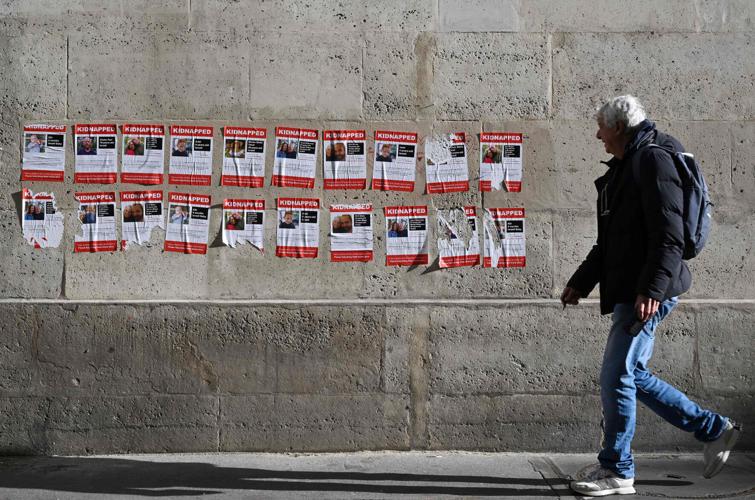
A man walks Friday in Paris past placards showing recently abducted or missing Israelis taken by Hamas militants. Videos on social media show people tearing down the posters in New York, Boston, Miami and other cities around the U.S. and the world.
The project, “Kidnapped from Israel,” is an idea from Nitzan Mintz and her partner, known as Dede Bandaid, two street artists from Tel Aviv who were in New York when Hamas launched its early morning incursion Oct. 7. According to the Israeli military, 222 people were abducted and about 1,400 Israeli citizens and soldiers were killed in the rampage by Hamas militants.
People are also reading…
As news coverage revealed the scale of the assault, Bandaid and Mintz, who originally came to New York for an artists’ residency, were glued to their television and phones nearly 5,700 miles away.
“Very quickly we understood that we have to do something, that we can’t sit so far from home and just do nothing,” said Bandaid, 36. “We really wanted to put the message out there.”

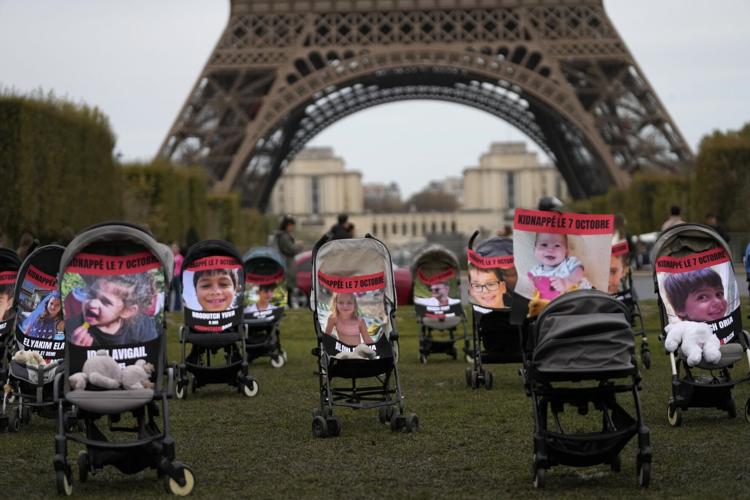
Empty strollers along with 30 photographs of children and adolescents who remain missing or abducted in the Hamas attack on Israel on Oct. 7 are displayed Thursday near the Eiffel Tower in Paris.
Inspired by the pictures of missing children that appeared on the sides of milk cartons in the 1980s, the artists turned their focus to the hostages, Bandaid said. Together with Tal Huber, an Israel-based graphic designer whom they connected with on Facebook, they created red-and-black flyers emblazoned with the word “Kidnapped” in bold, capital letters across the top. Below that, the flyers show the photos, names and ages of those who were abducted, along with other details about the attack and a call to action: “Take a photo of this poster and share it. Please help bring them home alive.”
The hostages on the flyers range from infants to octogenarians. Some were snatched from their homes; others were abducted from a music festival in the Negev desert.
Within days of the attack, Mintz and Bandaid had printed about 2,000 copies of the flyers and walked across Manhattan, taping the signs to street poles and anywhere else they could.
“We just put the posters up with duct tape, crying the entire day,” said Mintz, 32.

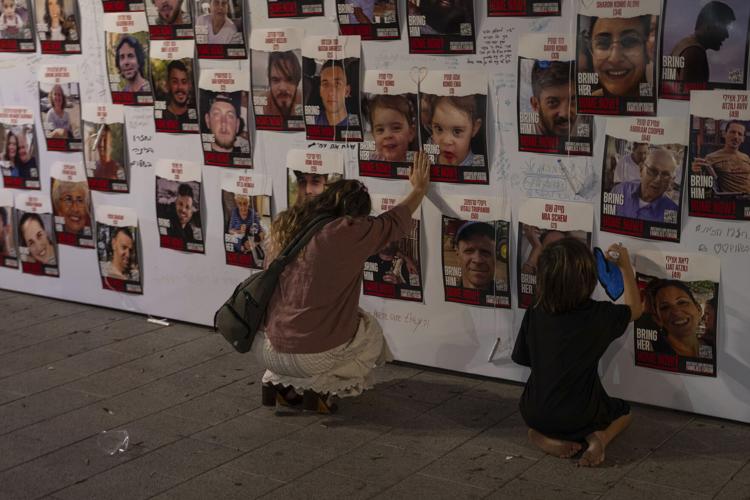
A woman touches photos of Israelis missing and held captive in Gaza, displayed on a wall Oct. 21 in Tel Aviv.
While putting up the flyers, they said, they met some people who were unaware of the crisis, and others who didn’t want to help.
“We went home in the night devastated completely,” Mintz said.
So they uploaded the flyers to the cloud and posted about the effort on social media, encouraging others to join. When they woke up, Mintz said, “the entire city was covered” with the posters.
The project has spread beyond New York, with flyers in 30 languages posted from Sydney, Australia, to Santiago, Chile. They have appeared at demonstrations and on the side of the United Nations building. Public areas worldwide portray the grief and anguish of families gripped with uncertainty.
But the images are especially poignant where they originated in Manhattan, bringing to mind the missing-person posters that covered the city after the Sept. 11 attacks, when families hoped their loved ones might be wandering different neighborhoods or unidentified in hospitals.
Hamas has so far released four hostages, including two Americans. Still, as the U.S. urges Israel to delay a ground invasion of Gaza to allow time to negotiate the release of hostages, who could be put in grave danger by urban combat, the exact whereabouts of many remains unknown. Their families have been turning in part to Mintz and her partners, particularly Huber, who is on the receiving end of many anguished phone calls.
Mintz and Bandaid said the project is humanitarian, not political — a campaign intended to bring depth and dimension to the rising number of hostages in Gaza circulating in the news media.
But the flyers have become enmeshed in the complicated and heated emotions surrounding the conflict. After the Oct. 7 attack, Israel ordered Gaza’s borders be sealed completely and has launched a round-the-clock assault on the enclave. According to the Gaza Health Ministry, which is run by Hamas, at least 5,700 people, about half of them children, have been killed in Gaza since the start of the war. The number has not been independently verified.
Videos circulating on social media show people tearing down the kidnapped Israeli posters in New York, Boston, Miami and other cities around the U.S. and the world, in some cases losing their jobs or facing disciplinary action by their schools for doing so.
“They tear it down because they feel they tear down Israel,” Bandaid said.
But the artists emphasized that they are not speaking on behalf of the government and pointed out that some Israelis have taken to the streets for rallies and protests against Prime Minister Benjamin Netanyahu and his right-wing coalition.
Mintz added that when people tear down the posters, “we see it and feel it on our flesh.”
“That could have been me,” she said.
Popular videos from the past week you may have missed
A man from Chicago has left his home to command Israeli units against Hamas, how the spicy food industry is changing how people eat, and more popular videos from the past week you may have missed.