Only one stone wall remains of the old mother and baby home in this town, but it cast a shadow over all of Ireland.
A mass grave that could hold up to nearly 800 infants and young children — some in a defunct septic tank — is being excavated on the grounds of the former home run by the Bon Secours Sisters, an order of nuns.
The burial site forced Ireland and the Catholic Church to reckon with a legacy of having shunned unmarried mothers and separated them from their children, who were left at the mercy of a cruel system.

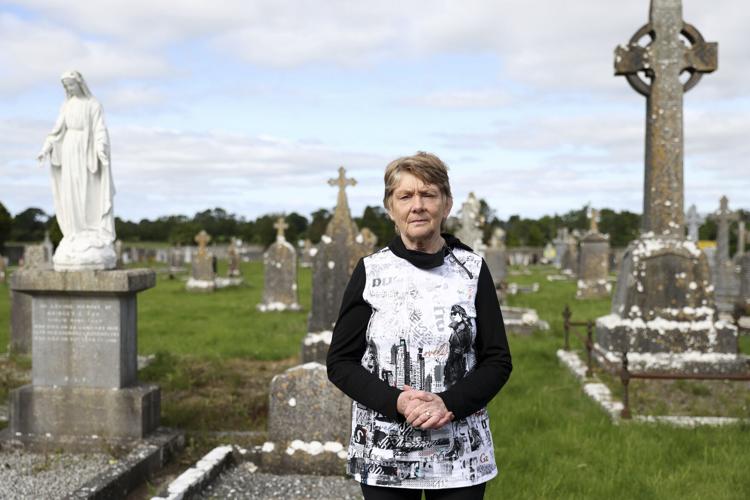
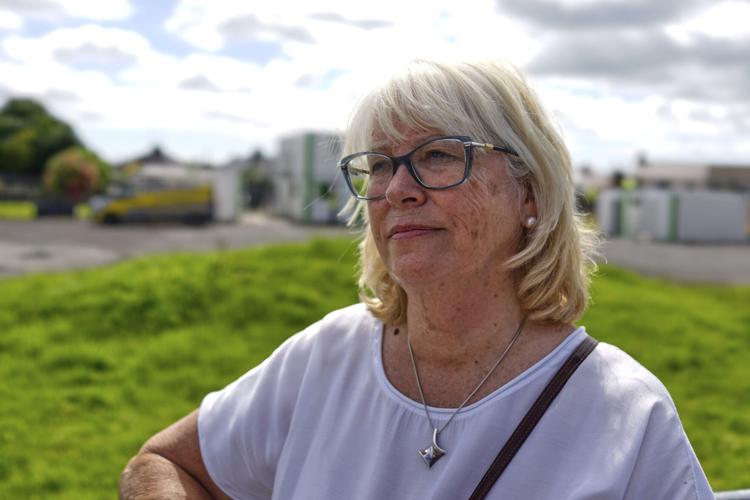
Historian Catherine Corless stands July 7 in a cemetery in Tuam, Ireland.
Two boys discovered the grave a half-century ago but the true horror was not known until a local historian began digging into the home's history.
Catherine Corless revealed that the site was atop a septic tank and that 796 deceased infants were unaccounted for. Her findings caused a scandal when the international news media wrote about her work in 2014.
People are also reading…
When test excavations later confirmed tiny skeletons were in the sewage pit, then-Prime Minister Enda Kenny called it a "chamber of horrors."
Pope Francis later apologized for the church's "crimes" that included forced separations of unwed mothers and children. The nuns apologized for not living up to their Christianity.
A deadly place

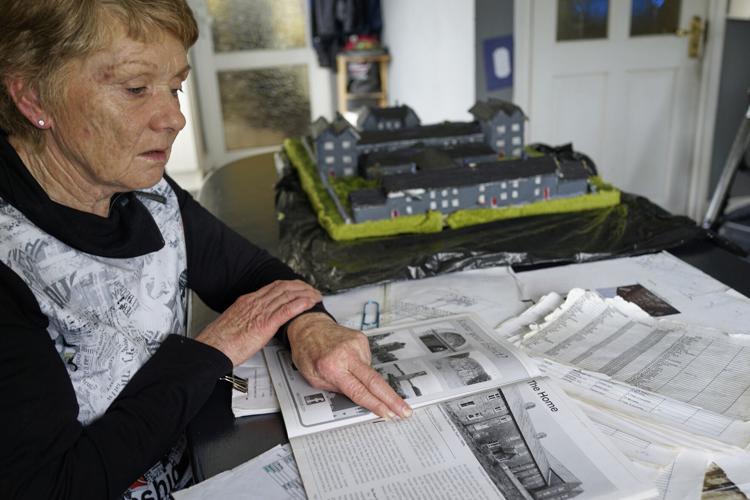
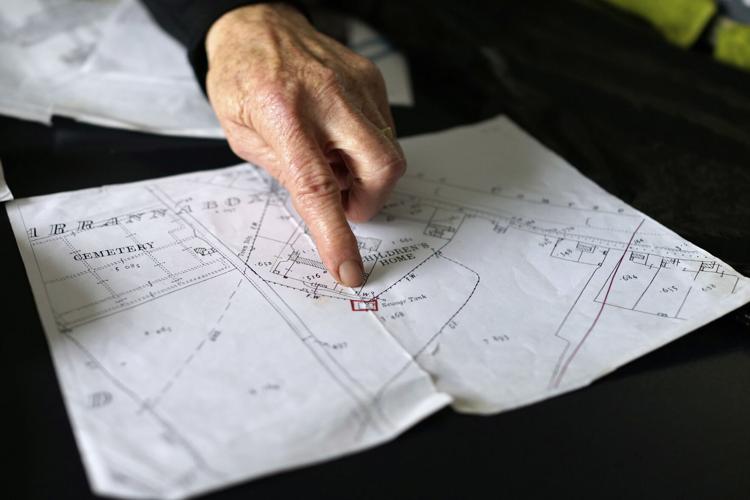
Corless points to the location of the former sewage tank at the mother and children home on a map.
The homes were not unique to Ireland and followed a Victorian-era practice of institutionalizing poor, troubled and neglected children and unmarried mothers.
The Tuam home was cold, crowded and deadly. Mothers worked there for up to a year before being cast out — almost always without their children.
Corless' report led to a government investigation that found 9,000 children, or 15%, died in mother and baby homes in the 20th century. The Tuam home — open from 1925 to 1961 — had the highest death rate.
She said she was driven to expose the story "the more I realized how those poor, unfortunate, vulnerable kids, through no fault of their own, had to go through this life."

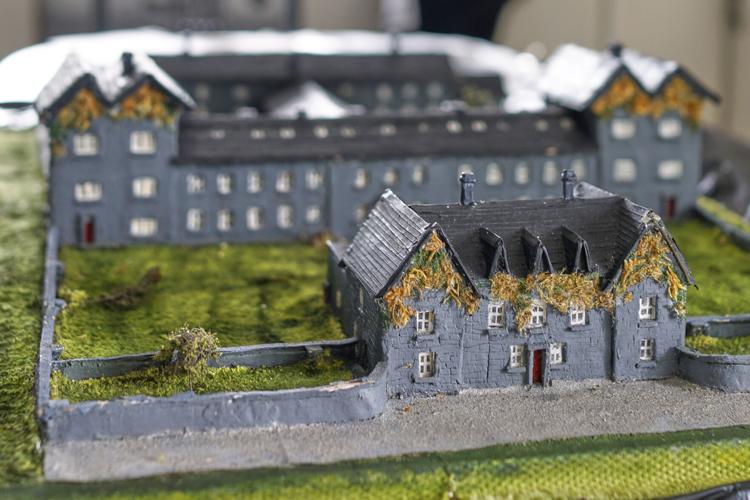
A replica of the Tuam mother and baby home, built by Corless, is seen July 8 at her home.
Deep secrets
Anna Corrigan was devastated when she discovered that, before she was born, her mother had two boys in the Tuam home. Her mother never spoke of it.
“I cried for brothers I didn’t know, because now I had siblings, but I never knew them,” she said.
Corrigan’s brother, John Dolan, died two months after birth in a measles outbreak. Her other brother, William, was listed as dying about eight months after his May 1950 birth. There was no death certificate and his date of birth was altered in the ledger, which was sometimes done to mask adoptions, she said.

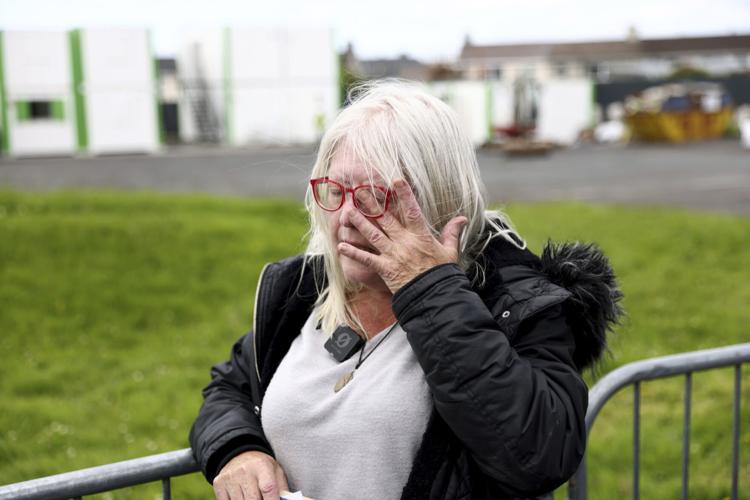
Campaigner Anna Corrigan wipes away tears July 7 while visiting the excavation site.
Corless' work brought together survivors of the homes and children who discovered their own mothers gave birth to long-lost relatives who died there.
Annette McKay said there's still a level of denial about the abuse, rape and incest that led some women to the homes while fathers and families were not held accountable.
Her mother ended up in the home after being raped as a teenager by the caretaker of the industrial school where she was sentenced for "delinquency" after her mother died and father, a British soldier, abdicated responsibility.
Her mother, Margaret "Maggie" O'Connor, revealed her secret when she was in her 70s, sobbing hysterically when the story came out.
Six months after giving birth in Tuam in 1942, O'Connor was hanging laundry at another home where she was transferred when a nun told her, "the child of your sin is dead."
She never spoke of it again.
About 20 years later, a Sunday newspaper headline about a "shock discovery" in Tuam caught McKay's attention. Among the names was her long-lost sister, Mary Margaret O'Connor, who died in 1943.

Annette McKay, whose mother gave birth to a girl who died at the mother and baby home in Tuam, Ireland, stands July 8 next to the area where workers are excavating remains.
Shame's long shadow
Barbara Buckley was born in the Tuam home in 1957 and was 19 months old when she was adopted by a family in Cork.
She was an adult when a cousin told her she was adopted, and later was able to find her birth mother.
Her mother came to visit from London for two days in 2000 and was there on her 43rd birthday — though she didn't realize it.
"I found it very hard to understand, how did she not know it was my birthday?" Buckley said. "Delving deep into the thoughts of the mothers, you know, they put it so far back. They weren't dealing with it anymore."
She said her mother worked in the laundry and was sent away after a year, despite asking to stay longer. Her lasting memory of the place was only being able to see the sky above the high walls.
Her mother told her it was lovely to meet her and her family, but said she'd never see her again.
Buckley was devastated and asked why.
"She said, 'I don't want anyone finding out about this,'" Buckley said. "Going back to 1957 — and it was still a dark secret."
Some were lucky

Corless, who revealed that remains of nearly 800 dead infants from a mother and baby home were unaccounted for and likely buried in a mass grave, reviews her records July 8 at her home outside Tuam.
Pete Cochran considers himself one of the lucky ones.
He was 16 months old when he got out of the home and was adopted by a family in the U.S., where he avoided the stigma that would have dogged him as a so-called illegitimate child in his homeland.
During his visit to Tuam before the dig began, a man from town told him at a bar: "I respect you now, but growing up, I used to spit on you because that's what I was taught."
"I hope they don't find 796 bodies," Cochran said of the dig. "That all these children were adopted and had a good life like I did."
McKay had the same hope for her sister. Still, if any of her remains are found, she'd like to reunite her with her mom, who died in 2016.
"The headstone hasn't got my mother's name on it," she said, "because I fought everybody to say I refuse to put my mom's name on until she can have her child with her."
Photos: ‘Chamber of horrors’ being exhumed at Ireland mass baby grave

Catherine Corless, who discovered that nearly 800 children died at a mother and baby home in Tuam, Ireland, is seen with a replica she built of the home Tuesday, July 8, 2025. (AP Photo/Brian Melley)

Historian Catherine Corless poses for a photo at Tuam cemetery, Ireland, in Tuam, Ireland, July 7, 2025. (AP Photo/Peter Morrison)

Catherine Corless, who revealed that remains of nearly 800 dead infants from a mother and baby home in Tuam, Ireland, were unaccounted for and likely buried in a mass grave, reviews her records at her home outside Tuam on Tuesday, July 8, 2025. (AP Photo/Brian Melley)

Patrick McDonagh, who grew up in the neighborhood built atop the former mother and baby home in Tuam, Ireland, sits outside his family's home on Tuesday, July 8, 2025. (AP Photo/Brian Melley)

Excavation Workers begin setting up at Tuam, Ireland, Monday July 7, 2025 ahead of the excavation at St Mary's home for unmarried mothers and their children which which was run by the Bon Secours Sisters, the Catholic nuns based in Tuam. (AP Photo/Peter Morrison)

Dr Niamh McCullagh, senior forensic consultant, speaks to members of the media in Tuam, Ireland, Monday July 7, 2025. (AP Photo/Peter Morrison)

From left, Dr Niamh McCullagh, Senior Forensic Consultant, Daniel MacSweeney, Director of Authorised Intervention and moderator Dermot Ryan take part in a press conference, in Tuam, Ireland, July 7, 2025, ahead of the excavation at St Mary's home for unmarried mothers and their children. (AP Photo/Peter Morrison)

Dr Niamh McCullagh, Senior Forensic Consultant, speaks to the media during a press conference in Tuam, Ireland, July 7, 2025, ahead of the excavation at St Mary's home for unmarried mothers and their children. (AP Photo/Peter Morrison)

Digging equipment and workers at the site of St Mary's home for unmarried mothers, in Tuam, Ireland, July 7, 2025. (AP Photo/Peter Morrison)

Historian Catherine Corless visits the excavation site of St Mary's home for unmarried mothers and their children, in Tuam, Ireland, July 7, 2025. (AP Photo/Peter Morrison)

Dr Niamh McCullagh, senior forensic consultant, points to the excavation site, Tuam, Ireland, Monday July 7, 2025 as workers have begun moving into the site ahead of the excavation at St Mary's home for unmarried mothers and their children which was run by the Bon Secours Sisters, the Catholic nuns based in Tuam. (AP Photo/Peter Morrison)

Excavation Workers begin setting up at Tuam, Ireland, Monday July 7, 2025 ahead of the excavation at St Mary's home for unmarried mothers and their children which which was run by the Bon Secours Sisters, the Catholic nuns based in Tuam. (AP Photo/Peter Morrison)

Excavation Workers begin setting up at Tuam, Ireland, Monday July 7, 2025 ahead of the excavation at St Mary's home for unmarried mothers and their children which which was run by the Bon Secours Sisters, the Catholic nuns based in Tuam. (AP Photo/Peter Morrison)