BEIRUT — Hamas said Tuesday that it gave mediators its reply to the U.S.-backed proposal for a cease-fire in Gaza, seeking some “amendments” on the deal.
It appeared the reply was short of an outright acceptance that the United States was pushing for but kept negotiations alive over an elusive halt to the eight-month war.
The foreign ministries of Qatar and Egypt — who are key mediators alongside the United States — confirmed that they received Hamas’ response and said mediators were studying it.
“We’re in receipt of this reply that Hamas delivered to Qatar and to Egypt, and we are evaluating it right now,” White House national security spokesman John Kirby told reporters in Washington.
Hamas spokesman Jihad Taha said the response included “amendments that confirm the cease-fire, withdrawal, reconstruction and (prisoner) exchange.” Taha did not elaborate.
People are also reading…

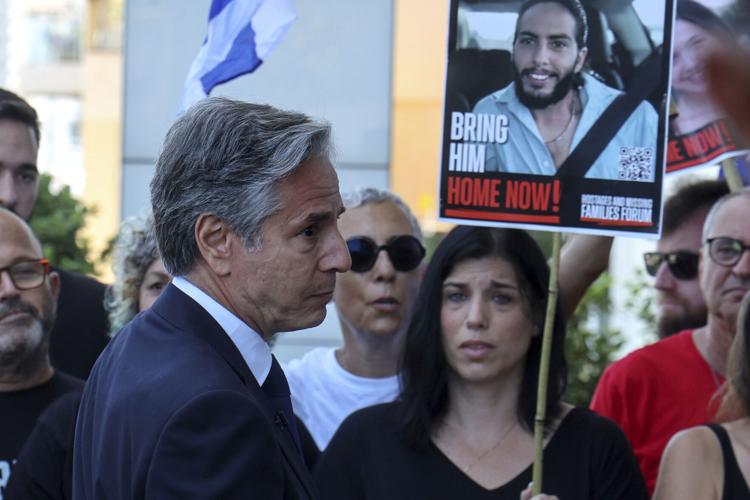
U.S. Secretary of State Antony Blinken meets Tuesday with families and supporters of Israelis held hostage by Hamas in Gaza during his visit to Tel Aviv, Israel.
While supporting the broad outlines of the deal, Hamas officials have expressed wariness over whether Israel would implement its terms, particularly provisions for an eventual permanent end to fighting and full Israeli withdrawal from Gaza in return for the release of all hostages held by the militants.
The U.S. said Israel accepted the proposal, but Israeli Prime Minister Benjamin Netanyahu gave conflicting signals, saying Israel will not stop until its goal of destroying Hamas is achieved.
In a separate development, the U.N. human rights office said Tuesday that Israeli forces and Palestinian militants may have committed war crimes during the deadly Israeli raid that rescued four hostages over the weekend.
Office spokesman Jeremy Laurence expressed concerns about possible violations of rules of proportionality, distinction and precaution by the Israeli forces in Saturday’s raid at the urban Nuseirat refugee camp.
At least 274 Palestinians were killed in the operation, according to Gaza’s Health Ministry.

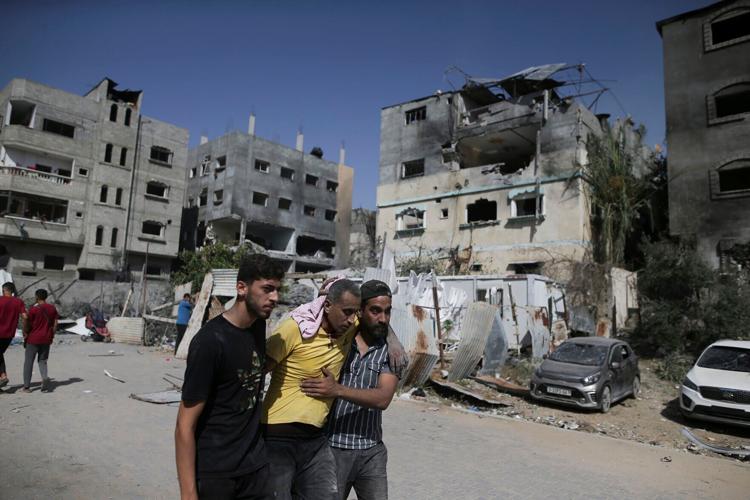
Palestinians help a wounded man Saturday after Israeli strikes in Nuseirat refugee camp, Gaza Strip.
U.S. Secretary of State Antony Blinken has been in the region this week trying to push through the cease-fire deal — his eighth visit since Hamas’ Oct. 7 attack on southern Israel ignited Israel’s campaign in Gaza.
On Tuesday, he continued pressure on Hamas to accept the proposal, saying that the U.N. Security Council’s vote in its favor made it “as clear as it possibly could be” that the world supports the plan.
“Everyone’s vote is in, except for one vote, and that’s Hamas,” Blinken told reporters in Tel Aviv after meeting with Israeli officials, hours before Hamas announced its reply. He claimed Netanyahu reaffirmed his commitment to the proposal when they met late Monday.
In a joint statement announcing that they submitted their reply to Qatar and Egypt, Hamas and the smaller Islamic Jihad militant group said they were ready to “deal positively to arrive at an agreement” and that their priority is to bring a “complete stop” to the war.
A senior Hamas official, Osama Hamdan, told Lebanon’s Al-Mayadeen television that the group had “submitted some remarks on the proposal to the mediators,” without elaborating.

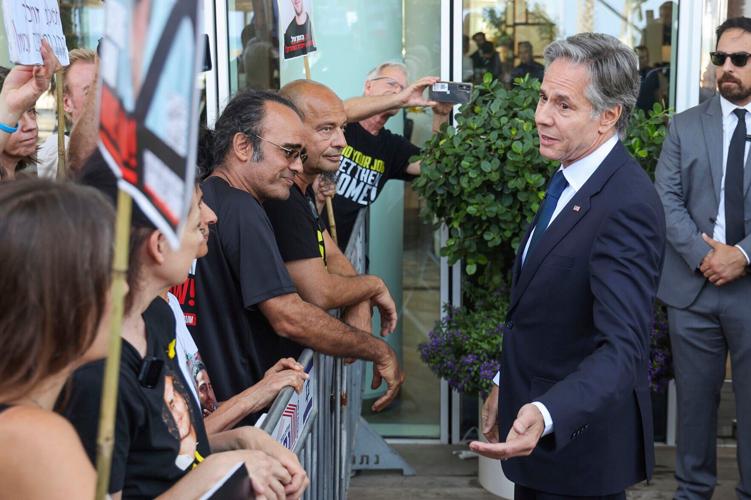
U.S. Secretary of State Antony Blinken meets Tuesday with families and supporters of Israelis held hostage by Hamas in Gaza during his visit to Tel Aviv, Israel.
The proposal raised hopes of ending an 8-month conflict in which Israel’s bombardment and ground offensives in Gaza have killed more than 37,000 Palestinians, according to Palestinian health officials, and driven some 80% of the population of 2.3 million from their homes.
Israeli restrictions and ongoing fighting hindered efforts to bring humanitarian aid to the isolated coastal enclave, fueling widespread hunger.
Israel launched its campaign, vowing to eliminate Hamas, after militants stormed into Israel on Oct. 7, killing some 1,200 people, mostly civilians, and taking around 250 hostage. More than 100 hostages were released during a weeklong cease-fire last year in exchange for Palestinians imprisoned by Israel.
Later Tuesday, Blinken attended a Gaza aid conference in Jordan, where he announced more than $400 million in additional aid for Palestinians in Gaza and the wider region, bringing the total U.S. assistance to more than $674 million over the past eight months.
U.N. Secretary-General António Guterres told the gathering that the amount of aid flowing to the United Nations in Gaza for distribution has plummeted by two-thirds since Israel launched an offensive in the territory’s southern city of Rafah in early May.
Guterres called for all border crossings to be opened, saying, “the speed and scale of the carnage and killing in Gaza” is beyond anything he has since he took the helm of the U.N. in 2017.

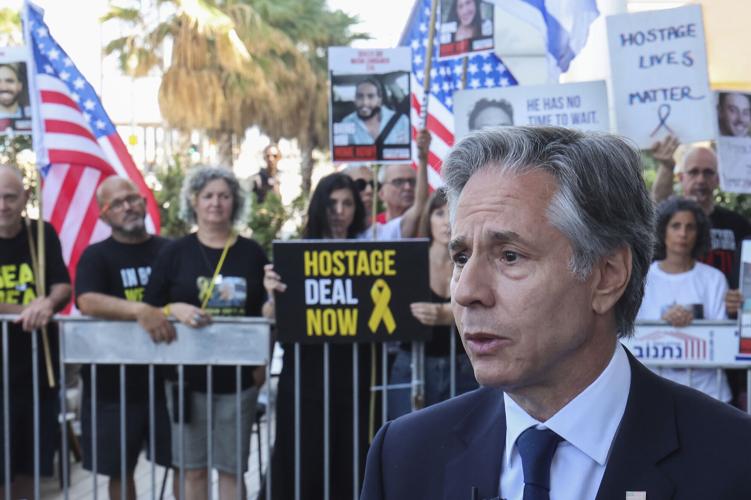
U.S. Secretary of State Antony Blinken speaks to the media Tuesday after meeting with families and supporters of Israelis held hostage by Hamas in Gaza in Tel Aviv, Israel.
Blinken, who was in Cairo on Monday, was also expected to visit Qatar — where talks would likely focus on the next steps in the push for a deal.
On Monday, the U.N. Security Council voted overwhelmingly to approve the proposal, with 14 of the 15 members voting in favor and Russia abstaining. The resolution calls on Israel and Hamas “to fully implement its terms without delay and without condition.”
The proposal, announced by President Joe Biden last month, calls for a three-phased plan that would begin with an initial six-week cease-fire and the release of some hostages in exchange for Palestinian prisoners.
The militant group embraced a similar proposal last month that Israel rejected.
Biden presented it as an Israeli proposal, but Netanyahu publicly disputed key aspects of it, saying there were parts left out by Biden.
The conflicting signals appear to reflect Netanyahu’s political dilemma. His far-right coalition allies have rejected the proposal and have threatened to bring down his government if he ends the war without destroying Hamas.