WASHINGTON — Ketamine, a pharmaceutical anesthetic that can leave users disoriented and immobilized, is drawing fresh scrutiny amid gang rape allegations at Cornell University.
Sexual violence experts say that's a good thing, given the dangers posed by the drug, often called “Special K.”
Ketamine received less attention in campus prevention efforts than alcohol and so-called date rape drugs like GHB and Rohypnol that also were “facilitators” in sexual assault cases, said Laura Palumbo, communications director of the National Sexual Violence Resource Center.
"When we're talking about drug-facilitated sexual assault," she said, "we need to be paying specific attention to ketamine."

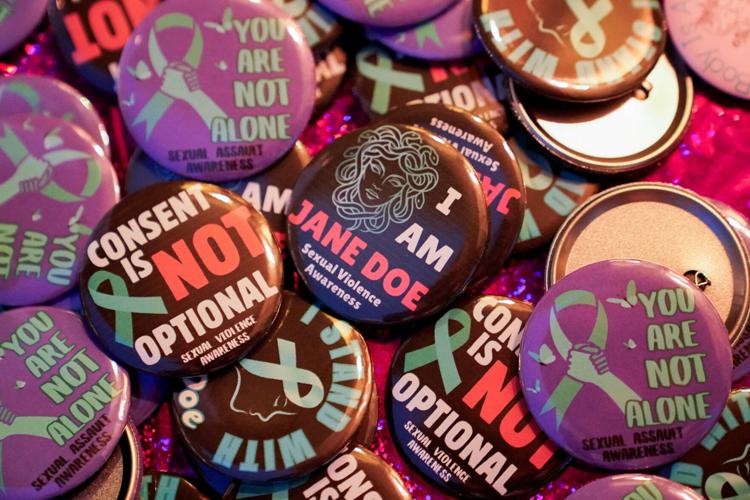
Buttons are seen Oct. 8 on a table as demonstrators gather for a "Stop Sexual Violence" protest in Seattle, Wash., part of U.S. rallies being held in the wake of the Cornell University rape allegations.
In 2004, the Justice Department issued a warning of the dangers of ketamine hydrochloride, a drug it described as “a dissociative anesthetic that has a combination of stimulant, depressant, hallucinogenic, and analgesic properties.”
People are also reading…
“Legally used as a preoperative veterinary anesthetic, ketamine is abused for these properties and used to facilitate sexual assault,” the DOJ said.
Yet, many campus prevention programs have not addressed ketamine in the way they have with alcohol and so-called date-rape drugs slipped into unwitting victims' drinks, Palumbo said.
Ketamine is often offered by a friend or acquaintance and taken willingly, she said. "If someone they trust says, 'Oh, you know, this is just like cocaine,' and that's a drug that they're familiar with and they've tried before … then that could be a really unsafe situation for them," Palumbo said.
Federal officials launched investigations into online ketamine sellers as part of an effort to curb at-home use of the controlled substance, The Wall Street Journal reported in July.

On Sept. 16, the woman at the center of the Cornell case, known as Jane Doe, filed a lawsuit against the university, the Chi Phi fraternity, seven then-fraternity members and others. Her lawsuit alleges she was pressured to use ketamine before fraternity members assaulted her at a house party in October 2024. It was her first time using the drug, and a number of fraternity members also snorted ketamine off her body, she said in her lawsuit.
In her initial interview with campus investigators in November 2024, Doe said she was drinking heavily before entering the frat house and a mix of drugs and alcohol made it impossible for her to consent to sex, according to The New York Times, which said it obtained more than 1,000 pages of Cornell University files.
"Whenever the ketamine went down, I would say, is when things really start becoming a problem," she told investigators, The Times reported.
New York prosecutors reopened the case, and Gov. Kathy Hochul named state Attorney General Letitia James as special prosecutor. Cornell recently announced it suspended fraternity house parties for the rest of the academic year and retained Sally Yates, a former acting U.S. attorney general, to review how it prevents and responds to sexual assault and harassment on campus.
All seven of the men denied wrongdoing. Four acknowledged having sexual contact with the woman but said it was consensual, while the others denied participating in sexual encounters, the Times reported. No criminal charges have been filed.

Protesters rally Oct. 5 at Cornell University in Ithaca, N.Y.
Cornell responded to a request for comment on how it deals with ketamine on campus by issuing a statement saying the university "hosts alcohol and other drug prevention workshops (by request), develops education and resources on alcohol and other drug use, and shares harm-reduction strategies for students as well as other efforts and initiatives."
Cornell spokesperson Rebecca Valli told USA Today on Oct. 13 that students can access the university's Health website, under Alcohol & Other Drug Services for information about ketamine — but a USA Today search of the site produced no results.
Ketamine is used mostly in surgical and diagnostic procedures, but also by paramedics treating pain from trauma, including fractures and burns. It can have hallucinogenic effects, according to the U.S. Drug Enforcement Administration, which mentions ketamine in its "Drugs of Abuse: A Resource Guide, 2026 Edition."
DEA spokesperson Amanda Wozniak referred USA Today to the Substance Abuse and Mental Health Services Administration, a federal agency within the U.S. Department of Health and Human Services, and the National Institute on Drug Abuse for questions about tracking drug misuse and trends.
If the DEA is involved in an investigation involving ketamine, it would be related to diversion of the drug from pharmacies or illicit distribution, not individual use, according to the agency.
At certain doses, ketamine can leave users suffering from dissociation, a trance-like state in which a person can feel a disconnect between his or her mind and body.
A prominent study by New York University professor Joseph Palamar found the percentage of New York City nightclub attendees who reported using ketamine almost doubled, from 7.4% in 2017 to 14.3% in 2024.
But research on ketamine's role in sexual assault is thin. There are few statistics kept by public health officials, school administrators and law enforcement specifically about how often ketamine is cited as a factor in sexual assault cases on college campuses, said Mary Koss, who published the first survey of the prevalence of unwanted sexual experiences on campuses in 1980 and has researched the issue ever since.
"I don't know, and I don't know who does know, of the drugs sold on campus, what proportion of them are ketamine," said Koss, an epidemiologist and psychologist at the Mel and Enid Zuckerman College of Public Health at the University of Arizona.
Ketamine “is not a new predatory drug," and some campuses have educated students about its effects for decades, especially recently, said Kim Webb, past president of the American College Health Association and a chair of its Creating Guidance for Addressing Sexual Assault Task Force.
Alcohol, by far, remains the biggest facilitator in sexual assault cases, said Webb, who leads the Relationship & Sexual Violence Prevention Center at Washington University in St. Louis.
“While it is important to increase awareness of ketamine,” Webb said, “the current focus on ketamine can create a dangerous blind spot that overlooks alcohol as the most frequently used predatory drug.”