Deadly US strike on Iran school may have been a war crime, UN report finds
WASHINGTON — When President Donald Trump addressed the United Nations a year ago, he touted the U.S. bombing of Iran’s nuclear sites just months earlier as "totally obliterating everything" and said he brought peace between Israel and Iran.
Returning to the world body Tuesday, Trump will face a deeply skeptical audience increasingly rattled by six months of war between U.S. forces and an emboldened Iran, growing regional instability and a nuclear threat that has not disappeared despite his claims.
Though battered militarily and economically, Tehran remains defiant, obstructing oil shipments through the Strait of Hormuz and in recent days gaining new leverage as its Houthi allies in Yemen tighten their grip on a Red Sea choke point, further spiking global energy prices.
The lightning advance by the Houthi militants put Trump in an ever-tighter bind over the unpopular conflict, dealt a blow to U.S. ally Saudi Arabia and exposed the limits of Washington’s ability to protect its regional partners.
People are also reading…
Most European and Asian allies spurned Trump's demands for assistance in a conflict he launched without consulting them and which has had damaging fallout for their economies.
With U.S. gasoline prices high and his approval ratings low, Trump could pay a price in November’s midterm elections when his Republican Party’s control of Congress is at risk.
“We are seeing what happens when a president launches a war of choice without anticipating the unintended consequences,” said Aaron David Miller, a former adviser on Middle East policy to Republican and Democratic administrations.
In Trump’s speech to the annual gathering of heads of state and government in New York, he is likely again to frame as a victory a military campaign he promised would be over in weeks.
The conflict instead hardened into an uneasy stalemate that has failed to achieve Trump’s shifting goals while depleting the Pentagon's missile stockpiles.
Trump’s problems have only deepened since Houthi fighters overcame Saudi-backed Yemeni government forces, sweeping down the Red Sea coast and seizing islands at the mouth of the Bab el-Mandeb Strait, a crucial shipping corridor that allows Iran to further threaten global oil supplies.
In response to Reuters' questions, a senior Trump administration official said the U.S. is focused on security interests such as ensuring freedom of navigation in the Red Sea "while empowering our regional partners to take the lead in managing and resolving regional security challenges."

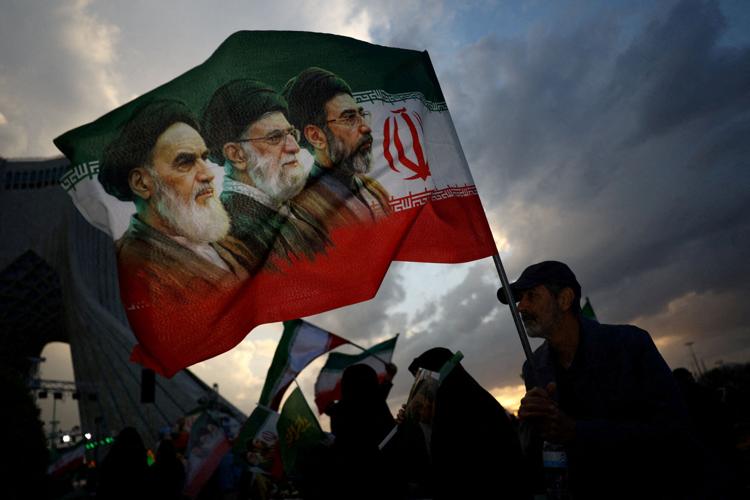
A man holds a flag with a picture of late leader of the Islamic Revolution Ayatollah Ruhollah Khomeini, late Supreme Leader of Iran Ayatollah Ali Khamenei and Iran's new Supreme Leader Mojtaba Khamenei, during a rally April 29 in Tehran, Iran.
Nuclear claims
Iran took up only a small portion of Trump’s speech at last year's UN General Assembly.
He recounted how, three months before, he sent B-2 bombers to drop 30,000-pound bombs that “demolished” Tehran’s uranium enrichment capacity. However, experts determined the strikes only seriously set back the program.
“No other country on Earth could have done what we did,” Trump said.
The U.S. president — who campaigned on a vow to avoid foreign military entanglements — also presented himself as a peacemaker, repeating claims to have ended conflicts around the world, including a 12-day war between Israel and Iran in 2025, and again insisted he should receive the Nobel Peace Prize.
Events since then stand in contrast to his remarks.
Trump joined Israel in striking Iran on Feb. 28, citing what he said was an imminent nuclear threat to the US. Experts disputed his claim that Iran was close to developing a nuclear weapon, which Tehran always denied seeking.

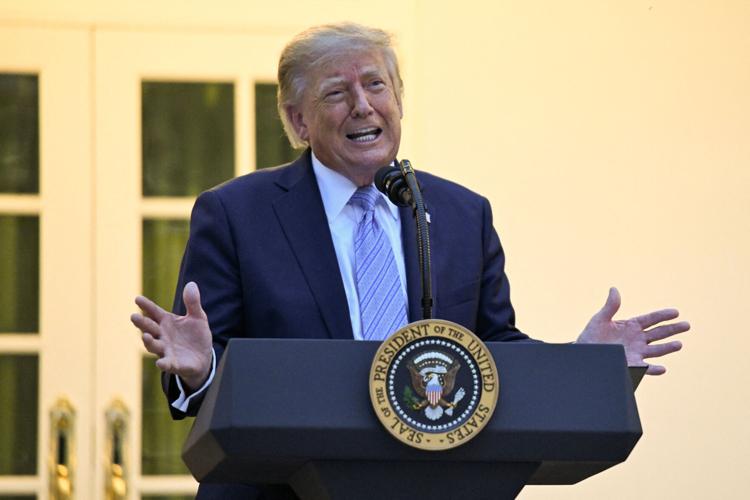
US President Donald Trump speaks Thursday as he hosts a dinner at the White House in Washington.
But Trump underestimated Iran’s resilience, analysts say. Despite airstrikes that killed many of Iran’s top leaders, it hit back at Gulf neighbors and the U.S. bases they host.
At the same time, Iran has retained a stockpile of near-weapons-grade highly enriched uranium believed buried by the U.S. strikes in June 2025.
White House spokeswoman Anna Kelly said Trump alone had “possessed the courage” to confront Iran over its nuclear program, that he had achieved all his objectives and Iran's economy was being crippled by stepped-up sanctions and a U.S. maritime blockade.
Trump, meanwhile, rebuffed Saudi pleas for direct military intervention against the Houthis, who agreed to a ceasefire with the U.S. last year.
This dented confidence about U.S. security guarantees among Gulf States, whose doubts already were fed by Trump’s decision to go to war over their objections, analysts say. He plans to meet Gulf leaders on the UN sidelines next week, Axios reported.

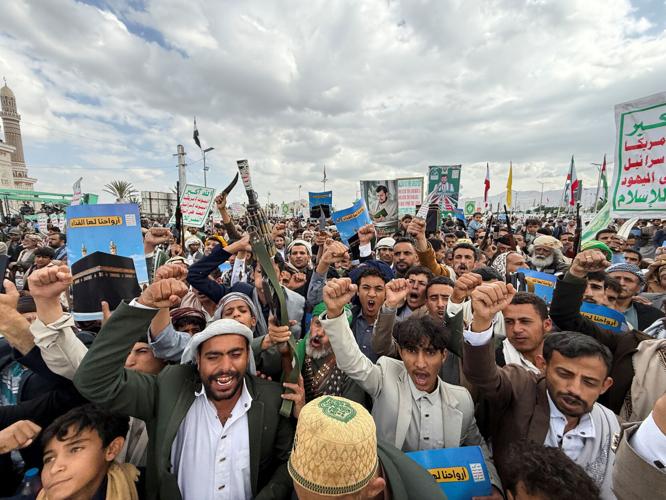
Houthi supporters rally to celebrate advances by Houthi forces along the Red Sea coastline, in Sanaa, Yemen, September 18, 2026. Picture taken with a mobile phone. REUTERS/Adel Al Khader
Trump’s dilemma
The dilemma for Trump is that while the U.S. can ill afford to have the Houthis close a second major shipping corridor, he is reluctant to undertake a dangerous new mission for a U.S. military stretched by the fighting against Iran.
U.S. officials met the Houthis last weekend in Oman, where the group said that while it was targeting Saudi shipping it had no intention of attacking American vessels, according to five people familiar with the matter.
“The U.S. clearly has (military) capacity challenges but even so the cost of inaction here is likely to intensify tensions among Gulf allies,” said Jonathan Panikoff, a former deputy national intelligence officer on the Middle East.
The Houthis’ sudden reemergence as a regional threat further complicated Trump’s efforts to find a way out of the conflict.
With the war grinding on in a seventh month, the U.S. is mired in a battle of attrition while Trump tries to intensify economic pressure on Tehran.
Trump, who has offered shifting timelines, told reporters on Wednesday that “hopefully we are towards the end.”