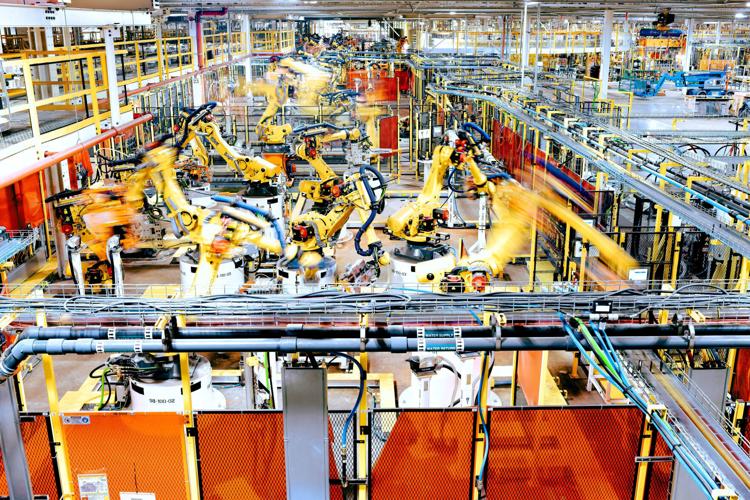
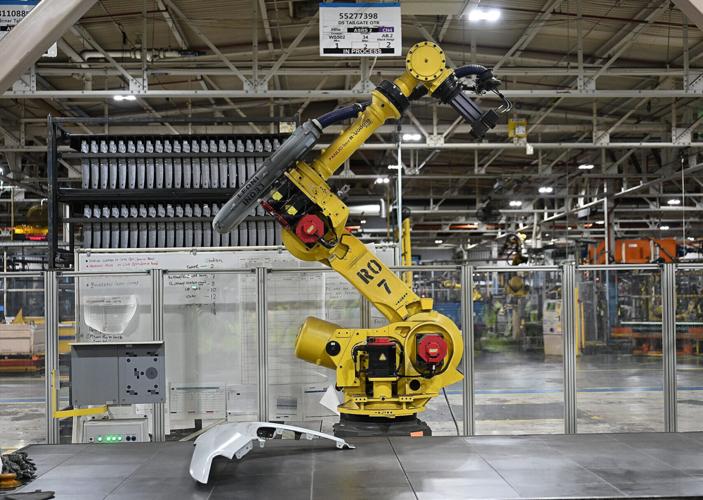
In parts of a Zeekr factory in northeastern China, hundreds of robots piece together luxury electric vehicles in the dark.
If there's no need for human workers, there's no need to keep the lights on.
Experts say no fully "lights-out" mass-vehicle plants exist yet, but that could change soon, exerting enormous pressure on legacy automakers from Detroit to Germany and Japan.
With fast-improving artificial intelligence and new, more agile robotics hitting the market, automakers and suppliers increasingly study how to eke out more efficiency inside their plants — even in notoriously complex stages of the process such as final assembly.
China is out front; some Chinese carmakers, such as Geely Group's Zeekr, BYD Co. Ltd. and Xiaomi Corp., already automated large swaths of their manufacturing processes.
People are also reading…
"There are entire sections where lights aren’t on or you don’t see people,” Tu Le, managing director of consulting firm Sino Auto Insights, said of several Chinese plants. “Usually in final assembly, though, there’s people. But it’s much more automated than I think rank-and-file Westerners believe.”
Detroit knows it must keep pace on automation to compete with China's increasingly dominant auto industry.
A growing number of physical AI and similar automation firms from Silicon Valley and beyond are arriving to test their technology and hardware in Michigan's manufacturing-dense environment. The prospect of auto factories completely or largely run by robots powered by AI also raises uncomfortable — even existential — questions about employment levels and the need for widespread job retraining.
"We are in a fight for humanity," United Auto Workers President Shawn Fain said of AI during a Detroit conference over the summer, warning the technology could be a job-killer for the union's members just as the North American Free Trade Agreement was decades ago. He added, "the rainy day is now; it's here," and the union must respond quickly.

Ford Motor Co.'s Louisville Assembly Plant will operate a highly automated production system following updates for the new Universal Electric Vehicle Platform underpinning the Fathom pickup truck. The factory will require hundreds fewer workers to run than it did previously.
'Greatest labor issue'
The UAW is watching major auto plants it represents become increasingly automated. Ford Motor Co.'s $2 billion overhaul of its Louisville Assembly Plant to make the new Fathom electric pickup, for instance, will include a highly automated assembly process that will mean about 600 fewer employees at the plant. That overhaul comes as CEO Jim Farley marveled at the pace of innovation and manufacturing know-how in China, and plainly stated it threatens Ford's existence as a company.
General Motors Co., meanwhile, took heat from the union for recently adding dozens of collaborative robots, or cobots, to its Factory ZERO in Detroit even as more than 1,000 workers remained laid off. Stellantis NV touted new AI-powered robotics systems in areas including quality control and tracking parts inventory inside factories.
Lear Corp., a major auto seating and electronics supplier headquartered in Southfield, recently opened an “advanced manufacturing and integration center” in Rochester Hills where it demonstrates lights-out production and other advanced manufacturing methods it aims to integrate into more plants. On a recent earnings call, CEO Ray Scott also described how Lear successfully ran a fully lights-out shift using automated injection-molding machines at one of its plants in Germany.
AI-fueled automation became a key issue in UAW leadership elections set to conclude in October. One candidate for president, Greg Mooney, built much of his campaign message around how the union must both adapt and fight back against AI. He's advocated for writing strong AI-specific contractual language and setting up job retraining programs within the union to help workers transition to new, in-demand roles involving AI and robotics.
“We need to have a seat at the table on how it’s going to be implemented — AI’s not going away," Mooney said in an interview. "This is the greatest labor issue of our generation.”
Given AI's rapid advancement, UAW leadership should prioritize bringing back tough contractual language setting minimum employment levels — language that was watered down following the Chrysler and GM bankruptcies, said Tony Totty, president of UAW Local 14 in Toledo and a candidate for one of the union's vice president roles. Such a policy would require a certain number of jobs to be maintained, regardless of whether carmakers introduce new automation inside their plants.
“We’ve got to have jobs, because those robots aren’t going to buy these vehicles," said Totty, who represents members at a large GM transmission plant and made AI a central plank of his campaign. Automation inside auto plants steadily increased, especially when new production lines were installed. Now, he said, the pace and intensity are gaining speed.

The Automated Body Inspection System that scans parts for imperfections is seen June 25 at the Sterling Stamping Plant in Sterling Heights.
Suppliers explore dark factories
In a “perfect world,” a dark factory might be the goal, Paul Thomas, president and CEO of Bosch in North America, told The Detroit News at an Automotive Press Association event on Sept. 22.
The current automation phase for the Germany-based auto supplier emphasizes people working alongside robots, as the company balances costs, quality and social responsibility. That means Bosch is adding more cobots and other purpose-built robots to its plants.
“We've been able to integrate automation while also increasing the knowledge of our workforce,” he said during the event. “So, the people that used to assemble parts are now controlling the (Programmable Logic Controllers) that run our automation. And for me, that's amazing."
Forvia SE of France, another major auto supplier with a large Michigan presence, is developing AI-powered tools that can automatically check weld quality or other potential flaws with products such as its seats, said Chad Durkee, the company's technology scouting director in North America. It's studying other robotics that could have the adaptability to pick and place seating materials, from metal and plastic, to foam and leather.
"AI is unlocking the potential for automation to scale much faster, because it gives it an intelligence level that we never had access to before," he told The News.
Forvia is studying the prospect of lights-out manufacturing in the long term. Durkee said even with rapid AI advancement, such a change would take time, and involve tweaking the designs of parts and sub-assemblies themselves to more easily be assembled by robots.
Auto companies invested more than $100 billion in AI across their operations in the past five years, and those investments are surging, said a recent report by consulting firm PwC. In addition to product-centered uses for AI, automakers and suppliers are pouring those investments into AI-powered quality inspection products and other areas where AI can help factories run more efficiently.
The next phase of investment: More AI-powered robots on the factory floor, said C.J. Finn, PwC U.S. automotive industry leader and one of the report's authors. Still, he noted that transition to smart robots won't happen overnight, nor will the emergence of fully dark auto factories.
【Voice_over】 New data from the China Association of Automobile Manufacturers shows that sales of new energy vehicles in August accounted for more than 60 percent of all new cars sold that month. According to the CAAM, last month NEV output topped 1.65 million units while sales reached 1.64 million, an annual increase of 18 and 17 percent respectively. NEV exports meanwhile topped 526,000 units, accounting for more than half of the country's total exports for the past three months. Officials from the CAAM say this fundamental shift in export structure shows China's auto exports are moving toward an NEV-led model.
'Can't compete' without automation
Many Chinese auto plants are built from the ground up, allowing them to be designed with automation in mind. Strong demand among Chinese consumers for electric vehicles that are less complex and have fewer parts also means assembly is easier and is more conducive to robotic work. China’s robot installations surged in recent years: In 2024, more than half of industrial robots worldwide were installed in the country.
Older existing U.S.-based plants, meanwhile, often aren't as optimized for automation. U.S consumers also haven't shown the same appetite for EVs.
Still, it's a safe bet that there will be a dark auto factory in the United States within 15 years, Le said: "We can't compete unless we automate our factories."
Some question the wisdom in pushing for fully lights-out operation, however. Jeff Burnstein, president of the Ann Arbor-based Association for Advancing Automation, is a prominent advocate for robotics and similar technology. But even he has concerns about the idea of a dark factory future where humans are completely sidelined from auto manufacturing and other industries.
"I mean, don't we still want the people?" he said. "I try to think of a world in which you take it to the extreme — there's no people doing anything. How are we going to survive? Who's going to buy your car? Is the government going to give you money to buy your car? And how much are we getting for this universal basic income? I just don't see it. I guess I can't imagine that world."