

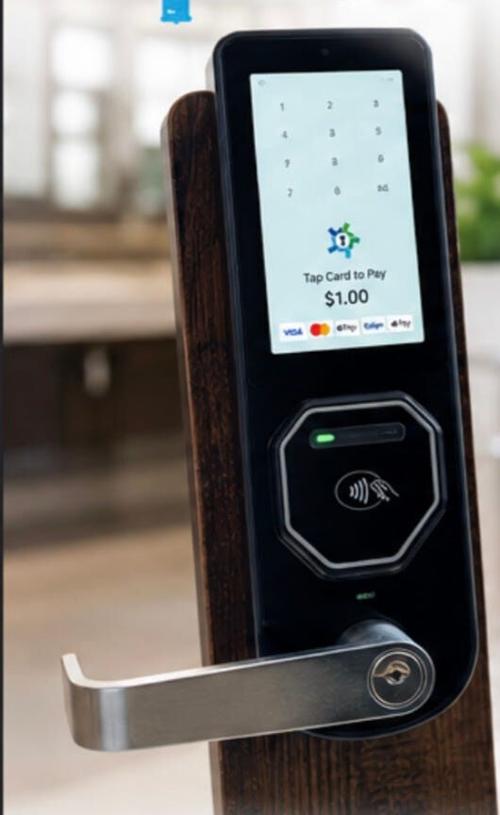
The next time you want to use a restroom in a restaurant, you might have to reach for your wallet.
Smart lock startup Flush Locks is installing cashless payment systems on the doors of bathrooms at small restaurants, cafes and such that usually limit access to their facilities to customers.
Businesses using the locks can opt to have the devices accept access codes provided to customers, credit and debit card payments or mobile device payments.
Flush Locks owners say it's a good fit for high-foot-traffic areas such as in Chicago and New Orleans, as well as near major sports and other events such as New Year's Eve in New York’s Times Square.
An app will allow users to find available toilets, along with their costs and ratings. Users also might be able to pay at a register to obtain access codes or bypass the counter and go directly to the facilities.
People are also reading…
“This allows them to control the door lock by having a paid access code for anyone who is not a customer, as well as giving a code to your actual customers,” said Floyd Freeman, who founded the Boulder, Colorado-based startup with his wife, Marisol Freeman. “With the nightlife on a Friday night, where people are walking from the street and they just might need to go to the restroom. ‘I don’t need a drink. I don't need a coffee.' They’re just looking for a place to let them use it for a dollar or two.”
Flush Locks, which makes money through revenue splits with the establishments, is piloting the device in Colorado.
The couple got the idea for the business after they had trouble finding a bathroom to change their baby’s diaper. They ended up spending about $5 for a soda to gain access to a toilet.
“At most restaurants, we are finding they don't want to open the restrooms to just anyone because they don't know who's in there,” he said. “People abuse them. They aren't all paying customers, so it becomes a cost.”
“Businesses don't want to take on that burden," he said. "We've shifted away from it to where there's just no access. It’s become now where we’re just locked out. The only way we are going to be able to use restrooms is to pay fifty cents to a buck.”
Not a new trend
The concept of pay toilets isn't new, but paid facilities in the U.S. started becoming less common in the 1970s. They’re more broadly used in other countries, but made a bit of a comeback here.
Israel-headquartered fintech company Nayax, founded in 2005, sold cashless payment systems for toilets in the U.S. for about a decade.
Indianapolis-based Nik-O-Lok, which has provided coin- and token-controlled bathroom locks to businesses since 1910, saw business shrink during the COVID-19 pandemic when restaurants didn't resume dine-in service, owner Rob Unterborn said.
He said he continues to see steady business from laundromats, fast-food restaurants and gas stations today, with its largest markets in California and Arizona.
“It’s another source of revenue where you can charge someone 50 cents or a buck where someone has to scan if you want to use the facility,” Unterborn said. “But I don't see this taking off in a trajectory where there’s a steep increase in demand or a steep decrease. It’s been a very consistent business day-in and day-out for the last 10 years.”
Unterborn, 51, was an executive of the company before he and his wife, Kathleen Unterborn, purchased it in 2021.
“You don’t necessarily have to pay to use the facilities, but you have to patronize the business in order to use the facilities,” he said.
Why the shift?
Requiring paid access to bathrooms appeals to businesses that seek to lessen the chances of vandalism, reduce cleanup time and deter other illegal activities, Unterborn said.
In cases of bad behavior, law enforcement can obtain information from credit card payment processors to help identify users within a targeted period, Freeman, 47, said.
“It gives them the security to know that if they allow somebody to use their restrooms that’s not a customer, at least they can still collect data by having this available,” he said. “If somebody abuses a restroom, they’re like, 'Hey, who used this restroom at three o’clock?' And they can find out if that was a vandalism scenario; they can actually recoup some of that information.”
Restaurants can change the prices, potentially increasing them for particularly high-volume periods, but Freeman said he wants to avoid price gouging.
“I hope the product doesn’t become something that takes advantage of people; I would hate to see in New York people charging 30 to 40 dollars for people to go to the bathroom,” he said. “One of my plans is to control that and make sure businesses have the right to charge what they feel is fair. But also they have to be in line.”


