

AI vendors can change their risk profile between reviews, and most oversight programs never notice
Organizations often treat AI adoption as a business decision, overlooking its third-party risk management (TPRM) implications. As a result, AI tools are frequently deployed outside procurement and security oversight, creating governance gaps that become harder to manage as risks evolve.
This challenge with AI risk management is the pace of change. Organizations are adopting AI systems and workflows faster than vendor oversight processes can keep up. Per Vanta’s State of Trust Report, 65% of organizations surveyed in July 2025 reported that their current use of agentic AI outpaces their understanding of it, highlighting the lack of effective risk visibility and governance.
People are also reading…
This guide from agentic trust platform Vanta will explain the key third-party risk implications of AI adoption and how to embed more effective oversight into existing vendor governance processes.
How AI affects your third-party attack surface
Every time an organization adopts an AI tool, it introduces a third-party relationship that must be evaluated and monitored. Many AI systems process sensitive information and create external data flows you need to account for and secure. Common ways AI expands your attack surface include:
- Employees submitting proprietary or sensitive data to AI tools
- Integration with internal systems and repositories
- Greater reliance on externally hosted AI models (which can cause operational disruptions)
- Shadow AI (unsanctioned AI tool use bypassing procurement)
AI tools also rarely operate in isolation. They depend on external ecosystems, including APIs, subprocessors, and underlying model providers, introducing fourth- and Nth-party dependencies that expand your vendor footprint. Without visibility into these downstream dependencies, the vendor risk management program undersells the true scope of third-party risk. These dependencies also change fast, often without triggering any governance process.
“Traditional TPRM wasn't built for vendors that can materially change their risk profile without triggering a contract clause,” Evan Rowse, governance risk compliance subject matter expert for Vanta, explained. “An AI vendor can change foundation models, introduce new subprocessors, or modify data-handling terms between reviews. Unless ‘material AI change’ is defined in vendor agreements and tied to notification requirements, your TPRM program could be reviewing the past.”
Why the traditional approach to TPRM fails with AI risks
Three mismatches between traditional risk processes and AI vendor ecosystems drive most of the exposure.
Traditional TPRM programs rely on point-in-time artifacts, such as vendor risk assessment questionnaires, periodic reviews, and risk register spreadsheets, to manage risk. AI vendors operate differently, as features, subprocessors, and data handling practices can evolve rapidly, making point-in-time assessments less reliable.
According to Rowse, “A security questionnaire gives you a snapshot of something that doesn't hold still. By the time your AI vendor has finished responding, their model has changed, a new subprocessor has been added, and last quarter's data handling terms are already out of date. A questionnaire is one input—not the program.”
Additionally, AI adoption cycles are faster than traditional procurement and vendor review processes, leading to one of the most persistent risk patterns in the current landscape. Business teams select AI tools based on capability, speed to deploy, or competitive pressure, while security and privacy review happen later in the process or are deprioritized.
The third mismatch: TPRM often operates separately from broader GRC programs. Disconnected tooling and workflows make it difficult to maintain up-to-date risk records or track how AI-related risks affect the wider control environment.
Modernize AI third-party risk management: 4 steps
To manage AI-related third-party risk, organizations must rethink how risk is identified, assessed, and governed. These four steps can make the transition easier:
- Implement continuous monitoring
- Scale risk analysis with AI and automation
- Unify vendor risk with broader GRC
- Expand AI risk visibility across the vendor ecosystem
Step 1: Implement continuous monitoring
Use leading GRC tooling and platforms to implement processes that move oversight beyond periodic assessments and provide ongoing visibility into an AI vendor’s security posture. Focus on signals that indicate changes in vendor exposure and fourth-party dependencies. You can track updates to the AI model, infrastructure, hosting environment, data residency, and vendor certifications such as SOC 2 Type II reports, ISO/IEC 27001, ISO/IEC 42001, and HIPAA (where applicable).
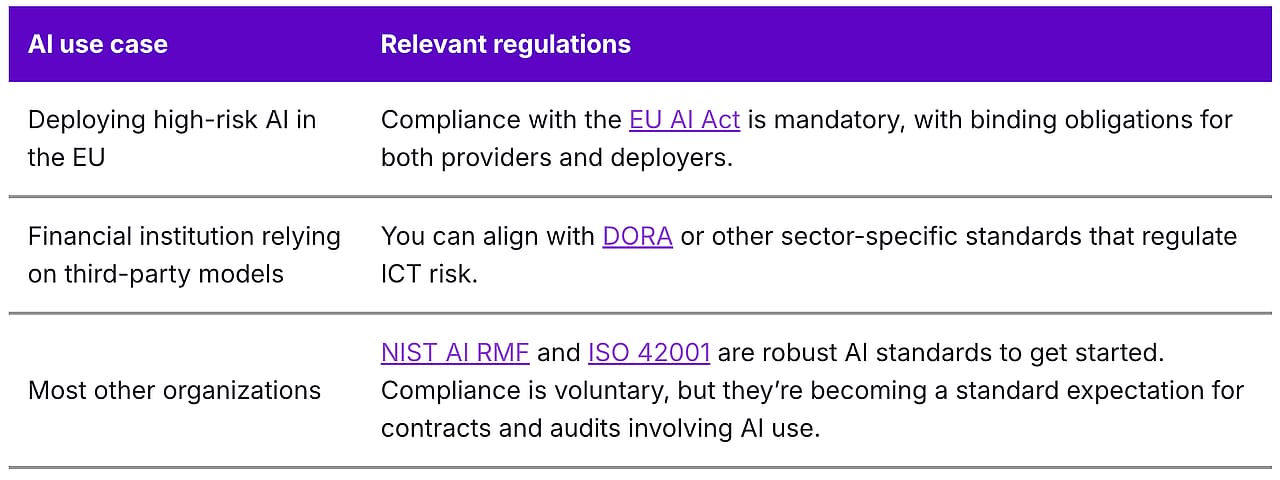
Align your monitoring efforts with applicable risk management frameworks and regulations to support compliance from the get-go. You can research which AI governance standard would work better for your AI use case, business environment, or industry. Examples include:
Step 2: Scale risk analysis with AI and automation
Reviewing every signal from continuous oversight by hand burns your team's time. AI and automation filter that stream, surfacing only the signals that require human review. AI can review vendor questionnaires and evidence packages faster than humans. It helps you scale oversight by:
- Identifying changes in vendor policies, subprocessors, and AI models
- Prioritizing findings based on criticality and impact
- Mapping vendor risk to internal controls, treatment plans, and regulatory requirements
- Triggering human reviews and reassessments for material findings
Many modern GRC solutions come with built-in risk management automation workflows that help you scale without overextending your team. That way, your team can focus more on risk validation, exception management, and remediation.
Step 3: Unify vendor risk with broader GRC
AI risks are not constrained to a single domain and can trigger privacy concerns, compliance implications, and operational dependencies simultaneously. But a common issue of TPRM is treating it as an isolated function rather than part of a broader governance program. When risk management functions are siloed, organizations have fragmented visibility into AI risks, which can lead to inconsistent AI use policies across departments, missed vulnerabilities, and weak accountability.
Work with your team to integrate third-party risk management into a unified GRC approach. Establish a centralized view of risk across your organization and provide shared context for stakeholders across teams. This improves coordination between departments and makes it easier to make consistent and auditable risk decisions.
Step 4: Expand AI risk visibility across the vendor ecosystem
TPRM typically focuses only on direct vendor relationships, not the downstream dependencies they introduce. In AI environments, some vendors may not offer a direct AI service but rely on AI model providers, cloud infrastructure, and embedded AI tools, which hide risk across multiple layers of the ecosystem. Expanding visibility across the vendor ecosystem helps account for these gaps by surfacing both direct and indirect dependencies.
For an AI-informed vendor risk assessment, focus on the following areas in your evaluation (whether or not you’re procuring AI):
- Data handling practices: How the vendor collects, processes, stores, and retains your data. As a best practice, determine whether your data is used for model training or fine-tuning as well.
- Model transparency: How much information the vendor discloses about training data sources, model architecture, and ways the tool generates outputs.
- Subprocessor and fourth-party dependencies: The downstream providers, cloud infrastructure, and APIs the vendor relies on, each of which expands your attack surface.
- Access controls and authentication: Methods used to govern access to models, APIs, and sensitive data, such as role-based access and audit logging.
- Incident response and breach notification: Whether your vendor has established and regularly tested procedures for identifying, responding to, and communicating security incidents.
- Regulatory and framework alignment: Whether the vendor's practices align with relevant AI governance standards such as ISO/IEC 42001, the NIST AI RMF, and the EU AI Act.
- Output integrity: The controls the vendor has in place to mitigate model hallucinations, bias, or adversarial manipulation that can impact the reliability of AI outputs.
Best practices for managing AI-related third-party risk
Alongside modernizing TPRM, implement these best practices for managing AI vendors throughout their lifecycle:
- Establish an AI inventory: Maintain a central inventory of AI tools, their use cases, and related external dependencies.
- Update vendor contracts for AI: Update existing contracts to include provisions about data usage, model training, subprocessor changes, and reporting obligations.
- Define clear AI governance: Establish security and compliance criteria for onboarding and approving AI vendors for consistency.
- Validate inherited controls regularly: If you rely on controls implemented by AI vendors, review annually (or continuously for high-risk vendors) to see if they’re still effective.
- Define AI “material change” criteria: Spell out what a “material change” means for AI vendors, such as a new model version or changes in privacy policy, and require notification when one happens.
What effective AI vendor oversight actually looks like
Traditional vendor oversight assumed a risk profile stayed stable between reviews. AI vendors broke that assumption, and more questionnaires will not restore it. The teams handling this well are not running more assessments; they are changing what an assessment is for.
That shift has three practical markers. Oversight becomes continuous rather than scheduled, so a new subprocessor or a swapped foundation model registers when it happens. Vendor risk stops living in its own system and feeds the same register the rest of the GRC program works from. And "material change" moves out of informal expectation and into contract language, with notification requirements attached.
None of this means abandoning existing TPRM processes. It means accepting that a point-in-time artifact cannot govern a vendor that changes weekly. Teams evaluating third-party risk management platforms should treat continuous monitoring and AI vendor discovery as core requirements, not advanced features.
This story was produced by Vanta and reviewed and distributed by Stacker.