MADISON, Wis. — The heart of a movement born of grief and resolve beats at the corner of Williamson and South Baldwin streets.
This is where a Madison police officer shot and killed Corey Ruiz, 38, in a confrontation Wednesday. Police say Ruiz had a knife and injured an officer. Protesters called the killing an execution. The state opened a homicide investigation into the death.

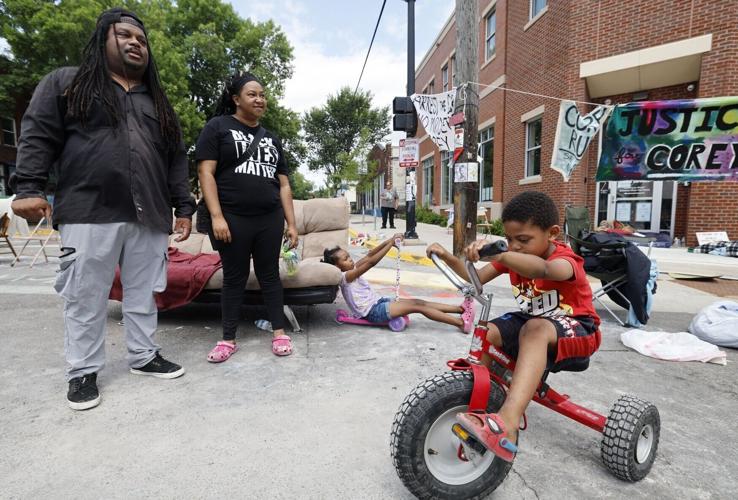
Derrick McCann, left, and Erica Davis, with their children Aaliyah, 6, and King, 5, right, gather at Williamson and South Baldwin Streets where Corey Ruiz was fatally shot by a police officer. The intersection has become a 24/7 gathering space.
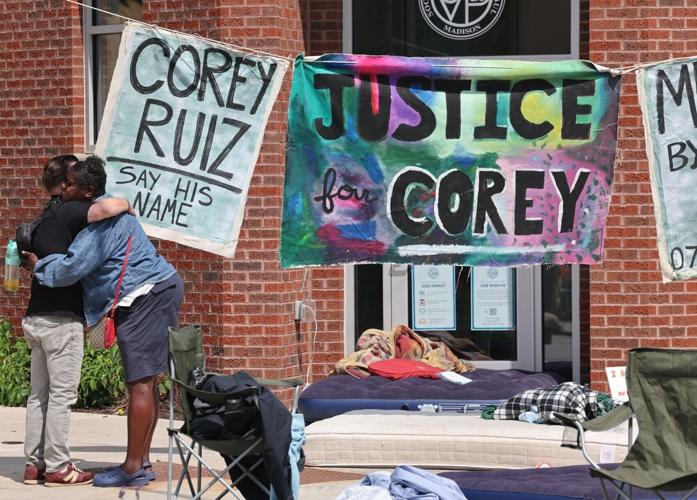
It was the third fatal police shooting in the neighborhood in 14 years, and the community’s collective trauma led impromptu organizers to turn the intersection where Ruiz died into a place where people could gather, bond and protest. The city has not tried to reopen the street.
Here, just steps from the Willy Street Co-op at the center of one of Madison's most liberal neighborhoods, expressions of sadness and anger poured out in art painted on pavement. It's where protest marches start and plans are made to disrupt daily life in Madison. It’s also where community bonds are strengthened over grilled hot dogs and lawn chair chats.
People are also reading…
The Wisconsin State Journal spent 24 hours at the intersection, from 1 p.m. Friday to 1 p.m. Saturday, to document the grief, anger and solidarity of this moment.

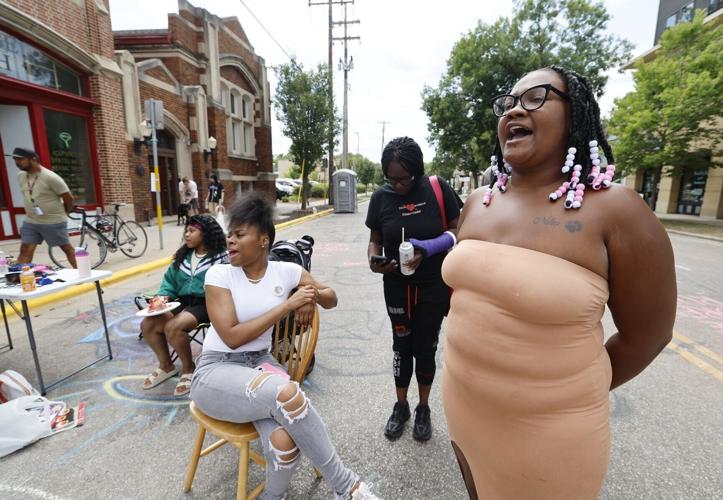
Trinity Wilson, right, chants with protesters as a crowd gathers at Williamson and South Baldwin streets on Friday.
1 p.m. Friday
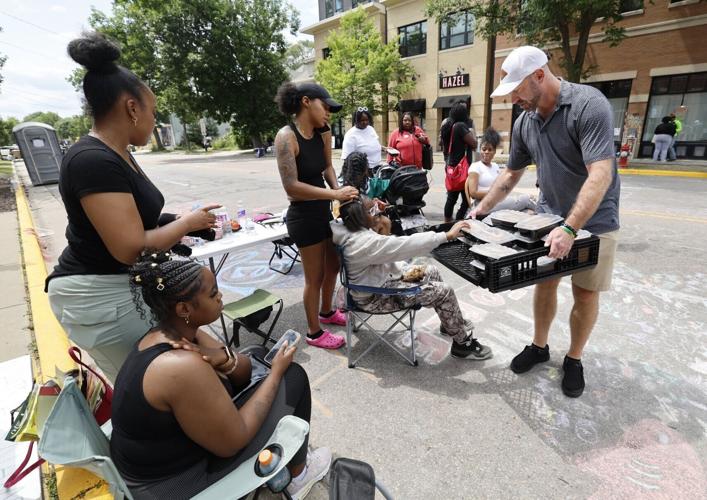
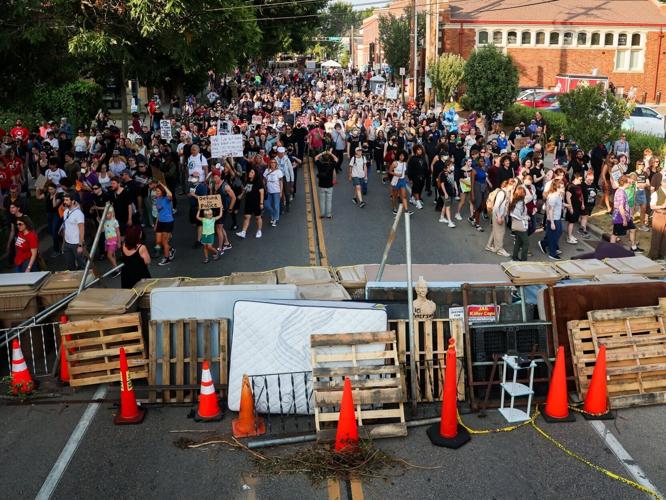
Within the makeshift barricades of wooden pallets, garbage bins and mattresses, about 70 people gather as a growing mound of flowers marks the spot where Ruiz died. Tents and chairs are set up by people who have been here for days, and some in the crowd hand out pizza, fruit and grilled brats. Among those handing out food is Eric Heitzinger, manager of Monty’s Blue Plate Diner. The food was meant for AtwoodFest, which was canceled in light of the police shooting.

Eric Heitzinger, manager at Monty’s Blue Plate Diner, offers food, that he planned to sell at AtwoodFest before it was canceled, to a crowd that gathers at Williamson and South Baldwin Streets where Corey Ruiz was fatally shot by a police officer.
2 p.m.
Protesters gather to march toward the Capitol, one in a series of protests that originated at Willy and South Baldwin, but Derrick McCann and his family stay behind. He had arrived at the intersection shortly after Wednesday’s shooting, where he saw the bike Ruiz had been riding still in the street and watched workers with a water hose clean the blood off the street.
McCann attended LaFollette High School with Ruiz and remembered him as a loving friend.
“Just a small city, kind of like everybody knows each other. Every time I see him, it was always love,” he says. “He was always thinking about the old times and memories, he always had a smile.”
3 p.m.

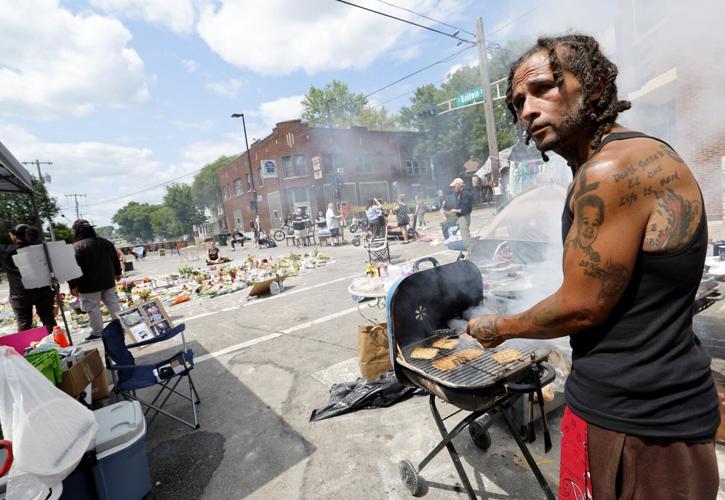
Asiatic King grills burgers for protestors gathering at the intersection of Williamson and South Baldwin streets.
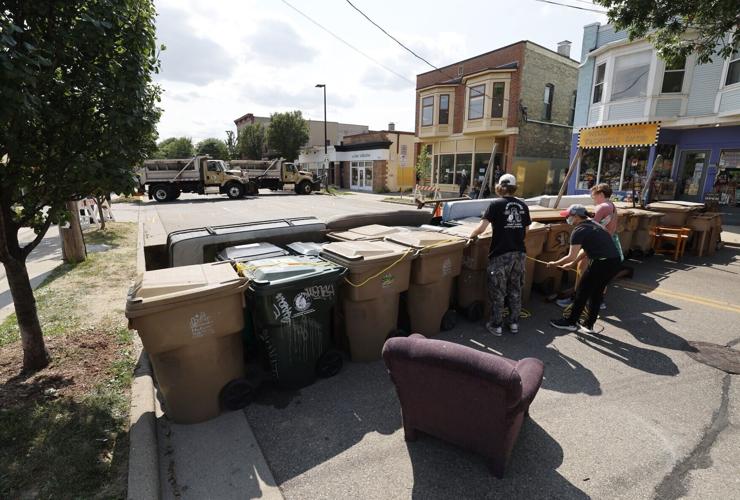
Public Works trucks are parked along the barricades on all four sides of the intersection to prevent anyone from driving into the area after a report of a car driving into the block the night before.
Many people head downtown to protest, so the crowd thins. Asiatic King, one of Ruiz’s close friends, helps grill brats next to his tent, which he’d set up at the intersection Thursday.
King and Ruiz saw each other almost every day, King says, frequently walked and talked together for hours. While Ruiz was troubled, King wants others to “remember him as a person, not just somebody that had mental problems, not somebody that just got killed by the cops.”
“Ask yourself if that was your son. Ask yourself if that was your brother. How would you feel?” he says.

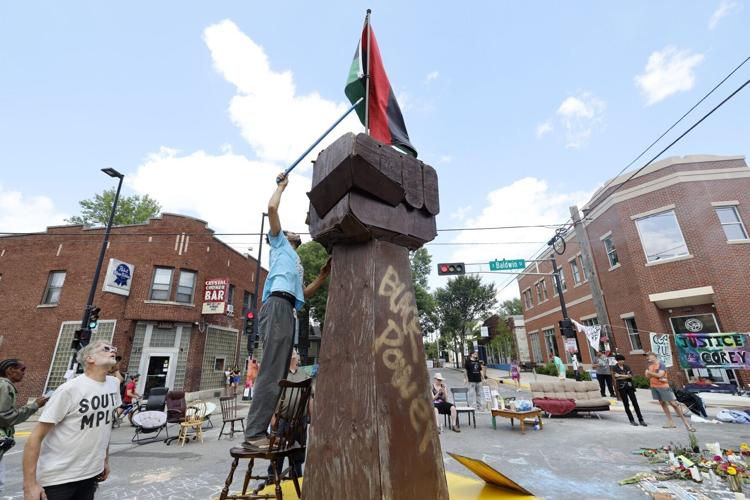
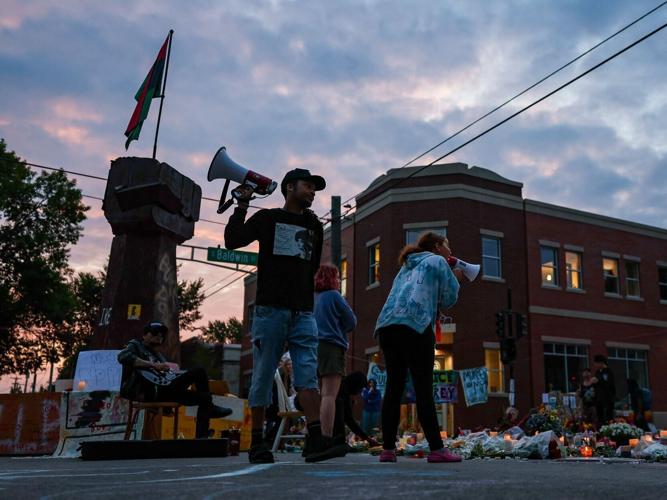
Jordan Powell Karis adjusts the Pan-American flag atop a 11-foot raised fist sculpture he built and delivered from Minneapolis, Friday at the intersection of Williamson and South Baldwin streets, where Corey Ruiz was fatally shot by a police officer on Wednesday.
Jordan Powell Karis, a Minneapolis-based artist, drops off one of his large wooden sculptures of a raised fist. The roughly 16-foot-tall plywood piece is one of nine fist statues he’s made, five of which have been in George Floyd Square in Minneapolis since 2021.
“This work is reaching really far and wide. Not the work of the fist statue, but the work of us all fighting for a better day, us working for Black liberation,” Powell Karis says. “We need symbols and beacons and places to come and gather … I hope this is just like a signal that says, ‘do more.’”
Protesters cheer as a Pan-African flag is raised on the top of the piece as people sign the base of the sculpture with “Justice for Corey” and “too many names.”
4 p.m.

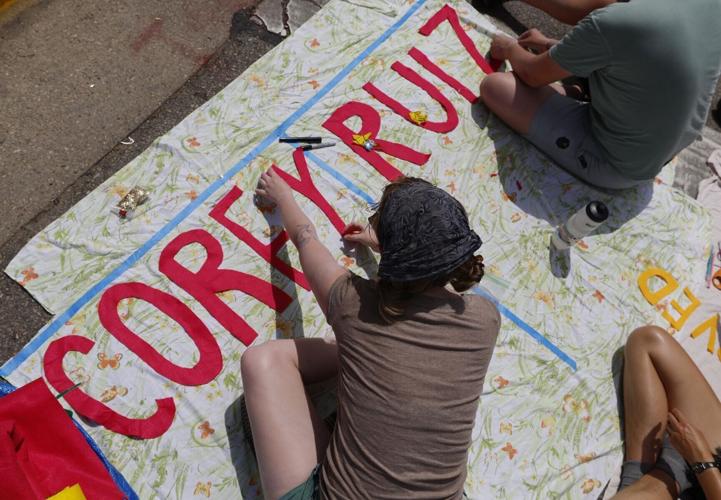
Astrid Berger, left, makes a banner using a fitted sheet that will read “Corey Ruiz deserved to live” as a crowd gathers Friday at Williamson and South Baldwin streets.
A protester spray-paints “The choices we make shape our world tomorrow” on the street as broadcast journalists prepare for their 5 p.m. live news shot.
Leaning against a building, Kaylee Marquis has been here since Thursday, aside from a few stops home to take care of her beagle pitbull mix, Cartier, who sniffed the ground next to her. During the day, she’s been calling Madison businesses, like the Chocolate Shoppe Ice Cream, to ask for donations to the site.
“I hope Madison police give up the footage,” Marquis says. “That’s why we’re here, besides justice for Corey. We wouldn’t be marching if they had body cams that they could’ve given up right away.”
On the corner of Willy and South Baldwin Streets, Cha Cha Beauty and Barber is open for business.
Some employees decided to take the rest of the week off after the shooting, co-owner Genevieve Smith says, but she wants to stay open.
“I just didn’t know if it was tacky to stay open, but also, I didn’t want it to affect our business necessarily because of what they did,” Smith says. “So, I just stayed open and I figured if we could help by letting people go to the bathroom, use electricity, all sorts of that stuff.”
A protester walked into the salon and barber shop to ask if they had an open bathroom.
“Down there to the right,” Smith says.
5 p.m.
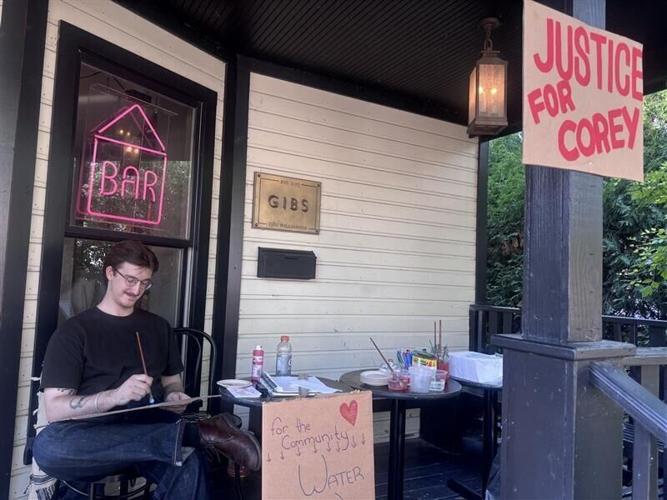
On the other end of Willy Street, Gibs Bar has just opened for the night.
Bailey Whistler, a bartender, is sitting on the porch painting a sign with blue lettering on a piece of cardboard. He’s surrounded by paint and art supplies that the bar is offering to the public.
“This bar in particular, I think, is pretty connected to the community of Madison, but most definitely, the community of Willy Street. It’s already a super tight-knit community that’s been through this before,” Whistler says.

Bailey Whisler, a bartender at Gibs Bar, located at 1380 Williamson St., sits on the front porch of the bar while painting a sign to honor Corey Ruiz, a 38-year-old Black man who a Madison police officer shot and killed down the street on Wednesday.
Half of the proceeds from the bar’s seasonal cocktail over the weekend will go toward the nonprofit advocacy group Freedom, Inc., says Gib’s manager Taylor Swanson.
6 p.m.
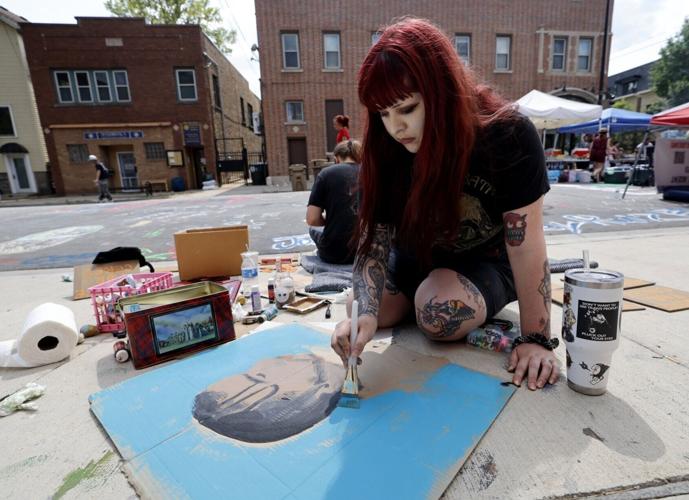
On the sidewalk along South Baldwin Street, Alyse Fleuette is putting the finishing touches on a painted portrait of Ruiz.
"You should be remembered as a person, and I’ve been seeing a lot of people, especially online, just be like, ‘Oh, well, he had convictions, he was a criminal,’” Fleuette says. “He was a person. He had a daughter. She spoke yesterday and it was really heartbreaking. His whole family was there crying over him. He was someone who was loved. He was a neighbor, he was part of our community.”
Fleuette had just clocked into a shift at the St. Vincent de Paul on Willy Street around 1:30 p.m. on the day of the shooting.
“I kind of saw the aftermath, compressions and stuff from the window,” Fleuette says. “It was really awful. We ended up closing the store, and I just wanted to put that negative restless energy into art.”

Alyse Fleuette paints a portrait of Corey Ruiz, who was fatally shot by a police officer on Wednesday afternoon, as protesters gather at Williamson and South Baldwin streets on Friday.
Behind Fleuette’s group of artists, a group of about eight volunteer first-aid responders wearing neon orange reflective vests is making a game plan for the night. They started passing out water bottles to protesters.
A plan forms to march to Madison’s police headquarters, and a group of more than 200 protesters begin marching down Willy Street to drumbeats and chants. “Shut it down.” “No justice, no peace.”

At 6:30 p.m., protesters march west past the protective barricade they had put up on Williamson St. towards the downtown Madison police station and the Capitol.
7 p.m.
Dani Bouboutsis, a 16-year-old West High School junior, is heading home for the night. Bouboutsis, who lives down the street, spent much of Thursday and five hours Friday on food duty, handing out fresh slices donated by Ian’s Pizza and freshly grilled hot dogs.
“I came out because I thought it was needed,” Bouboutsis says. “I don’t think anyone deserves to be hungry out here, to be starved,” she adds, gesturing to a small group of homeless people huddled on mattresses behind her, “and the protesters, they also need to eat, they need fuel.”
Across the street, Chakari Daezhare, 26, rests her vocal cords after an impromptu singing session with a group of band students from East High School, her own alma matter. Daezhare, who sings professionally, has offered up songs multiple times over the past couple of days in a cappella performances honoring Ruiz.

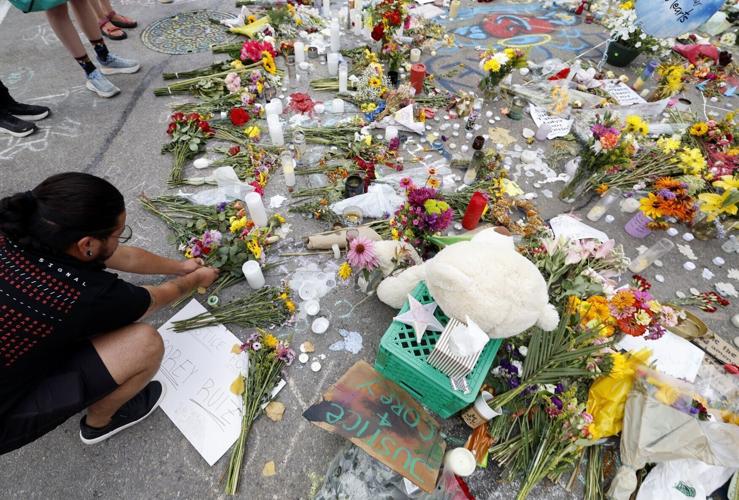
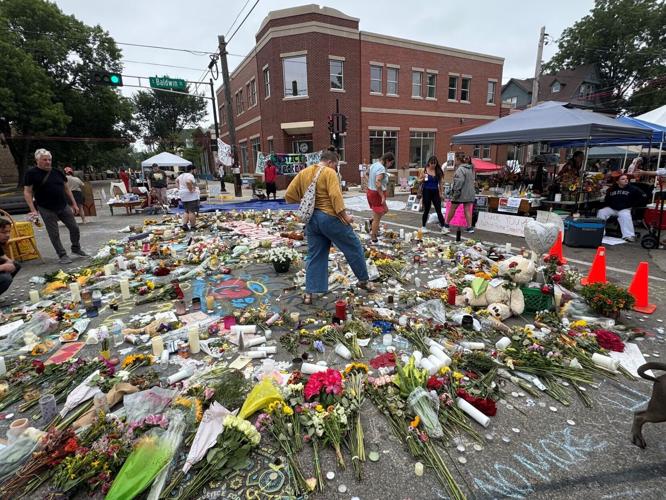
Visitors place flowers at the intersection of Williamson and South Baldwin Streets where Corey Ruiz was fatally shot by a police officer on Wednesday afternoon.
The high school saxophonist who had been performing for the past hour and a half also gives his windpipes a respite and comes to chat with Daezhare about their mutual band teacher. Daezhare promises to come back and visit the school soon.
The protest site is a popular spot for pets. Three dogs, including one Great Dane that towers over its canine peers, sniff each other eagerly as their owners exchange names and share their frustrations with Wednesday’s killing.
After the live music stops, someone begins playing Gospel music at full volume from a nearby speaker. The sound of the 1985 track “We Are the World” echoes over the crowd. Some people begin dancing, while others stretch out a long white rope and begin playing Double Dutch.
A breeze passes over the 70-degree evening, and some people pull their jackets tighter around their shoulders. Others huddle in lawn chairs or crouch beside a portable fire pit.
8 p.m.
Jamie Johnson, 56, and Taylor Kunz, 27, both traveled 45 minutes into Madison to show their support. They live in Beaver Dam and Randolph, respectively, but both lived in Madison previously. Johnson says she has “kept her foot in the community door” after being involved in Madison-area protests following George Floyd’s death in 2020.
Wednesday’s shooting happened just a block and a half from here police shot of Tony Robinson in 2015, which makes the incident feel like “picking a scab for the community,” Johnson says. As the mother of both a white child and one of color, she says, the conversations she had to have with the latter were completely different.
Meanwhile, the glow of candles radiates from the center of the intersection as the sun goes down.

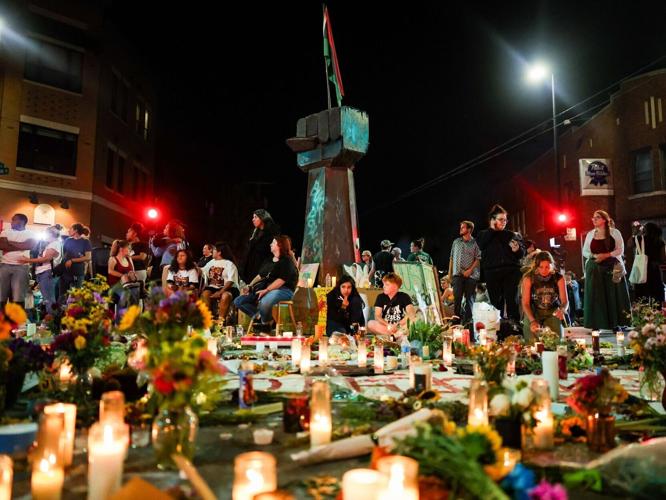
A crowd gathers at Williamson and South Baldwin Streets where Corey Ruiz was fatally shot by a police officer on Wednesday afternoon, in Madison, Wis. Friday, July 24, 2026. AMBER ARNOLD, STATE JOURNAL
“A peaceful protest like this needed to happen for sure,” says Kadin Hoger, 25. “People who are standing here right now, they connect because they don’t share all beliefs, but they at least have one belief that we can all share, you know, and that’s to treat everybody equal.”
9 p.m.
Groups of people begin filtering back into the Willy Street Site after returning from their march on Capitol Square. Surveying the scene, Madison resident Alan Robinson calls it “one of the more diverse aspects of Madison life.”
“However, Madison’s diversity only truly exposes itself in the wake of a tragedy,” he says. “You won’t find this kind of diversity in any of our social spaces, in any of our entertainment spaces. … At our restaurants, Black people there will be seen working and not enjoying space.”

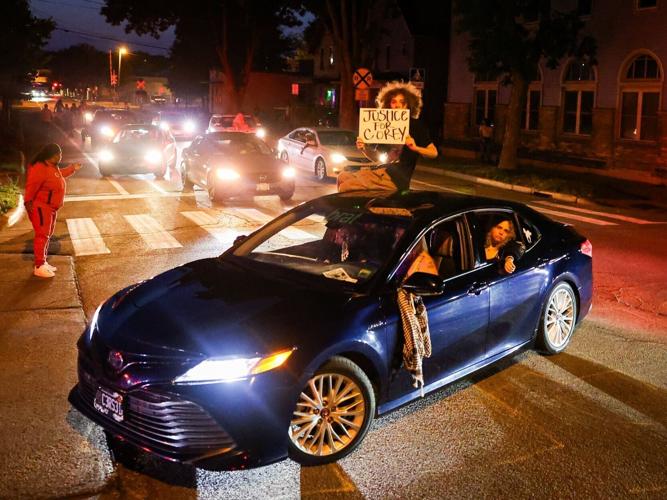
Just after 9 p.m., a caravan of cars with protesters turn right on E. Wilson St. after reaching the memorial barricade.
Robinson points out Ruiz was apprehended after being accused of checking cars, which he called a “desperate crime of poverty.”
He notes the median household income of Black residents in Madison is significantly lower than that of white residents, according to Census Bureau data he begins pulling up on his phone.
He then calls over Jazzman Brown, a community organizer who had known Ruiz since childhood.
Brown’s brother was childhood best friends with Ruiz, she says, and she remembers growing up together and watching them play video games at her house. She’s been involved in political activism since 2020, she says, but this incident hits a little harder.
“I’ve done it for countless strangers,” she says. “How could I not do the same thing for somebody I’ve known my whole life?”
10 p.m.

Just before 10 p.m., people gather around the memorial for Corey Ruiz. People have been gathering at Williamson and South Baldwin streets around the clock since the shooting Wednesday afternoon.
The crowd has reached its zenith for the night. The smell of smoke from the firepit and grills, music that can be heard blocks down the road and children and teens running and playing around the intersection.
Were it not for the ever-growing candlelight vigil, it would be easy to mistake the protest for a block party.
Jubilant may be too strong a word for the night, but it’s undeniable that many who have stayed and the few newcomers trickling in were having a good time. A couple holding hands on a carpet rolled out over the pavement, a group of friends in a circle complaining about work and school, a girl dancing to the seemingly haphazardl Spotify playlist.

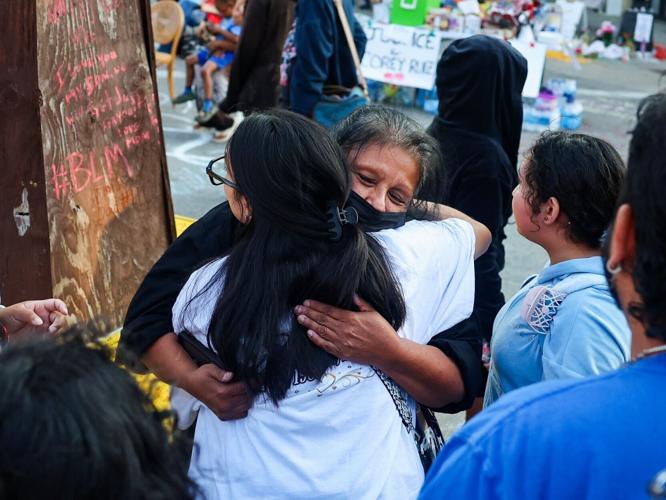
Corey Ruiz’s mother, Elsa, center, is embraced after writing a message to Corey on a statue of a raised fist at the intersection of Williamson and South Baldwin streets.
Inescapable, though, is the reason that everyone came together. More of Ruiz’s family enter the space. His mother, sitting in a white lawn chair, cries with a group of women attempting to comfort her.
But still the night goes on. Organizers who helped set up food stands and watch parties at the perimeter of the encampment debate what to do the following day.
One man, through his bullhorn, announces their intent to take the protest to the Dane County Farmers’ Market early Saturday morning. Not everyone can take part, however. Some will have to stay behind to watch over the vigil, but that’s a problem for tomorrow.
11 p.m.
It’s late, and as the energy of the crowd dissipates, the mood shifts from celebratory to somber.
A man shouts that the day’s events “aren’t just for Corey” but for everyone who wants to feel safe in their community. Those words may have meant something more to Rico Johnson, a longtime friend of Ruiz and brother of Richard Johnson, a man who died in police custody in December 2024.
Johnson’s brother died after being arrested by Madison police on Dec. 30, 2024. The Dane County Medical Examiner’s office ruled his death the result of drugs found in his blood, but an independent review conducted months later asserted his death was the result of an officer putting pressure on his back during his arrest.
Johnson, who says he had known Ruiz for more than 20 years, described feeling exhausted. Exhausted over yet another loss, and exhausted by the all-too-common reports of people dying at the hands of police.
But looking around, he found some optimism in the turnout and in those paying their respects to his friend.
“This is the way we got to come together, this is a way to make a difference,” he says. “It’s all love, because everyone came together as one, and that’s how it’s supposed to be.”
12 a.m.
It’s Saturday now, and about as soon as the clock struck midnight, drivers with the city’s streets division remove the trucks set up to block incoming traffic around the intersection.
Garbage and recycling bins stand as barricades, but some in the now much-reduced crowd begin to worry about vehicles attempting to drive through the intersection. A group begins organizing volunteers to park their cars where the trucks had been, adding their own layer of protection.

Garbage cans are tied together for reinforcement as the street is blocked off on Williamson Street near the site where Corey Ruiz was fatally shot by a police officer.
The music also begins to die down, as some people leaving for the night take their speakers with them.
The focus of the crowd turns toward keeping the candles around Ruiz’s vigil lit. Group prayers form, and a chant of “long live Corey” erupts. Some people sleep on mattresses and in tents.
1 a.m.
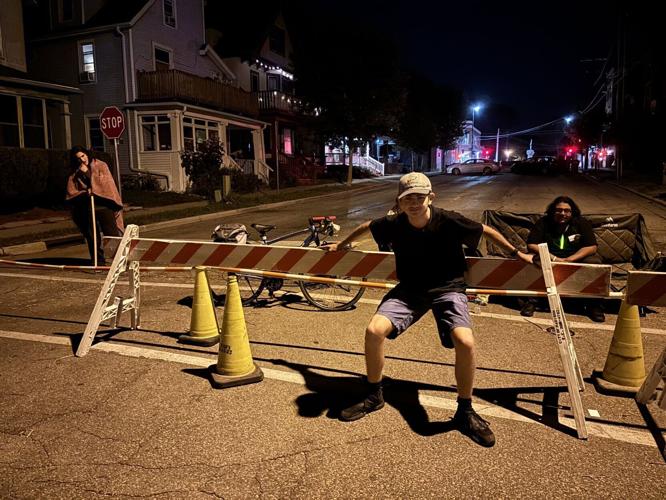
“No one's getting through here without a murder charge,” says Anderson Corcoran, 22, standing in front of the barricades the city erected blocking off South Baldwin Street at East Wilson Street, one block from Williamson Street.
He was speaking to a couple of others nearby, and to no one in particular. He had come to the gathering alone after hearing about it on the bus on the way home from his job on the South Side.
"Stay safe out there,” someone yells from a passing car.

“No one's getting through here without a murder charge,” said Anderson Corcoran, standing in front to the city barricades blocking off South Baldwin Street at Wilson Street, a block from the memorial.
Corcoran came, he says, "for Corey. I mean, the more people, the merrier. The more voices that are out here, the better."
He had intended to go home and play some video games but decided he'd rather show his support.
"The community just needs to come together," he says. "The more people that we have coming together, the stronger messages that we can get out. Because a lot of people that want things to change aren't stepping up for those changes to be made.”

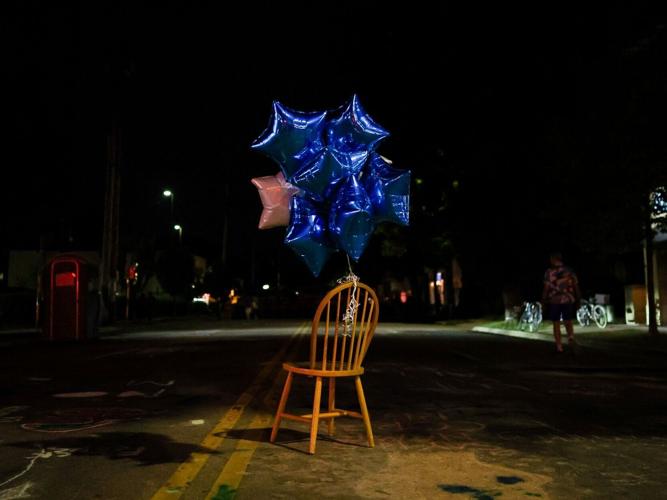
White and blue balloons, the colors Corey Ruiz was wearing when he was killed by a Madison Police Department officer, float in the wind, tied to an empty chair on Friday.
2 a.m.
The hour starts with a moment of silence.
Amanda Ottens, 40, sat in front of the warming fire with a small group of night owls on mismatched chairs between the Crystal Corner Bar and Lily Forest Designs across South Baldwin Street where on the glass door is scrawled "ALL POWER TO THE PEOPLE."
A smaller poster says "We stand with immigrant families." Three other signs are posted on the other door: "NO BUSINESS AS USUAL!! "Closed 7/24 and 7/25." A third sign simply says, "Justice for Corey Ruiz."
Ottens has lived on the block for 10 years, next to the Willy Street Co-op, and had help bringing over her fire pit to the encampment. She brought a large bin of wood, but others have replenished her supply and then some.
"I didn't personally know him, but that could have been anyone," she says about Ruiz. "Could have been any of us here. And I think that's what Madison doesn't realize. A lot of people seem to want to be upset with us right now, but we're trying to be peaceful, and we're trying to bring the community together because right now there are so many people who never get together for any other reason."
3 a.m.
About two dozen residents and activists remain in the intersection. The resolve of the smaller group is palpable as they chant “we’re still here” and “say his name.”
Christine Lawal leads the group in song with Whitney Houston’s “I Will Always Love You” and Nina Simone songs.
“If I see you smiling, that’s God’s work,” she tells the crowd.
A man who lives above the Crystal Corner and works in maintenance there carefully puts Ruiz’s name in black letters outside the marquee. He says he’s been at the corner nearly around the clock for days and heard the shots from his apartment.
“I haven't come down here and not seen, like, three plus people I know each time other than 4:30 in the morning,” he says.

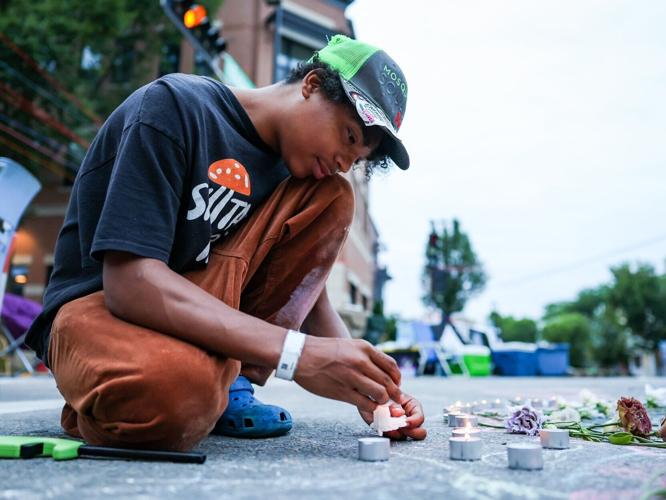
Trevor Ewing, who grew up in the Marquette neighborhood and was a friend of Corey Ruiz, lights candles at a memorial for him at the intersection of Williamson St. and S. Baldwin St. on Friday, July 24, 2026 in Madison, Wis. OWEN ZILIAK, STATE JOURNAL
4 a.m.
Activists work to keep the energy high in the wee hours of the morning with call-and-response slogans including “We ain’t going nowhere,” “Who are we here for? Corey!” and “Kill that killer cop.”
Among the 35 to 40 people is Elliott Gilfillan, 37, who says he came out because “I value human life, and what happened this week was another blatant disregard of that … and I can’t sleep.”
Gilfillan says the activists “demands have been set” and that when the officer who killed Ruiz is arrested, “we can allow this to become a street again.”
At around 4:15 a.m., Nashawn Davis, 25, walks around the site holding a bullhorn in one hand and the hand of a 7-year-old family friend in the other. “Imagine a 7-year-old Black boy having to look at this,” he says, while circling the main memorial to Ruiz. “It is a disgrace to our culture.”
“When will it stop?” he asks. When given a chance to hold the bullhorn himself, the boy says, “Rest in peace Corey.”
Kadin Hoger was grilling at the encampment on Williamson and South Baldwin streets from 2 p.m. Friday until 2 a.m. Saturday.
5 a.m.
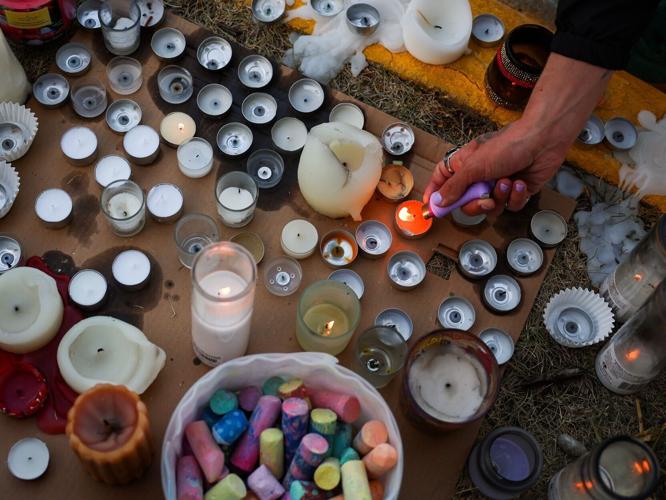
Beau Wiley, 22, is one of about six people manning tables stacked with donated household and first aid supplies and votive candles activists could add to the ever-growing memorial at the spot where Ruiz was killed.
He says he first started volunteering at the encampment at about 8 p.m. Wednesday and was there for about 40 hours before going home to rest for a while and then returning.
“I feel like having the ability to let people volunteer, to bring food, to make it a community thing that people also have the capacity to take care of themselves …. It’s just something where it helps really bring everything together. “

At 5:40 a.m., protesters with megaphones speak and lead brief chants as the sun rises on Saturday, July 25, 2026 in Madison, Wis. OWEN ZILIAK, STATE JOURNAL
While some find their purpose in the more prosaic aspects of a keeping a 24/7 protest going, Lawal again finds hers in song. The 45-year-old — who also goes by her artist’s name, Olutoy — sings rather than chants slogans and keeps up a steady cadence of songs known and that she made up on the spot.
“When I’m singing, I feel like I’m really heard,” she says. “I write songs like, you know, hurt pain or struggle — I want to get that across that divided we fall, united we stand.”
6 a.m.

Just after 6 a.m., Kieran Hauge lights candles around the edges of the memorial for Corey Ruiz. Hauge had stayed up all night at the memorial. OWEN ZILIAK, STATE JOURNAL
Around 6 a.m., the group of about 30 people stops for a prayer led by Rev. Ben Weger of the Stoughton United Methodist Church.
“God of many names, we come before you this morning and we’re tired, angry, sad,” Weger begins. The prayer ends with, “Let your peace and your presence still us and sustain us.” it ended.
An “important part of my job is to show up in spaces where oppressed and marginalized people are being harmed, to speak truth to power,” he says.
7 a.m.
Only a few dozen people occupy the intersection now, some just waking up and others having gone without sleep.
Having slept in a tent overnight, local performer Daezhare is preparing to sing, grieve and mourn alongside fellow community members for another day.
“There’s always someone here, which I’m very grateful for,” she says. “Everyone’s doing their part. Nothing has escalated to a point where police have to intrude. The care is here, and I think that’s what matters.”
8 a.m.
Candles placed in the street have largely burned to their wicks, leaving pools of wax in the cracks of the road. A breakfast of fruit, pastries, coffee and applesauce is served, though people had been grazing throughout the morning. Local businesses and community members drop off loads of food, water and other supplies.

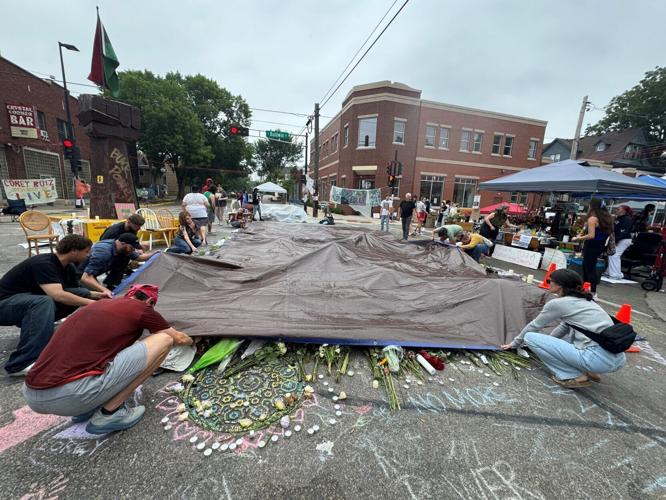
Community members clear glass vases and candles from the ground, preparing for a tarp to be put over the growing memorial as a light rain hit around 10:30 a.m.
9 a.m.
A man named Sam, who declined to provide his last name, beats a drum near the barricades.
“I’ve been putting in as much time as possible,” he says. “I just know that holding the space is the absolute most important thing … I was here the first night, I may have even been there when the memorial area was, like, the smallest it’s been.”
His job throughout the morning was to maintain the perimeter, keeping an eye out for any problems.
“This just has to stay exactly as it is as long as it needs to,” he says.

Protesters secure a tarp over the Williamson Street memorial for Corey Ruiz as a light rain falls.
10 a.m.
The overcast sky opens up a bit, sprinkling an almost imperceptible rain. Organizers gather the ends of a massive tarp, moving prayer candles and floral arrangements out of the way to avoid broken glass. Nashawn Davis’s exhausted voice crackles through the megaphone periodically to make announcements. Davis got to the protest around 10 p.m. Friday night, and plans on sticking it out for the long run.
“It’s a step-by-step process, but as we keep stepping and as we keep protesting, as we keep making sure that Corey’s name, Tony’s name, anybody who has been unlawfully shot by the police, that their deaths aren’t in vain,” Davis says.

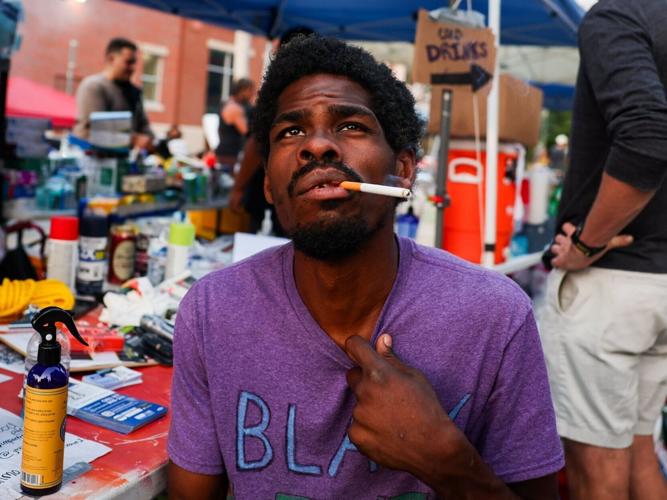
Maleyk Mason, who works with the Madison-based non-profit Freedom Inc. enjoys a cigarette as he takes a break from moving water and food for protesters on Friday, July 24, 2026 in Madison, Wis. OWEN ZILIAK, STATE JOURNAL
11 a.m.
Davis has stepped back up to the microphone, leading chants among a growing crowd now reaching more than 100 people. Many volunteers crouch to relight candles, a Sisyphian task with the morning breeze. Many people sing, some play music from their phones. Chaka Khan and Whitney Houston pour through the air.
The memorial for Corey Ruiz has been in place on Williamson Street since Wednesday, when Ruiz was shot dead by police there. It was still holding strong Saturday, with no sign of police or other means of removal. Protesters said they plan on staying as long as they can.
Noon
The now-uncovered memorial display grows as more people come with bouquets and flowers of their own. Many people lay orange Fanta cans at the site.
Volunteers make burgers, veggies and hot dogs. A few minutes later, Davis says the group s plianning on marching, though the details are still unclear.
Weger mingles with the crowd, offering comfort and assistance where he can.
“Even as we’re marching and demonstrating around the city, we are not seeing police presence,” he says. “They’re not coming out. It’s our hope that no one ever drives through this intersection again.”
State Journal reporters Teagan King, Sabine Martin, Zoey Thomas, George Wiebe, Noe Goldhaber, Samara Kalk Derby, Chris Rickert and Anna Hansen and photographers Amber Arnold and Owen Ziliak contributed to this report.

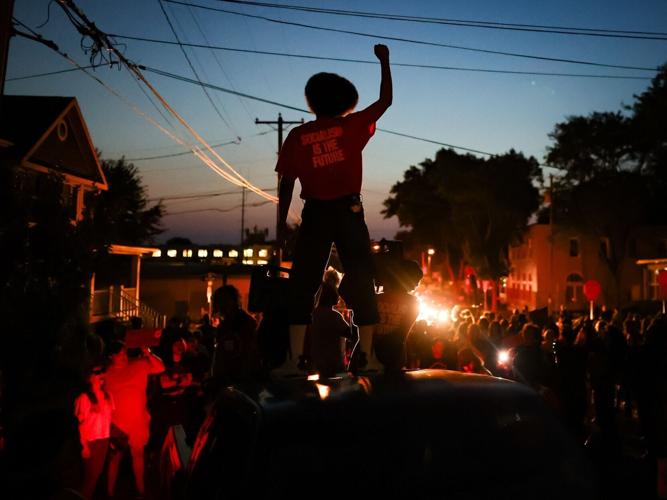
Just after 9 p.m. a protester raises a fist while standing on top of a vehicle after protesters returned from a march to the intersection of Williamson St. and S. Baldwin St. on Friday, July 24, 2026 in Madison, Wis. OWEN ZILIAK, STATE JOURNAL