


NEW YORK — In the winter of 2010, shortly after police discovered the remains of his roommate and three other women buried on a remote stretch of Long Island shoreline, Dave Schaller provided detectives with a description of the person he believed to be the killer.
More crucially, Schaller told them about the man's truck.
The man they were looking for was a towering, Frankenstein-like figure with an "empty gaze" who drove a first-generation Chevrolet Avalanche, Schaller recalled telling investigators. The man's size stuck out, as did his unusual pickup truck, which he'd used to flee the house Schaller shared with Amber Costello.
On that night, Schaller said he came home to find the stranger threatening Costello, an occasional sex worker, who locked herself in the bathroom. The two men came to blows, and the hulking intruder eventually left in the truck.
People are also reading…
Prosecutors say Costello was last seen alive Sept. 2, 2010, as she left her home to meet that same client. A witness saw a dark-colored truck drive by the house again shortly after she left.
"When they told me she was dead, he was the first person who jumped in my head," Schaller said. "I've been picturing his face for 13 years."
On July 14, police arrested Rex Heuermann on charges of killing Costello and two other women: Melissa Barthelemy and Megan Waterman. He is the prime suspect in the death of a fourth woman, Maureen Brainard-Barnes.
Heuermann, an architect who worked in Manhattan, pleaded not guilty to the charges.
The arrest marked a stunning breakthrough in the hunt for a serial killer who eluded investigators and whose crimes gripped Long Islanders since the bodies of four women — all of them sex workers — were found wrapped in burlap near Gilgo Beach.
Within months, the remains of six other bodies, including a toddler, were discovered elsewhere along the same beach highway. Heuermann has not been accused in those cases; police said the deaths may be the work of multiple killers.
The arrest brought a measure of relief to families of the victims at a moment when the trail appeared to have gone cold. However, as new details emerge about how police finally caught the alleged killer, they've also raised questions about whether investigators adequately pursued a key lead — Schaller's description of the stranger and his truck — that could have helped solve the case sooner.
"This was crucial information, and I don't know why they didn't share it," said Rob Trotta, a county legislator who worked as a Suffolk County Police detective until 2013. "They made some serious blunders here."
Suffolk County District Attorney Ray Tierney, who inherited the investigation when he took office in 2022, said the key to unraveling the case was the description of the truck, discovered by a state investigator after the launch of a new task force formed to take a fresh look at the evidence.
When they ran it through a vehicle records database, one of the results turned up a hit: A man who owned a Chevy Avalanche lived in a neighborhood that investigators were zeroing in on as the suspect's likely location because of a sophisticated analysis of cellphone location data and call records. Heuermann fit the physical description provided by Schaller, too: He was 6 feet, 4 inches tall and weighed 240 pounds.
Those involved in the case pointed to fierce divisions between the various law enforcement agencies — as well as overlapping scandals that engulfed Suffolk County — as a potential explanation for a key clue slipping through the cracks.
Tierney said he did not know why police had not run a search earlier but suggested the piece of information may have been "lost within a sea of other tips and information."
He stressed there were other elements that ultimately helped investigators arrest Heuermann, including new technology that helped match samples of DNA to the suspect.
"What solved this case was a lot of dedicated investigators, analysts and attorneys from a bunch of agencies getting together and collaborating," he said.
For Schaller, any feelings of relief over the arrest were soon eclipsed by anger and confusion.
Speaking out for the first time since the arrest, he said he met with homicide detectives on multiple occasions during the initial years of the investigation.
During one of their final meetings, roughly two years after the women went missing, he said he picked the truck's model out of a line-up of photographs provided by the detectives.
"I gave them the exact description of the truck and the dude," he said. "I mean come on, why didn't they use that?"
The question vexed some law enforcement officials as well.
Two high-ranking officials who worked closely on the case and attended briefings between 2011 and 2013 said they never heard anything about a witness statement describing the suspect and his vehicle. They spoke on condition of anonymity.
According to a vehicle history report, Heuermann bought the pickup — a dark green, first-generation edition — at a Chevrolet dealer on Long Island in 2002 and transferred ownership to his brother, Craig, in South Carolina in 2012.
Authorities seized the vehicle this month. In a search warrant, they said they were looking for other clues in the vehicle or at property the brothers owned in Chester County, South Carolina, and what they described as possible "trophies" — items that may have belonged to the victims, such as clothing, jewelry or photos.
A look at some of the most notorious serial killers in the US since 1970
1970-2005: Samuel Little

Samuel Little claims to have killed more than 90 women across the country between 1970-2005. The FBI said that federal crime analysts believe all of his confessions are credible, and officials have been able to verify 50 confessions so far. He says he strangled his 93 victims, nearly all of them women.
Little has been behind bars since 2012 and is serving multiple life sentences in California.
February-May 1971: Juan Corona

Juan Corona was convicted of murdering 25 farm workers whose bodies were found buried near Yuba City in northern California. Local authorities believe he may be responsible for several other murders.
Corona died in prison in March 2019.
1972-1978: John Wayne Gacy

John Wayne Gacy killed 33 young men and boys in suburban Chicago from 1972-1978. He was known as the "Killer Clown" because he often performed as a clown at fundraisers and children's parties.
Gacy was sentenced to death for 12 of the murders and was executed in 1994.
1974-1991: Dennis Rader

Dennis Rader, who called himself BTK for "bind, torture and kill," killed 10 people in Wichita, Kansas from 1974-1991. He sent letters describing his crimes to police and the media, which eventually led to his arrest in 2005.
Rader is currently serving 10 consecutive life sentences at a Kansas prison.
1975-1998: Robert L. Yates Jr.

Robert L. Yates Jr. was convicted of 13 counts of first-degree murder and one count of attempted first-degree murder in Spokane County, Washington, as well as two additional murders in Pierce County. The 13 women he killed in Spokane, were sex workers on the city's E. Sprague Avenue.
Yates's original death sentence was commuted to life in prison without the possibility of parole in 2018 after Washington abolished the death penalty.
1976-1977: David Berkowitz

David Berkowitz, also known as the "Son of Sam," killed six people and wounded seven others in New York City. He sent several taunting letters to police before he was caught in 1977. Initially, he claimed to be carrying out the orders of a demon that took the form of his neighbor's dog.
Berkowitz is serving six consecutive 25-years-to-life sentences.
1976-1986: Joseph James DeAngelo

Joseph James DeAngelo, a former police officer in Auburn, California, is suspected of being the so-called Golden State Killer. He has been arrested on four murder charges but is suspected of 170 crimes, including a dozen murders and 45 rapes between 1976 and 1986. He cannot be charged for the rape or burglaries due to statute of limitation laws.
1977-1978: Angelo Buono Jr. and Kenneth A. Bianchi

Cousins Angelo Buono Jr. (pictured) and Kenneth A. Bianchi, known as the "Hillside Stranglers" killed 10 young women in California in the late 70s. Bianchi also killed two other women in Washington state. The pair would often pretend to be undercover police officers to lure their victims into their vehicle.
Buono was convicted and sentenced to life in prison without parole. He died in prison in 2002.
Bianchi agreed to testify against Buono in exchange for leniency. He is currently serving life in prison and is also a suspect in three murders in Rochester, New York.
1977-1978: Ted Bundy

Ted Bundy was convicted of three Florida murders that occured after he had escaped from a Colorado jail. He eventually confessed to more than 30 murders in seven states, but the number of actual victims is unknown.
He was executed in 1989.
1978-1992: Jeffrey Dahmer

Jeffrey Dahmer, also called the "Milwaukee Cannibal" or the "Milwaukee Monster," killed 17 men and boys from 1978-1992. Sixteen of the murders took place in Wisconsin, with one occurring in Ohio.
He was sentenced to 16 consecutive life terms. Dahmer was killed in prison in 1994.
1978-1995: Theodore Kaczynski

Theodore Kaczynski, also known as the "Unabomber," carried out a series of mail bombings that killed three people and injured 23. He is serving a life sentence in Colorado.
1979-1981: Wayne B. Williams

Wayne B. Williams was convicted and sentenced to two life terms for killing two men in Atlanta in 1981. Police believed he may have been responsible for the deaths of at least 23 of the 30 children who were murdered in Atlanta between 1979-1981. He was never tried for any of those crimes.
Authorities announced in early 2019 that they would re-test some of the evidence related to the Atlanta Child Murders.
Wayne is currently serving a life sentence at Telfair State Prison.
1983: Henry Lee Lucas

Henry Lee Lucas was arrested on murder charges and confessed to police that he killed hundreds of people. He later recanted. Lucas was convicted of 11 murders. He was sentenced to at 10 life terms and one death sentence. Then-Gov. George W. Bush commuted that to life in prison, his only commutation as governor.
Lucas died in prison in 2001.
1984-1985: Richard Ramirez

Richard Ramirez, also known as the "Night Stalker" was convicted of killing 13 people during break-ins in the Los Angeles area. He was also convicted of five attempted murders, 11 sexual assaults, and 14 burglaries. A fourteenth victim who was also killed in 1984 was connected to Ramirez in 2009.
Ramirez died in prison in 2013.
1984-1985: Charles Ng and Leonard Lake

Charles Ng and Leonard Lake are suspected of raping, torturing and murdering between 11 and 25 victims at a cabin in the Sierra Nevada foothills. Ng was convicted of 11 of the murders and is on death row in California. Shortly after his arrest, Lake killed himself with cyanide pills that were sewn into his clothing.
1985-2007: Lonnie David Franklin Jr.

Lonnie David Franklin Jr., known as the "Grim Sleeper," was convicted in the deaths of nine women and a teenage girl in Los Angeles. Franklin was linked at trial to 14 slayings, including four women he wasn't charged with killing. Police have said he may have had as many as 25 victims.
He is on death row in California.
1989-1990: Aileen Wuornos

Aileen Wuornos, a rare female serial killer, was convicted of murdering six men while working as a sex worker along highways in central Florida. She claimed the murders were committed in self-defense and that the men either raped or attempted to rape her.
She was executed in 2002.
1989-1993: Joel Rifkin

Joel Rifkin is believed to have killed up to 17 women in New York City and Long Island. He was sentenced to 203 years in prison for the murders of nine women between 1989 and 1993.
His first victim, Heidi "Susie" Balch, was killed in 1989 but went unidentified until 2013. The identities of two of his suspected victims are still unknown.
1990-1993: Heriberto Seda

Heriberto Seda, also known as the "New York Zodiac Killer," killed three people and wounded four in New York City. He also sent cryptic messages to police and claimed to kill people based on their zodiac signs.
Seda was caught in 1996 after an unrelated shootout with police and is currently serving a 232-year sentence.
1997-1999: Ángel Maturino Reséndiz
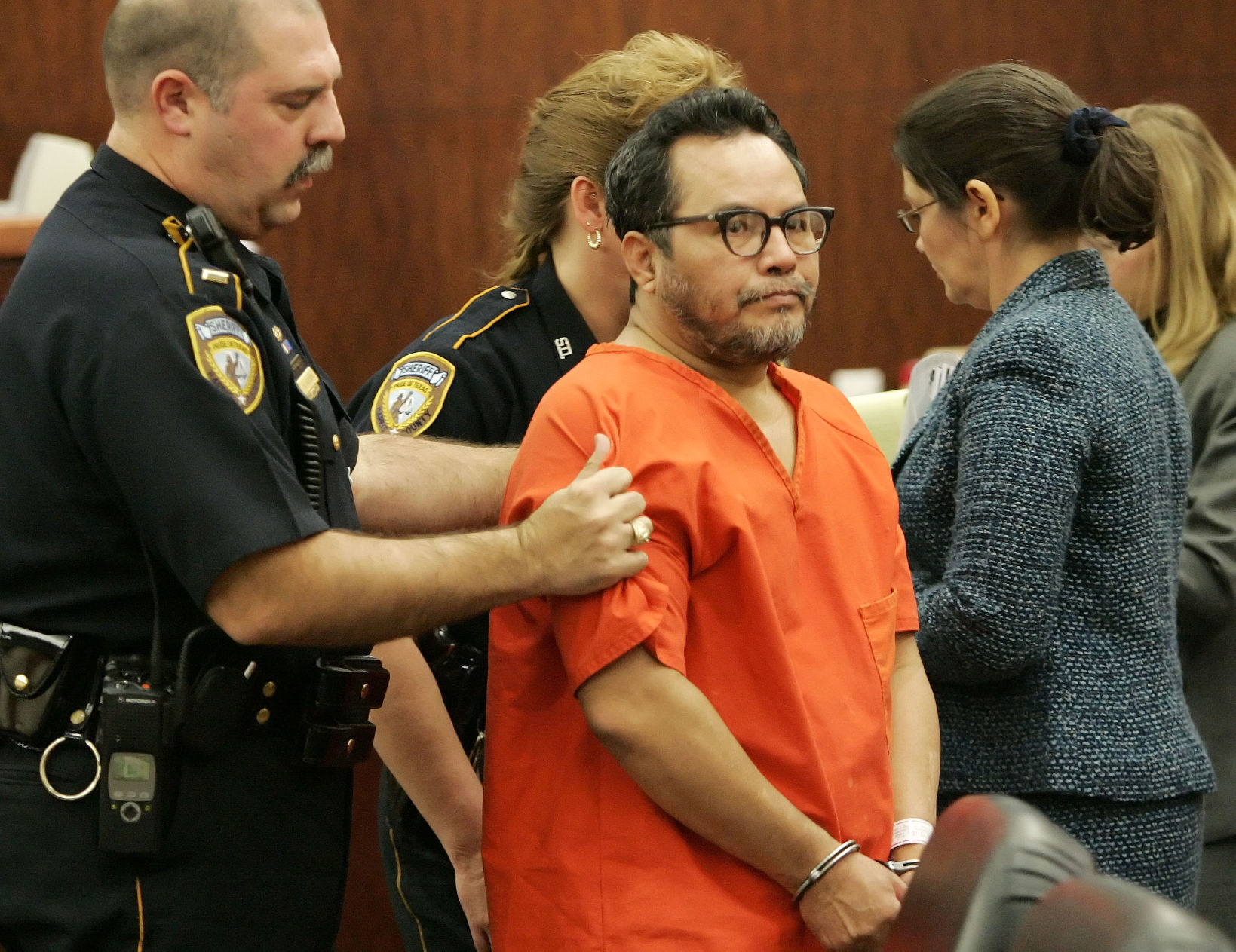
Ángel Maturino Reséndiz, nicknamed the "Railroad Killer" (also "The Railway Killer"), was convicted of murdering Claudia Benton, but was linked by confessions and evidence to at least 15 other killings nationwide. He also confessed to killing seven people in Mexico. Reséndiz was executed in 2006.
2002: Lee Boyd Malvo and John Allen Muhammad

Lee Boyd Malvo and John Allen Muhammad randomly killed 10 people in Washington, D.C., Virginia and Maryland as they pumped gas and went about their business during a three-week period in 2002. Malvo is serving several life sentences at a Virginia prison; Muhammad was executed in Virginia in 2009.
2005-2006: Mark Goudeau

Mark Goudeau, a former construction worker who was also known as the "Baseline Killer," was convicted of killing eight women and a man in Phoenix, Arizona. He was sentenced to death in 2011 and remains on death row.
2007-2009: Anthony Sowell

Anthony Sowell, known as the "Cleveland Strangler," was convicted of killing 11 women and hiding the remains in and around his home in Cleveland, Ohio. He is on death row in Ohio.
2014: Darren Deon Vann

Also known as the "Gary Strangler," Darren Deon Vann was arrested in the killing of a 19-year-old woman at a motel in Indiana and later confessed to the murders of six other women. He was sentenced to seven concurrent life sentences in May 2018.


