CHICAGO — At least once a month, Rita Leary incorporates food into a science lesson at Ashburn Community Elementary School. On a recent Thursday, it was all about honey.
The goal was to conduct a sensory exploration of honey samples native to Illinois, while hitting a core standard of food education: Food connects us, and food and the environment are interconnected.
Leary’s lesson was sparked by Pilot Light, an organization founded in 2010 that developed a food-based curriculum for educators to integrate lessons about food, nutrition and the food system into everyday subjects like math, science and reading.
“It’s not like, ‘Oh here’s a carrot and here’s why carrots are good for you,’ but instead we use food to learn more about science,” Leary said. “Everybody likes food. And the students are so engaged, calm and so polite with each other.”
People are also reading…

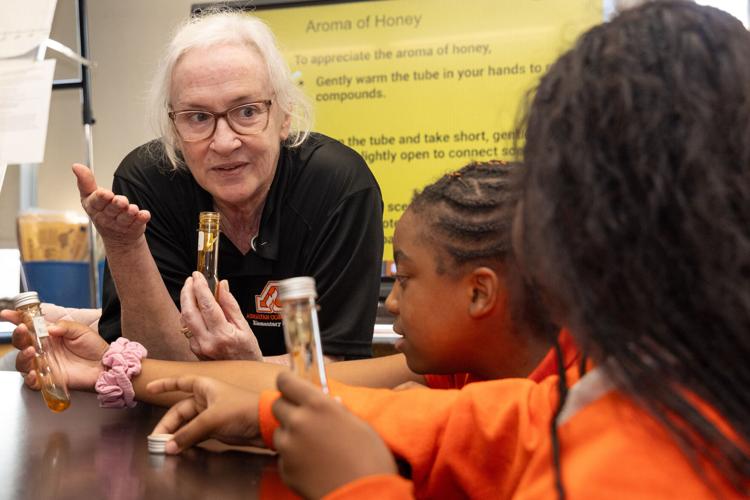
Teacher Rita Leary engages with her students during a Pilot Light-inspired food education lesson on Sept. 17 in her science classroom at Ashburn Elementary School in Chicago.
In September, Pilot Light launched an update to its Food Education Center, a digital hub of free pre-K-12 lesson plans and resources. The nonprofit, which started in a single Chicago classroom with local chefs, now partners with administrators, schools and teachers in 26 states. It also planned to launch its first chapter in New York City this fall.
Leary has used a mix of self-made lessons and digital curriculum from the organization for more than five years. She wants more educators across Chicago Public Schools to find the benefit in incorporating food into classroom learning.
On that recent Thursday, Leary’s sixth, seventh and eighth graders sat at lab tables in groups of four, watching as their science teacher promised a tasting of pumpkin honey, apple blossom honey, blueberry honey and clover honey. Each flavor corresponds to the plant the bees pollinated, she reminded them.
But first — a few tests, for science.

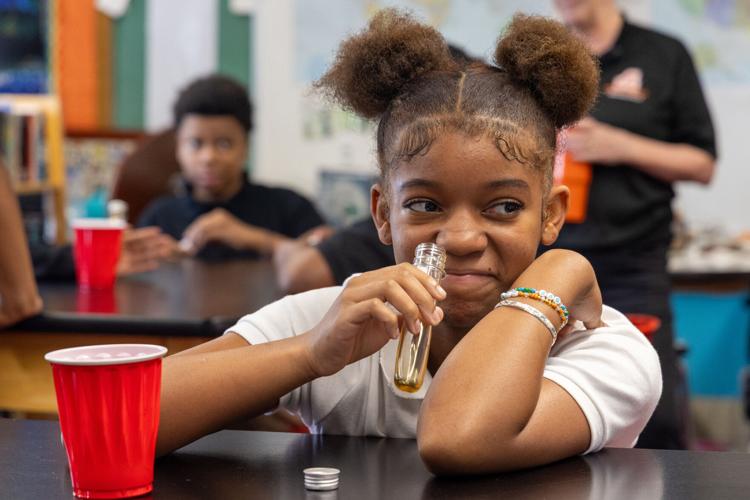
Eighth grader Taylor White smells a honey sample during a food education class Sept. 17 in Rita Leary’s science classroom at Ashburn Elementary School in Chicago.
Leary turned off the lights and asked her students to use mini flashlights to categorize the honey by shades. Then, to test each honey’s viscosity, the students flipped over the vials to see how quickly or slowly the honey flowed.
“Viscosity is thickness, how slow something flows — seventh graders, we’ll be talking about it a lot when we get to lava and volcanoes, because some lava is quite viscous,” Leary said.
She explained that when forager bees collect nectar from flowers, it’s almost 80% water. The worker bees fan their wings to make a phase change that turns it into that gooey honey texture.
Next, she asked the students to smell each sample.
“Oh my God, the pumpkin one smells like NyQuil, the honey NyQuil!” screeched Lia Henry, a seventh grader.
When it was time to taste each one, Henry confirmed that the dark-hued pumpkin honey tasted like NyQuil, too.
It was a “pretty cool” day in science class, seventh grader Tyjon Poole said, plus he never knew different kinds of honey could taste so unusual.
“If you really look and think about your tongue, it’s a map, right? All of those taste buds aren’t the same. They are chemical receptors, and they receive different kinds of chemicals,” Leary said, instructing the class to spread the honey on different parts of the tongue.
Though the honey project was her own, Leary said if it wasn’t for Pilot Light, she may have never thought to incorporate food into her science lesson plan, because the public education system doesn’t necessarily require food education.

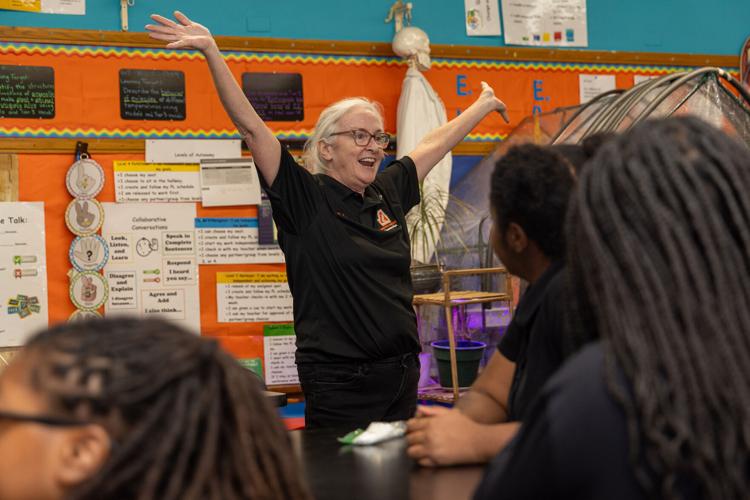
Science teacher Rita Leary teaches a food education lesson about bees and honey on Sept. 17 at Ashburn Elementary School in Chicago.
“And it’s not always eating — the next one for the sixth graders, because they’re looking at plant and animal cells, we’re going to see what cooking does to the cell wall,” Leary said. “A few years ago, when I was teaching social studies, we had a chef visit us through Pilot Light, and he gave a presentation on spices that traveled to Spain through North Africa, and that fit right in with our medieval history unit.”
Pilot Light’s ultimate goal is to make food education a part of every child’s learning, said Alexandra DeSorbo-Quinn, the organization’s executive director.
“What are all the ways in which we connect with food? What do we need to know about food? What is it we can do once we have all this knowledge? We can make different decisions. We can advocate,” DeSorbo-Quinn said. “There’s a lot of different ways in which food connects to our lives. You can teach anything through food.”

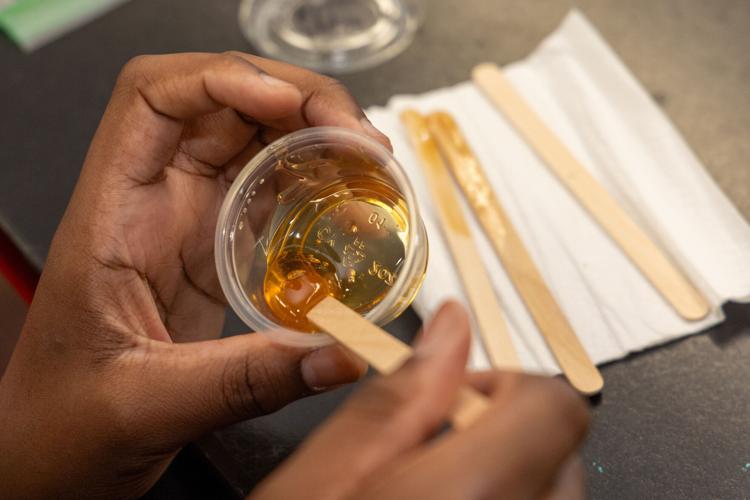
Tyjon Poole stirs a sample of honey during a food education class on Sept. 17 in Rita Leary’s science classroom at Ashburn Elementary School in Chicago.
Getting the Food Education Center to where it is now was a heavy undertaking, driven by teachers who were part of focus groups that helped shape more than 200 lesson plans designed by a team of chefs, farmers, medical experts and psychologists.
The resources cover an array of topics, including agriculture, astronomy, historical events, ecosystems, geometry, global challenges, sustainability and food insecurity.
Pilot Light now reaches thousands of educators and classrooms, but it didn’t start that way.
During the Obama administration, first lady Michelle Obama’s “Let’s Move!” campaign urged chefs to partner with K-12 schools to weave nutrition and food into everyday life. Some chefs also helped students build school gardens.
Before the plan materialized, Matthias Merges, chef and proprietor of hospitality group Folkart, was already working in classrooms at his daughter’s school, sharing insights about salmon farming, fish migration, how something goes from the ocean to someone’s plate and more. After he and other chefs went to Washington, D.C., for the launch of Michelle Obama’s “Chefs Move to Schools” program, they started to put a plan on paper.

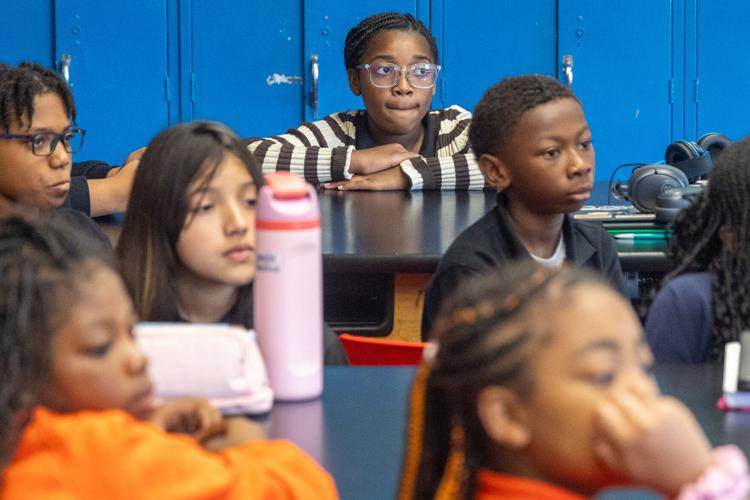
Students in Rita Leary’s science class listen to a food education lesson about bees on Sept. 17 at Ashburn Elementary School in Chicago.
Chefs took turns going to classrooms on select days, using food to teach a lesson.
“We’d email our list of teachers and ask, ‘What do you happen to be teaching that day?’” said Jason Hammel, chef and owner of Lula Cafe in Logan Square. “When the emails came back, like one classroom was doing fractions. OK, that’s easy. We’ll make a pie and cut it up, or make a recipe. But then we got the Boston Tea Party, or plate tectonics, or how magnets work … the different chefs had to figure out a way to use food to teach (it).”
Recently at Ancona School in Kenwood, educator Christopher Weber brought together 80 elementary students, parents and teachers for a day of learning and cooking to fill their neighborhood’s Love Fridge with homemade soups and bread, with custom labels to promote allergy safety and raise awareness of food insecurity in their community.

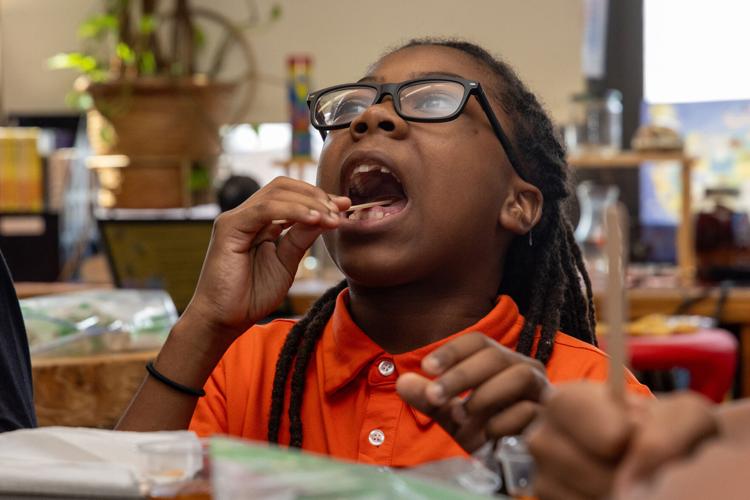
Seventh grader Da’Sean Mackey tastes a honey sample during a food education class on Sept. 17 in Rita Leary’s science classroom at Ashburn Elementary School in Chicago.
At Langston Hughes Elementary in Roseland, STEM teacher LaTina Taylor spearheaded a project that became one of the most cherished stories within Pilot Light. K-8 students spent the year caring for a flock of chickens in their school coop — a hands-on “living textbook” that taught them about agricultural responsibility, animal husbandry and sustainable closed-loop food systems.
However, the students encountered a harsh reality of farming midyear when predators breached the coop overnight, killing four chickens. The students then moved to safeguard the sole surviving chicken, using their STEM training to build him a secure, predator-proof “fortress.”
As Pilot Light continues to grow, the crux of it has been the same since day one, DeSorbo-Quinn said.
“We were founded with this idea of food being a common language,” she said. “There are only a few things that will universally engage people, and food is one of them. It’s an extraordinary teaching tool.”