At a play kitchen stove and classroom tables covered with animal figurines, laminated labels identify the names of toys in English and Bengali at the Wayne Metropolitan Community Action Agency Mitchell Head Start Center in Hamtramck, Mich.
Bengali is spoken by almost 90% of the 146 preschoolers enrolled there. Teachers and staff say toggling between the two languages is necessary to help bilingual children feel comfortable and excel.
Which is why they’re worried about how an English-only instruction mandate for Head Start, proposed by President Donald Trump’s administration, could change the way programs operate across the U.S. Children who speak non-English languages at home make up one-third of enrollment nationwide in the federal program, which provides free early education for low-income kids and other family services. In Michigan, it's almost 15% or about 4,000 children.
People are also reading…

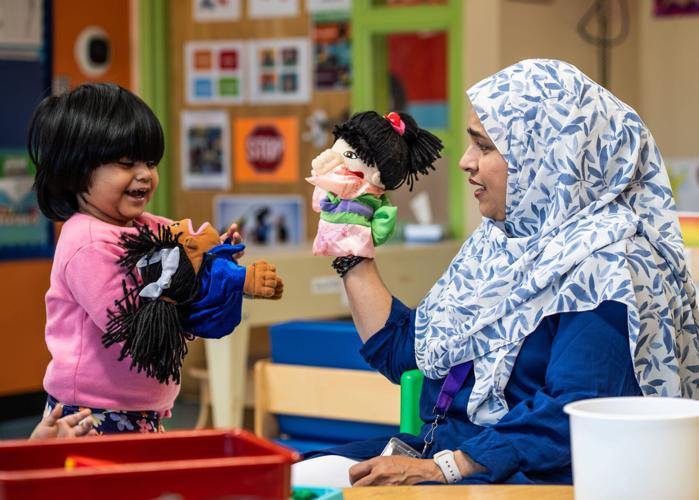
Teacher’s assistant Zutsnara Rahman, right, uses a puppet Oct. 5 with Aliza Ahmed at Mitchell Head Start Center in Hamtramck.
The change could mean teachers will no longer be allowed to talk with preschoolers in their native language and all classroom materials would be English-only. Experts warn the change would leave dual-language learners worse off.
“When I read a book in English, and I see they are not paying attention, not listening, they are all over the place because they don’t understand the book? Then we do it in our language and explain to them,” said Nahida Akther, a lead teacher in a 3- to 5-year-old Head Start classroom at Mitchell. “It’s comprehension. If they don’t understand, what’s the point of reading the book?”
Trump administration officials said the proposal’s purpose is in line with the Republican president’s 2025 executive order “Designating English as the Official Language of the United States.”
This would increase kids’ ability to learn and speak English, according to the proposal, in addition to other potential benefits like simplifying classroom curriculum and helping a child assimilate into their community and eventually access opportunities.

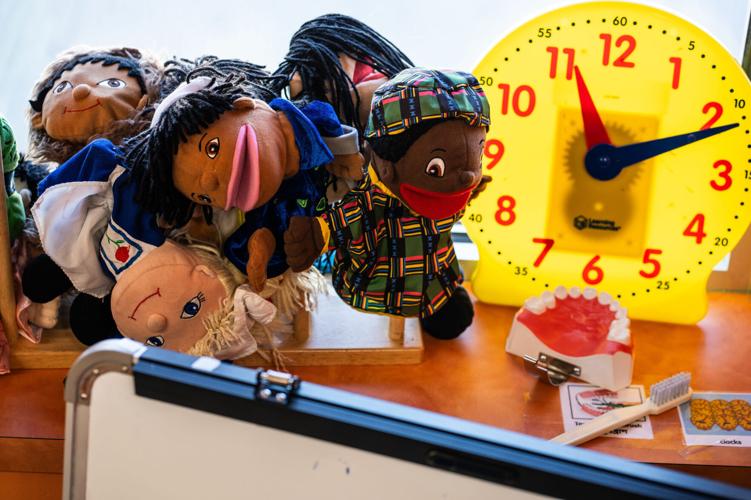
Puppets sit in a pile Oct. 5 in a classroom at Mitchell Head Start Center.
“Head Start is a school-readiness program. The goal is to help children enter kindergarten able to participate fully in English-language classrooms and the broader community,” Alex Adams, assistant secretary at the federal Administration for Children and Families, told Education Next.
The proposal notes programs could submit waivers to continue bilingual education, though there aren't specific details on what would qualify and some program directors expressed doubt that the administration would approve them.
The English-only mandate is part of a broader proposal overhauling Head Start regulations the Trump administration published in August. It also aims to roll back hundreds of Head Start rules that dictate program standards, such as the allowable staff-to-student ratios in classrooms. The goals are to reduce burdensome regulations, open more seats for kids and cut spending, officials say.
English-only instruction would make it harder for kids to learn English, teachers and experts say.
Kids commonly get misdiagnosed with speech delays due to language barriers, said Minuwawa Whitehead, assistant director of operations at Mitchell Head Start. This is one of the reasons she feels it’s essential to have bilingual staff in each classroom. This allows kids to express themselves and engage in the classroom in their language, building confidence and acquiring English skills.
Teachers thought a 4-year-old, enrolled at Mitchell Head Start since she was about 18 months old, might have a speech delay because she was mostly nonverbal in class, said Akther, her current preschool teacher.
“Since most of the communication around her was in English, she was not responding or communicating verbally in English,” Akther wrote in an email.
The girl was tested and evaluated through the school district. It became clear she didn’t have a speech delay, because she spoke and communicated in Bengali, Akther said. She just hadn’t yet developed English language skills.
“Once she had the opportunity to speak and communicate in Bangla, it became clear that she was able to communicate well,” Akther wrote. “As she gained confidence and understanding in English, she became more comfortable speaking English as well. She is incredibly chatty and confident in English now!”

A Bengali translation is printed under English words Oct. 5 in a Mitchell Head Start classroom.
Akther speaks Bengali, the language of the majority of kids in her classroom. Zutsnara Rahman, her assistant teacher, speaks Arabic, the second-most commonly spoken language at the center. They conducted a recent class — activities, songs and instructions — in English but, as needed, could switch to a child’s home language.
That’s often necessary and goes hand in hand with consistent repetition of English translations so children comprehend what they're learning, which opens the door to acquiring English, Akther said. She said she's seen kids, once able to fully express themselves only in Bengali, a few months later saying the same sentences in English.
Acrisio Pires, a professor of linguistics and researcher at the University of Michigan who studies bilingual language development, said several large studies that looked at dual language programs across the U.S. found children, given the opportunity to be educated in their home language and English, have better outcomes.
“They not only learn the other language, the language they speak at home, but they have better outcomes in development of the English language and also other subjects as well,” like math, Pires said.
“They do better than kids just forced in an English-only system,” he added.

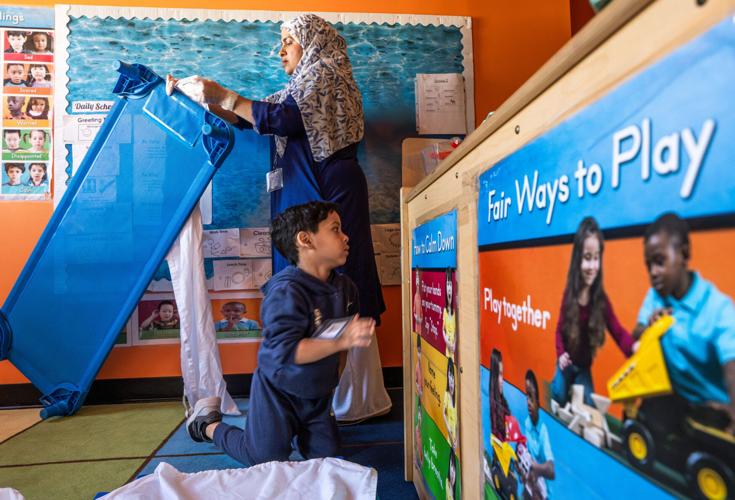
Teacher’s assistant Zutsnara Rahman, right, applies a sheet to a cot for a student to take a nap after having a meal Oct. 5 in a Mitchell Head Start classroom.
Part of the need to move between languages is also simply to comfort children or correct their behavior, which allows teachers to keep classrooms running smoothly, said Carla Chinavare, executive director of family services at Wayne Metropolitan Community Action Agency, the organization that runs Mitchell Head Start.
DeAija Kaigler enrolls parents and connects them to services, including GED and English as a Second Language classes, at Mitchell. If the English-only mandate takes effect, she predicts she'll have a lot of trouble getting parents to enroll their kids.
“If the families are not comfortable with where they’re sending their children,” she said, “they’re not going to send them there.”

The federal Administration for Children and Families, which oversees Head Start, is reviewing more than 30,000 public comments on the proposal, many of which push back against the requirement. The ACF must consider comments and respond to them, but doesn't have to amend the proposal.
A final rule change likely won't be seen until December or January, said Chanda Hillman, executive director of the Michigan Head Start Association, a nonprofit that represents Head Start grantees in the state.
If it is adopted, Head Start centers would have to comply within a given timeline or their funding could be stripped.
They’d also need to retrain or replace staff, as current regulations require programs to have staff members who speak the non-English language spoken by the majority of their students. Tribal Head Start locations would be exempt.