BEIRUT — The Iran war reached a costly stalemate.
Six months after the United States and Israeli forces attacked Iran on Feb. 28, killing its supreme leader and maiming his son and successor, the Iranian government is under economic siege but still holds power and believes it has time on its side.
U.S. President Donald Trump’s threat to impose crippling new sanctions on Iran faces a fundamental problem: Tehran is betting he will not take the final step to break the stalemate: aggressively enforcing secondary sanctions on the countries keeping its economy afloat, foremost among them China and India.
Washington's latest measures, announced Monday, mark a new phase in the conflict, shifting the battlefield from missiles and airstrikes to Iran's oil revenues, banks and trading partners.
Treasury Secretary Scott Bessent said the U.S. will cut off the financial lifelines sustaining Iran's economy, while a U.S.-led naval blockade restricts Tehran's oil exports and access to hard currency.
People are also reading…
"The (Trump) administration is groping in a sort of desperate fashion to try to find a pathway out of this,” said Aaron David Miller, a former U.S. diplomat and senior fellow at Carnegie Endowment.
Bessent invoked the 1944 D-Day landings in France during World War II when he unveiled the sanctions.
"To me, this isn’t D-Day,” Miller said. “It’s Desperation Day. I don’t think the administration is any closer to finding a way out of this.”

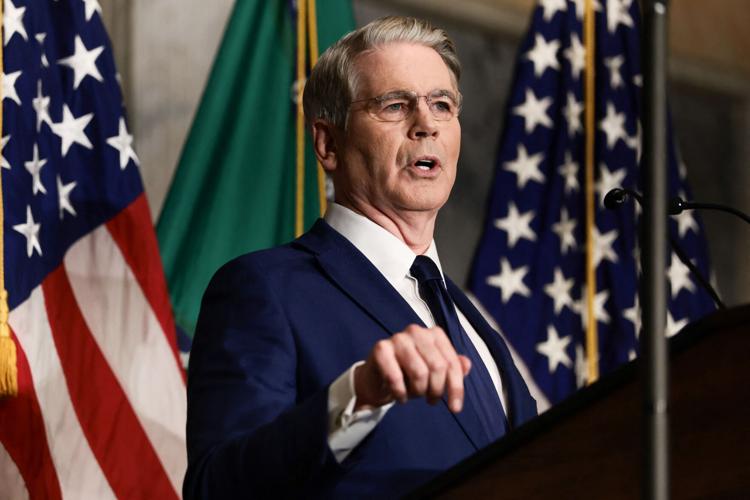
Treasury Secretary Scott Bessent speaks Monday at the Treasury Department in Washington during a news conference to outline further sanctions against Iran.
Blockade and sanctions
Michael Knights, head of research at New York-based strategic advisory Horizon Engage, said the blockade may prove more consequential than the sanctions because Iran's immediate challenge was no longer how to survive economic pressure but how to break out of it.
Tehran spent decades adapting to and enduring sanctions without altering its behavior, he said. Mounting economic pressure, he said, may increase Iran's incentive to raise the cost of the confrontation for its adversaries by pressuring Persian Gulf states, particularly Saudi Arabia, to push Washington toward a diplomatic off-ramp.
Knights said Iran could increasingly adopt the model used by its Houthi allies in the Red Sea: periodic attacks, intermittent negotiations and a prolonged campaign of disruption short of all-out war, potentially targeting shipping, ports, energy infrastructure or other critical assets to make the conflict increasingly costly for Gulf states to tolerate.
Washington rejects that assessment and says the balance of power is in its favor.
"The Iranian economy is in free fall and the regime’s military has been decimated," U.S. State Department spokesperson Tommy Pigott said in response to questions for this article. “President Trump holds all the cards, and we are cutting off every financial lifeline the regime has remaining.”

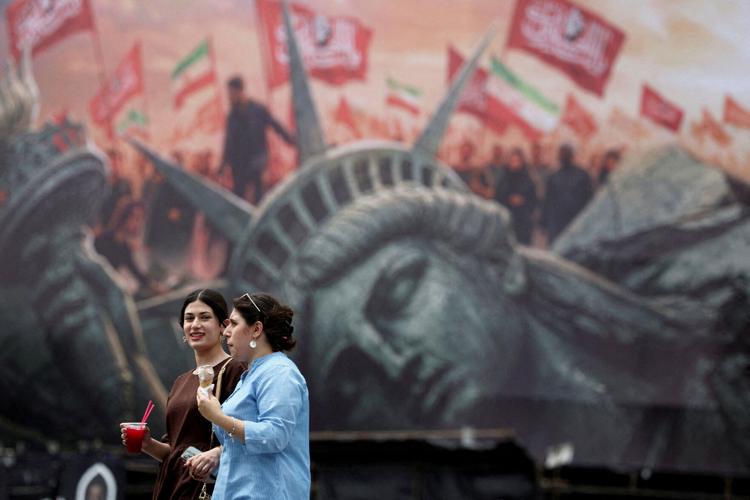
People walk past an anti-U.S. billboard Aug. 3 on a street in Tehran, Iran.
Iranian officials dismiss US strategy
Alan Eyre, a former U.S. diplomat who worked on Iran, questioned whether Washington has the international support and bureaucratic machinery to make the sanctions stick.
He said unlike the multilateral campaign preceding the 2015 nuclear deal between Tehran and major powers, which curbed Iran's nuclear program in exchange for lifting sanctions, the latest measures rely on public threats rather than sustained diplomacy with allies and trading partners.
Iranian officials dismiss the U.S. strategy as a replay of a failed playbook. One senior Iranian official said countries such as China would not stop cooperating with Iran simply to serve U.S. interests.
Some political analysts say the strategy faces a deeper flaw: from North Korea to Russia and Iran itself, sanctions rarely forced governments to abandon goals they view as existential for their survival.
The senior Iranian official said Tehran believes Washington's broader objective is to fuel domestic discontent in the hope that economic hardship eventually could translate into political unrest, but the "maximum pressure" campaign failed during Trump's first term and would fail again.
"If the pressure increases, Iran's approach will change too," he said, adding Gulf Arab governments understood that squeezing Tehran further could put them at greater risk as well.
Americans are feeling less confident about the economy, with consumer sentiment falling to its lowest level in seven months.
Threat of unrest for Iran's leaders
For Iran’s rulers, the biggest threat may be the risk that worsening hardship again spills into mass unrest, according to insiders and an Iranian official.
Annual inflation reached 66% in July, while consumer prices were 87.9% higher than a year earlier, according to Iran’s Statistical Centre. Food prices rose 128% year over year.
President Masoud Pezeshkian acknowledged the severity of the squeeze last week, saying: “Our problems have multiplied several times over, while our income has also fallen.”
Economic grievances repeatedly erupted into nationwide protests in recent years. Iran’s leadership historically answered domestic unrest with repression, and external pressure with threats of retaliation abroad.
In January, demonstrations over economic hardship were crushed by the Revolutionary Guard and the Basij militia, with thousands killed.
The appointment this month of Hossein Taeb, a key architect of previous crackdowns, to lead the Basij was one of the clearest signs yet of official concern about renewed unrest, a former reformist official said.

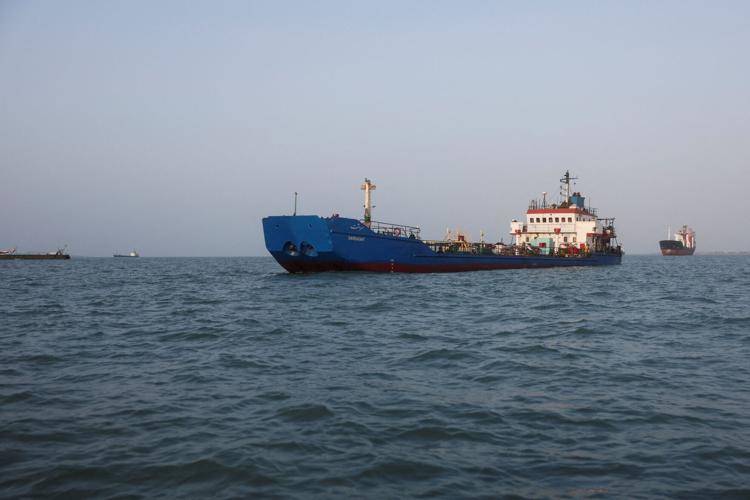
Vessels are spotted Thursday in the Strait of Hormuz near the beach of Bandar Abbas, Iran.
'Dangerous impasse'
Washington wants Iran to abandon its leverage over Hormuz without conceding Tehran a role in managing the waterway, while Iran wants the U.S. naval blockade lifted without appearing to surrender.
Gulf states prefer economic and diplomatic pressure to another round of war, but fear an outcome that would enable Iran to declare victory while retaining the ability to disrupt traffic through the Strait of Hormuz, a vital global oil supply route that Tehran effectively blocked, pushing up global oil prices.
Abdulaziz Sager, chairman of the Saudi-based Gulf Research Center, said Gulf governments are unconvinced that sanctions alone can rapidly alter Iran's behavior. Significant political change, or the collapse of Iran's theocratic leadership, he said, is unlikely to come quickly.
The result is a dangerous impasse if mediated talks fail to produce a breakthrough.