NUUK, Greenland — European Commission President Ursula von der Leyen unveiled plans Monday for $232 million of EU investments in Greenland and closer ties with the Danish Arctic territory, which U.S. President Donald Trump has insisted should belong to the United States.
EU Commission President von der Leyen is expected to announce investments and closer ties with Greenland.
Von der Leyen arrived in Greenland on Sunday for a two-day visit serving as a show of support for the governments of Greenland and Denmark, which have strongly rebuffed Trump’s campaign to acquire the world’s largest island.

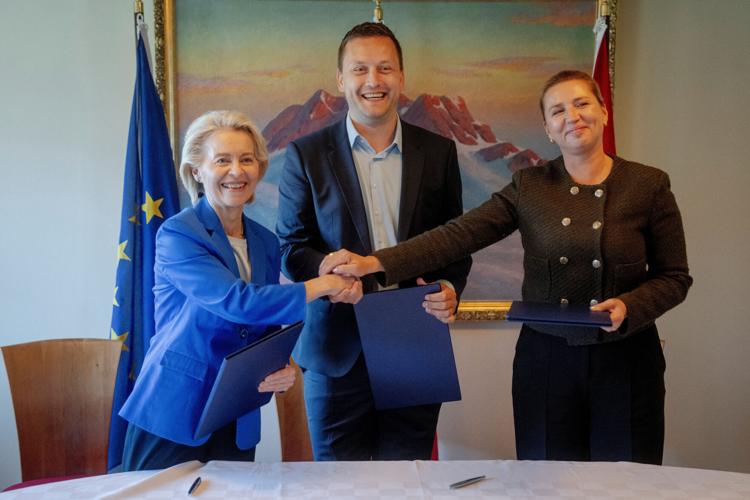
Danish Prime Minister Mette Frederiksen, President of the European Commission Ursula von der Leyen and Greenland's Prime Minister Jens-Frederik Nielsen react Monday after signing a joint declaration in Nuuk, Greenland.

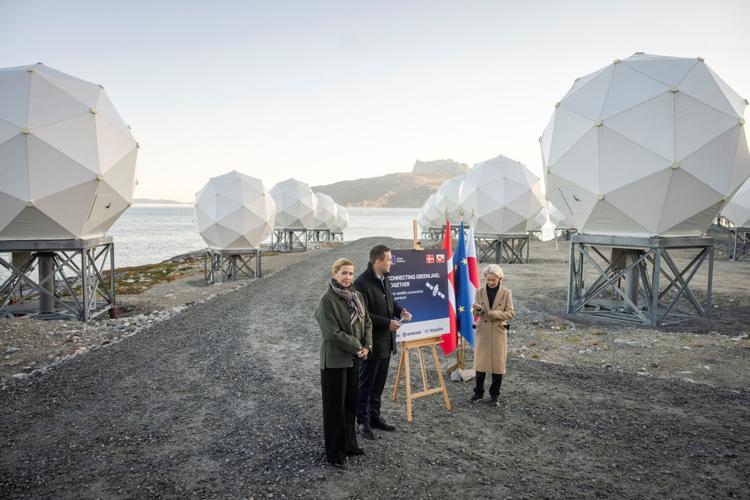
Danish Prime Minister Mette Frederiksen, President of the European Commission Ursula von der Leyen and Greenland's Prime Minister Jens-Frederik Nielsen visit the company Eutelsat OneWeb on Monday in Nuuk, Greenland.
The head of the 27-nation European Union's executive body said the EU money would focus on sectors including critical minerals, satellite communications and renewable energy in Greenland, a semi-autonomous part of the Danish realm.
"The EU stands in full solidarity with the Kingdom of Denmark and the people of Greenland," von der Leyen told a news conference. "We will continue to do so."
People are also reading…
Von der Leyen's visit reflects the increasing geopolitical importance of the Arctic to major powers, such as the United States, Russia, China and Europe, as melting ice opens new shipping routes to make the region’s mineral wealth more accessible.
The European Commission chief, who took a boat trip on Sunday in a fjord scattered with chunks of ice, posted on social media how she was struck by Greenland's stunning landscapes, but aware of the "visible scars of climate change."
"As the ice melts, a new reality is taking shape," she wrote.
Trump sparked a crisis in U.S.-European ties and turmoil within the transatlantic NATO military alliance this year when he stepped up his demands for the U.S. to control Greenland, arguing that fellow NATO member Denmark could not defend it.
European officials stressed Greenland is part of NATO territory, meaning it is covered by the alliance’s mutual defense pact, and that the U.S. already has the right to increase its military presence there under a longstanding treaty.
Tensions lowered after Trump and NATO boss Mark Rutte agreed in Davos in January that the United States, Denmark and Greenland would begin talks to resolve their differences and NATO would step up its role in Arctic security.
However, the trilateral talks have yet to yield an agreement and, at a NATO summit in Turkey in July, Trump restated his insistence that the U.S. should control Greenland.
Von der Leyen said Greenland's future was for the people of Greenland and Denmark to decide and no one else.
"The Arctic has become one of the places where the tectonic plates of geopolitics collide. We have a direct stake in what happens here," she said, adding that her Commission would set out a new EU Arctic strategy in the coming months.
While Denmark is a member of the EU, Greenland left the bloc in 1985. But its people, as Danish citizens, are also citizens of the EU.
The EU has long provided funding to Greenland, mainly to pay for fishing rights and support its education system. The $232 million investment package represents not only a big increase in funding but a broadening of the sectors that will receive EU cash, according to EU officials.
Russia and China are making a major Arctic shipping push as geopolitical tensions with the United States intensify. Russian President Vladimir Putin and Chinese President Xi Jinping are deepening cooperation in the Arctic, with the Northern Sea Route emerging as a key strategic trade corridor between Asia and Europe.The development comes as U.S. President Donald Trump continues to focus on Greenland and the wider Arctic, where shipping routes, natural resources and military positioning are becoming increasingly important.Russia sees the Northern Sea Route as a critical economic and strategic corridor, while China has shown growing interest in Arctic trade and infrastructure. The expanding Moscow-Beijing partnership could challenge Western influence in the region and reshape the future of Arctic shipping.At the same time, Russian Foreign Minister Sergey Lavrov has accused NATO of militarizing the Arctic and warned that Moscow could respond to hostile actions with asymmetric measures. #Russia #China #Putin #XiJinping #Trump #Greenland #Arctic #ArcticShipping #NorthernSeaRoute #RussiaChina #NATO #Geopolitics #USRussia #USChina #GlobalTrade #ArcticRoute #WorldNews #InternationalNews #BreakingNews