

Sometimes the connection is intuitive.
So far this spring, there have been dominating heat waves in different parts of the world. At the end of April, Spain and Portugal surged more than 30 degrees hotter than normal, reaching 100 degrees. Numerous locations in Japan have had their hottest single May day on record — between 90 and 96 degrees.
But recent heat waves in western Canada and South Asia have made bigger news.
Although May is wildfire season in the Canadian province of Alberta, hot and dry conditions there have enabled wildfires to grow and spread dramatically — with the smoke from the fires reaching into Kentucky and Virginia.
In addition to the heat in Alberta and neighboring British Columbia, temperatures have reached into the 80s into the western part of Canada’s Northwest Territories, which sit at the same latitude as Alaska.
People are also reading…
On the other side of the globe, a massive heat wave hit South Asia at the end of April. Some all-time records were set from India to Thailand, with the Thailand city of Tak reaching 113.7 degrees — a national record.
Heat waves are not new, but their frequency and intensity have deepened as the climate has warmed. Figuring out how much climate change affected any particular heat wave requires an understanding of the local climate and accurately simulating the past and current climate.
In this way, connecting a specific heat wave to the warming climate is not a binary proposal, but one that deals in probabilities. A recent evaluation of the South Asian heat wave from the scientists at the World Weather Attribution (WWA) team suggests heat waves of this magnitude over India and Bangladesh are now 30 times more likely than during the climate of a century ago.
This particular WWA study was a comprehensive collaboration of 22 scientists from Africa, Asia, Australia, Europe and the United States. Friederike Otto is among the veteran scientists on the WWA team and senior lecturer at Imperial College in London. She is also concerned about the high humidity that often accompanies these heat waves.
“We see again and again that climate change dramatically increases the frequency and intensity of heat waves, one of the deadliest weather events there are," Otto said in a news release. "Still, heat action plans are only being introduced very slowly across the globe. They need to be an absolute priority adaptation action everywhere, but in particular in places where high humidity enhances the impacts of heat waves.”
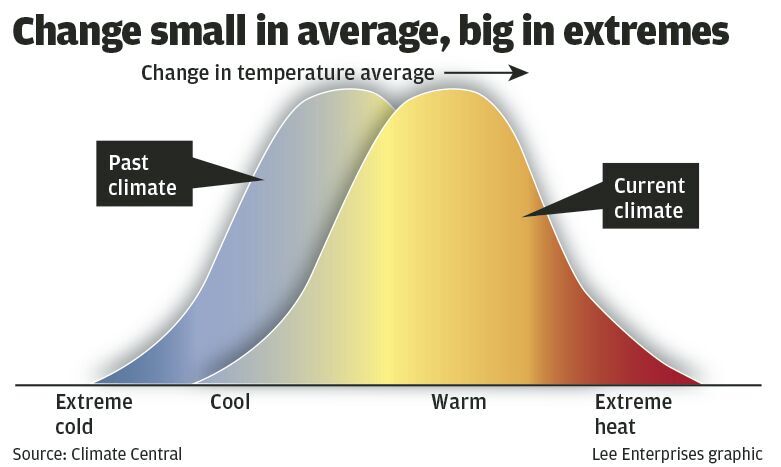
Although there is variability within the climate of any region, some of the fundamental statistics are straightforward — a small increase in average temperature leads to a disproportionate increase in the occurrence of extreme heat.
If the climate were not warming, the number of record highs and record lows would happen with about the same frequency, but the number of new record high temperatures is far outpacing new record lows. That is also seen very dramatically in the last few decades in the United States.
There will still be occasional record cold in a warming climate, but the intensity, extent and duration of cold will all decrease as the climate warms.
Other extreme events — which are admittedly more visually striking — have connections to the warming climate, but their connection is not as direct. And in some cases, the connection is not clear at all.
Tornadoes, hurricanes, hailstorms and winter storms all have more indirect influences. Droughts and extreme rainfall are more closely tied to the warming climate with a few caveats. But the basic air temperature is one of the strongest connections.
Coming back to North America, and using a more straightforward statistical analysis from the science team at Climate Central, the May heat in western Canada is about four to five times more likely as a result of the warming climate. It certainly could have happened in the climate of a century ago, but the background warming has made it much more likely.
Not everyone on Earth warms evenly, but as the Earth continues to heat up from the accumulation of greenhouse gases from fossil fuel burning, the average temperature will continue to rise. Combined with a recurring warming of the Pacific Ocean now underway, known as El Niño, expect the next couple of years to be among the five warmest on the global record.
No matter where you are in the next couple of years, the odds will favor warm over cool. And those odds will continue to mount in the decades that follow.
Sean Sublette is the chief meteorologist for the Richmond Times-Dispatch in Virginia.


