SAN FRANCISCO — Bus drivers shuttle America’s children to schools where cafeteria workers feed them and teacher aides assist students who need the most help.

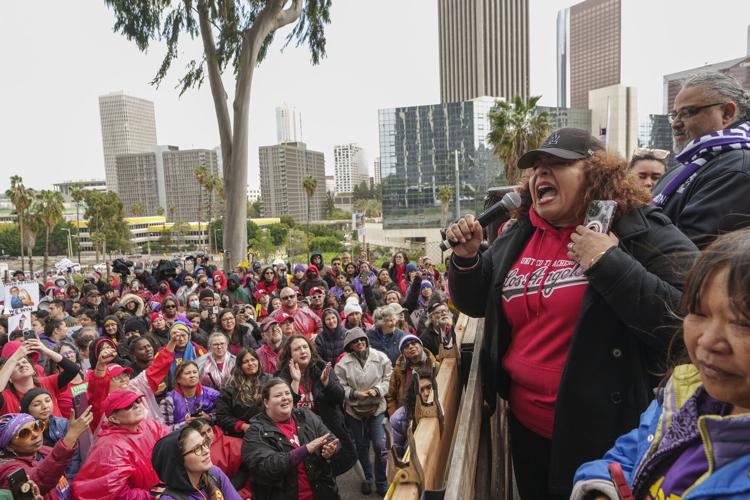
Cecily Myart-Cruz, United Teachers Los Angeles, UTLA President, with Max Arias, executive director of the Service Employees International SEIU Local 99 union, speak to thousands of Los Angeles Unified School District teachers and SEIU members rallying outside the LAUSD headquarters Tuesday in Los Angeles.
And their pay is notoriously low. School support staffers earn, on average, about $25,000 a year in Los Angeles, barely enough to get by in one of the most expensive cities in America.
The pay is a driving factor behind a three-day strike that has shut down the entire Los Angeles school system and put a spotlight on the paltry pay of support staff that serves as the backbone of schools nationwide.
Even outside pricey California, the school gigs often don’t pay enough to live on.
Arthur Anderson, a school worker in Virginia, says it’s a shame it took a walkout to draw attention to the longstanding problem, but he hopes it helps.
People are also reading…
“People are so frustrated. We all are,” said Anderson, a teacher’s assistant in the Chesapeake Public School System where he has worked for 30 years and makes $32,000. He works three other part-time jobs to make ends meet. “I struggle to pay my rent. I struggle to pay my bills,” he said. “I love what I do. I just don’t love what I get paid.”
Anderson works 36 hours as a special education aide in his school’s science department. But he is also asked to fill in as a bus driver and a custodian. When a science teacher is absent, he fills in as a substitute, which pays an extra $10 per class. “I did that today. I got an extra $20.”

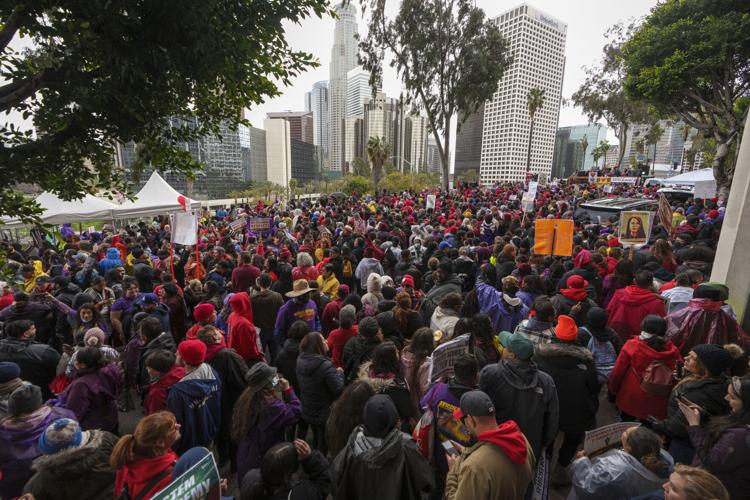
Thousands of Los Angeles Unified School District teachers and Service Employees International Union 99 members rally outside the LAUSD headquarters Tuesday in Los Angeles.
The strike against the Los Angeles Unified School District that started Monday has been led by the teachers’ assistants, custodians and other support staff who are among the district’s lowest-paid workers. They’re demanding better wages and increased staffing. Teachers joined the picket lines, in a show of solidarity that forced the district to close schools in the nation’s second-largest district that serves a half-million students.
School support staff around the country tell stories of spending entire careers in public education, filling jobs that keep schools functioning. Yet, many are not making a living wage and like the striking workers in Los Angeles cannot afford to live in the communities where they work.
“The issue in Los Angeles is not confined to Los Angeles. It’s an issue across the country and it has been decades in the making,” said Princess Moss, vice president of the National Education Association, which represents about half a million educational support staff.
The NEA, the nation’s largest teachers’ union, last year released data that showed full-time school support staff earned an average salary of $32,800. Delaware had the highest salary for full-time K-12 support staff ($44,738), while Idaho had the lowest ($25,830), but salaries vary widely by state. They can also vary by metro area and even within school districts, depending on how long a person has been in a job.
Amid staff shortages exacerbated by the COVID-19 pandemic, schools have struggled to hire during a strong labor market, adding to the burden on the staff that remain.
A RAND survey of school leaders last year found that around three-fourths of school leaders say they are trying to hire more substitutes, 58% are trying to hire more bus drivers and 43% are trying to hire more tutors. In recent years, staff also have found themselves on the front lines of enforcing pandemic protocols or helping students struggling with their mental health or behavior.

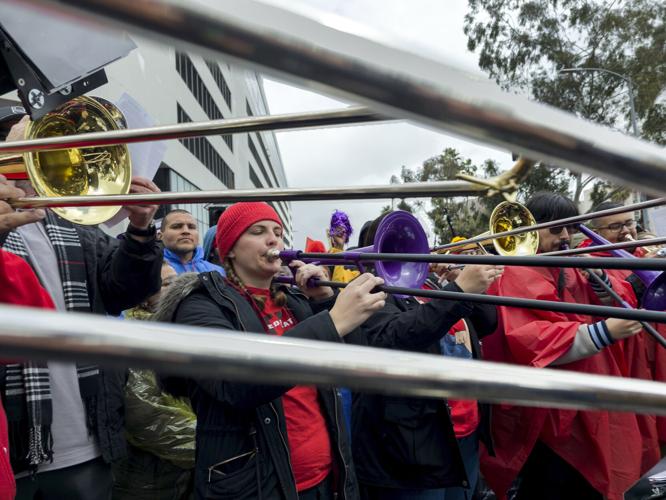
Music teachers perform as they join Los Angeles Unified School District members and Service Employees International Union 99 (SEIU) members outside the LAUSD headquarters Tuesday in Los Angeles.
More than half of the nation’s public schools started this school year feeling understaffed, with many struggling to fill key support staff jobs, especially in transportation and custodial work, according to an Education Department survey. Asked about the biggest challenges, roughly four in 10 said candidates felt the salary and benefits weren’t good enough.
Local 99 of the Service Employees International Union represents about 30,000 LAUSD teachers’ aides, special education assistants, bus drivers, custodians, cafeteria workers and other support staff. The union says many live in poverty because of low pay or limited work hours while struggling with inflation and the high cost of housing. Support staff, including many who work part-time, earn about $25,000 a year, according to the union, which is asking for a 30% raise.
The school district has offered a cumulative 23% raise, starting with 2% retroactive as of the 2020-21 school year and ending with 5% in 2024-25. The package would also include more full-time positions and an expansion of health care benefits. Superintendent Alberto Carvalho has accused the union of refusing to negotiate and said that he was prepared to meet at any time.
Leaders of United Teachers of Los Angeles, which represents 35,000 educators, counselors and other staff, have pledged solidarity with the strikers.
Experts say it is unusual for different unions in the same school district to band together but the unified labor action in Los Angeles could mark an inflection point.
“The idea of the teachers union and service personnel union saying we can do better if we stick together, could be a contagion in other communities looking and saying, ‘Hey, they did it in Los Angeles — maybe we can do it,’” said Lee Adler, a lecturer and expert on education union issues at Cornell University’s School of Industrial and Labor Relations.
How teachers unions have changed since the 1980s
How teachers unions have changed since the 1980s

Teachers unions have played an integral role in shaping the U.S. education system, providing a platform for educators to advocate for themselves and their students when working and learning conditions become poor. Citing union membership data among elementary and secondary school teachers from UnionStats.com, HeyTutor examined how teachers unions have evolved since the 1980s.
Union members are employed workers who are members of unions while people covered by unions are workers covered by a collective bargaining agreement. Some of the largest teachers unions in the country include national groups like the National Education Association (NEA) and American Federation of Teachers (AFT) as well as state and city groups such as the California Teachers Association, West Virginia Education Association, Detroit Federation of Teachers, and Chicago Teachers Union.
One way teachers unions campaign for themselves is by going on strike. During this time, union teachers do not work in protest of, oftentimes, poor working conditions and wages. The teachers’ refusal to work puts pressure on school and government officials to negotiate a deal with the union. The first teacher strike in the U.S. took place in 1902 in Chicago, the home of several historical teacher union protests. The first statewide strike took place in Florida in 1968 when over 40% of the state’s teachers took to the picket lines over funding.
Read on to see just how far teachers unions have come since the ’80s.

1985

- Total employment: 5,477,043
- Members of unions: 44.5% (2,435,136)
- Workers represented by unions: 53.8% (2,945,869)
The year 1987 marked what is considered the longest teacher strike in U.S. history. The strike did not take place in a big metro like Los Angeles or New York City but in the small Midwestern town of Homer, Illinois. Starting in October 1986, teachers went on strike in the town of 1,200 residents after the school board only offered a 2% raise.
Tensions were high as the school district reportedly fired some teachers and hired substitutes, which broke the terms of the strike. The protest didn’t end until June 1987, essentially canceling school for the entire 1986–87 school year. The school board and teachers agreed to base pay on the median salaries of other local school districts, and that the teachers who were fired during the strike would regain their employment.
1990

- Total employment: 6,048,835
- Members of unions: 44.9% (2,716,948)
- Workers represented by unions: 53.5% (3,237,215)
The early 1990s were a time of rapid growth for teachers unions. The American Federation of Teachers, one of the most sizable teachers unions in America, began to aggressively recruit teachers into their organization. The group even created a television ad campaign with the slogan, “Union, yes.”
Another significant event in the early part of the decade was the 11-day West Virginia teachers union strike held in 1990 over benefits and wages, the first statewide teachers strike in West Virginia. To end the strike, the West Virginia House speaker and Senate president agreed to hold a legislative session to come up with solutions.
1995

- Total employment: 6,619,776
- Members of unions: 45.3% (3,000,660)
- Workers represented by unions: 52.3% (3,464,079)
In 1995, Washington teachers went on the longest strike in state history after the Fife Education Association refused to accept Fife school district pay cuts. About 2,500 teachers took to the picket line on Oct. 9 of that year.
Teachers refused to return to the classrooms even after a Superior Court judge gave the order to go back. The union’s refusal to get back to work, even after a court order, caused bargaining between the school board and teachers union to pick up speed. The teachers came back to work after both the district and union agreed to supplemental pay cuts.
2000

- Total employment: 7,556,886
- Members of unions: 43.9% (3,314,309)
- Workers represented by unions: 49.8% (3,766,976)
Between No Child Left Behind legislation being signed into law in 2002 and the 2003 Higher Education Act, the early 2000s was a significant time for education policy. However, lawmakers weren’t the only ones making moves. In 2001, two of the largest teachers unions—the American Federation of Teachers (AFT) and National Education Association (NEA)—joined forces to lobby together and strategize legal matters.
The two groups had formerly attempted to merge in the 1960s; however, the NEA ended up turning down the offer. With a collective 2.5 million teachers at the time, the partnership between the AFT and NEA created a force to be reckoned with.
2005

- Total employment: 8,311,445
- Members of unions: 42.8% (3,559,196)
- Workers represented by unions: 47.7% (3,968,048)
The mid-to-late 2000s brought about several instances of unrest among teachers in major U.S. cities. In 2005, New York City’s United Federation of Teachers threatened to go on strike during New York City Mayor Michael Bloomberg’s reelection campaign. The union leveraged the mayoral election in their favor to secure a 14.25% raise that also required them to work longer days.
In Detroit, the public school district’s teachers went on strike after a proposed 5.5% wage cut and a drastic increase in the cost of benefits. On day one of the strike, which was the first day of school for the district, only 7% of teachers went to work. The Detroit Federation of Teachers returned to their classrooms after 16 days behind the picket line once teachers agreed to a temporary pay freeze and an eventual 2.5% pay raise in the following years.
2010

- Total employment: 8,713,733
- Members of unions: 42.7% (3,721,096)
- Workers represented by unions: 47% (4,094,972)
After not going on strike since the 1980s, in September 2012, the country’s third-largest teachers union took to the streets to protest against a host of issues. For a week, 26,000 Chicago teachers marched on the picket line over low pay, classroom sizes, layoffs, student testing, and more. The strike eventually ended when the union and city officials compromised on a 17.6% pay raise, a scaled-back emphasis on test scores, better employment protections, and improved health insurance.
The strike was so monumental for Chicago teachers that a book was written on the subject—“A Fight for the Soul of Public Education: The Story of the Chicago Teachers Strike,” authored by Robert Bruno and Steven K. Ashby, two labor education professors at the University of Illinois. They described the Chicago protests as being so impactful that “the ripple effects” of the strike were felt nationwide.
2015

- Total employment: 8,943,415
- Members of unions: 40.4% (3,615,515)
- Workers represented by unions: 44.9% (4,013,628)
The years between 2015 and 2020 were marked with two major strikes by teachers unions that made national headlines. The first was the 2018 West Virginia teachers’ strike over low wages and rising health care costs. In February that year, thousands of teachers—whose starting pay was ranked #42 in the U.S. at the time—went on strike for nine days, impacting roughly 277,000 schoolchildren.
West Virginia Gov. Jim Justice eventually agreed to a 5% pay raise for teachers. The second major strike took place in 2019 when Chicago teachers went on an 11-day strike to protest poor pay, overwhelming classroom sizes, and a lack of support from schools. After all was said and done, Chicago Mayor Lori Lightfoot agreed to a 16% bump in salaries, smaller classroom sizes, and to hire more nurses, librarians, and social workers for schools.
2020

- Total employment: 8,597,685
- Members of unions: 40.9% (3,514,453)
- Workers represented by unions: 45.2% (3,886,705)
The COVID-19 pandemic, which flipped the world on its head starting in early 2020, threw a wrench in everything from the housing market to unemployment rates. One of the pandemic’s biggest points of impact, however, was the education system.
As schools across the U.S. struggled with whether to reopen in the fall of 2020, teachers unions were one of the biggest influences in pushing for remote and hybrid learning. This was particularly evident with the nation's three biggest school districts—Chicago, Los Angeles, and New York City—as teachers unions in these cities galvanized against reopening schools due to safety concerns. Teachers unions in other cities applied pressure to school officials as well. In August 2020, Detroit teachers voted to approve a strike to push back against the Detroit Public Schools Community District’s decision to bring back in-person learning.
This story originally appeared on HeyTutor and was produced and distributed in partnership with Stacker Studio.