
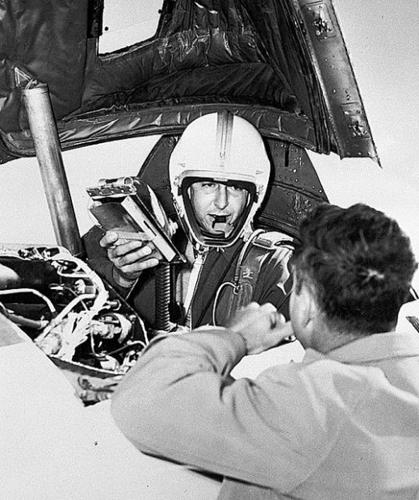
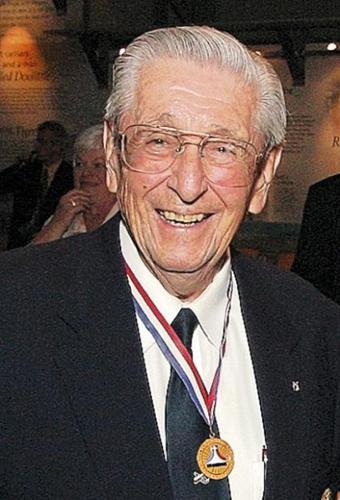
RANGER, Ga. — Scott Crossfield, the hotshot test pilot and aircraft designer who in 1953 became the first man to fly at twice the speed of sound, was killed in the crash of his small plane, authorities said Thursday. He was 84.
Crossfield's body was found in the wreckage Thursday in the mountains about 50 miles northwest of Atlanta, a day after the single-engine plane he was piloting dropped off radar screens on a flight from Alabama to Virginia. There were thunderstorms in the area. Crossfield was believed to be the only person aboard.
During the 1950s, Crossfield embodied what came to be called "the right stuff," dueling the better-known Chuck Yeager for supremacy among America's Cold War test pilots. Yeager broke the sound barrier in 1947; only weeks after Crossfield reached Mach 2, or twice the speed of sound, Yeager outdid him.
Yeager, reached at his home in California, said he was "sure sorry to hear" about Crossfield's death, but he wondered whether the pilot's penchant for taking risks might have been his undoing.
People are also reading…
Crossfield was flying "in very bad weather," Yeager noted.
During flight-test days, he said, Crossfield "being a civilian, had a lot more freedom than we did, as military guys. ... Sometimes he exceeded his capability and got in trouble."
Asked for an example, Yeager, 83, said: "Flying in weather that he should have never been in."
The Cessna 210A in which Crossfield died was a puny flying machine compared with the rocket-powered aircraft he flew as a test pilot. He routinely climbed into some of the most powerful, most dangerous and most complex pieces of machinery of his time, took them to their performance limits or beyond — or "pushed the envelope," as test pilots put it — and usually brought them back to Earth in one piece.
"He's really one of the major figures," said Peter Jakab, aerospace chairman at the Smithsonian Air and Space Museum. "He was not only the great cutting-edge research pilot ... but after that, he continued to be a great adviser and participant in all aspects of aerospace."
Crossfield, who lived in Herndon, Va., and flew regularly into his 80s, was a member of a group of civilian pilots assembled by the National Advisory Committee for Aeronautics, the forerunner of NASA, in the early 1950s. Yeager did his test-flying as an Air Force pilot.
Crossfield flew Mach 2 on Nov. 20, 1953, when he hit 1,300 mph in NACA's Douglas D-558-II Skyrocket. The plane reached 72,000 feet.
After leaving the NACA, he had a major role in the development of the X-15 rocket plane and piloted it on several of its early test flights in the early 1960s.
In "The Right Stuff," Tom Wolfe's history of the dawn of the space age, Wolfe portrayed Crossfield, Yeager and other members of the brotherhood of test pilots as possessors of "the right stuff," which the author defined as "the ability to go up in a hurtling piece of machinery and put his hide on the line and then have the moxie, the reflexes, the experience, the coolness, to pull it back in the last yawning moment — and then to go up again the next day, and the next day, and every next day."