

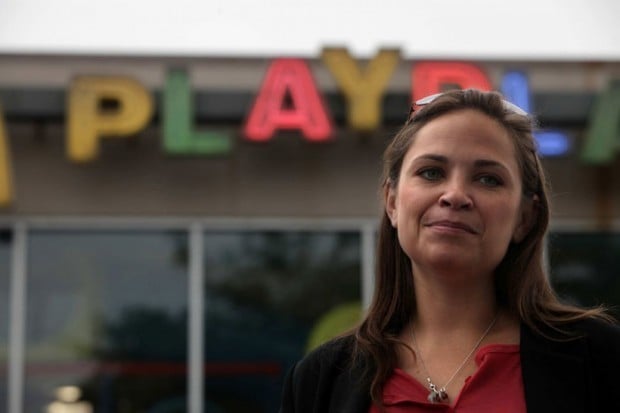
Hair clumps and graffiti were among the "disgusting" discoveries Erin Carr-Jordan says she made during a recent visit to assess indoor play areas in Tucson fast-food restaurants.
Her worst visit was to Chuck E. Cheese, 6130 E. Speedway, says the Chandler mother of four, who has been making national headlines of late for pointing out deficiencies in regulation of the country's indoor playlands.
"It breaks my heart to see these are the types of places children play in, and it's not OK," she said of the indoor playgrounds she's seen. "It's just so important and I hope other people see that children deserve safe places to play. ... Without regulation, they are not going to continuously be better."
Chuck E. Cheese counters that its play equipment is cleaned at least daily with a sanitizer, and a state health official says parents shouldn't be overly concerned about germs at indoor play areas.
People are also reading…
McDonald's dirty, too
Carr-Jordan's project began by happenstance, she says, when her son needed to use the restroom and the family stopped at a McDonald's in the Phoenix area. She was shocked by grime she saw in the indoor playland. A family car trip to Colorado followed, and she noticed the indoor playland at a McDonald's there was similarly dirty, although a McDonald's spokeswoman says the company has stringent sanitizing procedures.
In May, Carr-Jordan began posting video recordings of indoor play areas in fast-food places across the country on YouTube.
While it's common to see workers in restaurants spraying down tables and mopping floors, Carr-Jordan said that cleanliness often stops at the playground. She's seen old Band-Aids, rotting food and black dirt in between the connecting tubes of plastic equipment.
She swabs the playlands she inspects and takes the samples to a commercial lab. While Carr-Jordan has been criticized as a germaphobe, she says the swabs have turned up positive for a multitude of opportunistic pathogens, including strains of staphylococcus and streptococcus.
Some of the playlands do not look so bad at first glance. Yet many are not well-lit, noted Carr-Jordan, who will frequently pull out a flashlight in such places only to find spills and filth that no one should want their children near, she said.
No playland regulations
Her most surprising finding, however, is that there's no federal or state regulation of indoor playlands.
Indeed, inspectors with the Pima County Health Department check local restaurants and issue penalties for those that don't meet the health code. But there are no standards for inspectors to hold owners accountable for their playgrounds, which are nonfood areas, said Jeff Terrell, program manager for the county's health and food safety program.
The best defense for parents is talking to a store manager if there's a cleanliness problem, said Diane Eckles, chief of the state's Office of Environmental Health.
"We don't ever see outbreaks associated with playgrounds," Eckles said. "There's never been a documented outbreak even remotely associated with these playgrounds."
Eckles' other advice to parents?
"Let kids play and wash their hands really well before and after," she said. "Just use general hygiene."
She added that there's an Arizona nuisance law that could possibly be applied to indoor playgrounds if they're threatening public health, but, "It would have to be blatantly bad to do anything about it."
Companies respond
Carr-Jordan, who is an adjunct professor of developmental psychology at Arizona State University, has visited 13 states so far. She created a nonprofit organization in addition to a website to showcase her findings. So far, her nonprofit is funded by her own money and time.
When she visited three indoor playlands at fast-food restaurants in Tucson last month, she found several problems, including a broken plastic window on a second-story climber, she said.
But it was Chuck E. Cheese in particular where she found filthy equipment, she said, adding that it was consistent with other Chuck E. Cheeses she's seen around the country. A video of the local Chuck E. Cheese shows spills and crusted food in the play area.
"There was a big mixture of all things I don't like to see," said Carr-Jordan. "If you moved the mats, there was a putrid odor."
Company officials at Chuck E. Cheese say cleanliness is a "critical element" toward meeting their goal of providing families with a wholesome, safe and entertaining experience.
"We have detailed, step-by-step cleaning instruction manuals with video training in each of our entertainment centers," the company said in a written statement. "All existing play equipment is cleaned at least daily with Oasis 146 Multi-Quat sanitizer. Touch-ups are completed throughout the day as needed."
For its part, McDonald's USA has taken notice of Carr-Jordan's project and has assigned a team to review her findings and the company's own existing procedures, spokeswoman Danya Proud said.
"We put our customers first, take these concerns very seriously, and will continue to take action," Proud said. "While we have stringent sanitizing procedures for weekly, daily and even spot cleaning, we're always looking for ways to improve our standards and how they are followed at your neighborhood McDonald's."
ONLINE
To see Erin Carr-Jordan's website: www.kidsplaysafe.net
In building her database, Carr-Jordan would like to hear from parents whose children have been adversely affected by indoor playlands, whether through pinkeye or a physical injury. She may be emailed through her website.
ONE CHAIN MAKES HER GRADE
For her own children, activist Carr-Jordan says most indoor playlands are off-limits. She will allow them to play at the Chick-Fil-A near her house, however, and notes that all Chick-Fil-A restaurants she's visited have high standards for clean indoor playgrounds.
Contact Star reporter Stephanie Innes at sinnes@azstarnet.com or 574-4134.


