

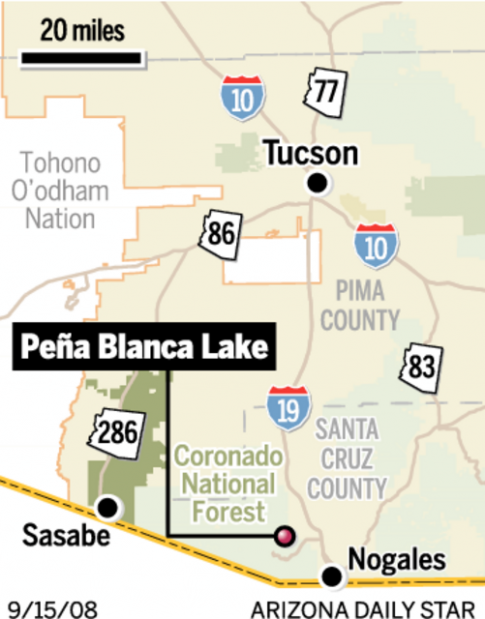
Authorities will begin the first mercury cleanup at an Arizona lake this month when they drain Southern Arizona's Peña Blanca Lake and close it to the public for up to a year.
The U.S. Forest Service will start the nearly $3 million project in late September by pumping out most if not all the water from the 49-acre lake, 17 miles northwest of Nogales.
Removing the water and its accompanying oxygen will choke off thousands of mercury-tainted fish living in the lake, officials expect. The agency is prepared to use a toxicant to kill off any fish still left if all the water can't be removed.
Then, authorities will dredge and remove about 20 feet worth of dirt — about 255,000 tons total — underneath the lake, which has been contaminated for many years with mercury, lead and arsenic from long-abandoned mining operations.
People are also reading…
The sediment will be put into a nearby above- and below-ground repository, capped by at least 18 inches of area dirt.
This is one of 10 lakes in the state where the Arizona Game and Fish Department has recommended that people either limit their eating of fish or not eat any fish because of mercury.
Two other Southern Arizona lakes also have mercury-tainted fish — Arivaca and Parker Canyon — but there are no immediate plans for cleanup.
Despite the prolonged closure expected at the Peña Blanca Lake, several fishers, including a National Wildlife Federation official, welcome the federal government's action.
At nearly 22 feet deep, Peña Blanca had been a very popular lake until mercury was discovered in its fish in the mid-1990s.
Since then, officials have urged people not to eat any fish caught there, and public use by fishers has dropped about 20 percent, state statistics show.
Fish in the lake include largemouth bass, black crappie, channel catfish, bluegill, sunfish, yellow bullhead and threadfin shad.
"Obviously, any time Arizona can put a waterway back on the rolls for the anglers, heck, that's great news," said Guy Sagi, an author, fisher and former Arizona resident who first came to the lake with his family in the early 1970s. "It's been pretty good traditionally. It's probably one of the most scenic lakes in Arizona."
It will take at most 30 days to drain the lake, but it could take a lot longer for the lake to be refilled and fish to be restocked because the refilling will come from rainfall. "It could be one to eight years. That's really up to Mother Nature," said Eli Curiel, a Forest Service engineer who will be the on-scene coordinator for the cleanup.
Once the lake is reopened, the fishing will be better because the lake will be deeper, he said — as deep as it was in the 1950s before the lake was created by construction of a dam across Peña Blanca Canyon.
It will also be more accessible to fishers because authorities also plan to clear cattails that have sprouted all along the lakeshore since the 1950s.
The cattails are so thick that there's not a lot of access for fishers except at the lake's fishing pier or in boats, said Don Mitchell, fisheries program manager in Tucson for Arizona Game and Fish.
But it may be at least a year before his department restocks the lake, even after it refills, he said.
"We have to wait a time for it to stabilize and the water quality to normalize and be ready to accept fish," Mitchell said.
Tucson fisherman Bobby Lee said he used to eat as many as 150 fish from Peña Blanca annually and boasts "I'm still here" at age 71. Once the mercury is gone and the lake is renovated, he would likely go down to Peña Blanca more often, he said.
"I would always go down there with my fly rod, and I never got skunked," Lee said.
A mercury-free Peña Blanca will be "just like Lake Patagonia, with all the same kinds of fish that we had before," said Larry Audsley, the Arizona Wildlife Federation's Southern Arizona representative.
"What had happened is they made Peña Blanca catch-and-release only, and the people who liked to take a couple of fish home with them stopped going, including me," Audsley said. "There were some guys, some really serious bass fishermen, who may be disappointed for a while because it was the best-kept secret where you could go and catch a 7- to 9-pound bass."
That won't be possible, with people eating the fish again. In fact, "if you want fish like they've got there now, it will take a good 10 years" for them to come back, Mitchell said.
"A 7- to 8-pound fish is usually 7 to 9 years old. It's too expensive to buy at that size," he said. "But Peña Blanca is a pretty fertile lake, and the fish will grow back."
how mercury affects health
The highest concentration of mercury found in an Arizona fish was in a largemouth bass in Peña Blanca Lake — 3.38 parts per million. That compares with recommended federal limits of 1 part per million from the Food and Drug Administration and 0.3 part per million from the Environmental Protection Agency.
Samples taken from largemouth bass at the lake showed that average mercury concentrations rose from 1.31 parts per million in 1995 to 1.79 in 2005. For perspective, 1 part per million is the equivalent of one second out of 12 days, or 1 cent out of $10,000.
For fetuses, infants and children, the main health effect of methylmercury — the kind typically found in fish — is impaired neurological development.
Methylmercury exposure in the womb, which can result from a mother's consumption of fish and shellfish that contain it, can harm a baby's growing brain and nervous system. Impacts on cognitive thinking, memory, attention, language, and fine motor and visual spatial skills have been seen in children exposed to methylmercury in the womb.
Other symptoms of methylmercury poisoning may include peripheral vision impairment; "pins and needles" feelings in the hands, feet and around the mouth; lack of coordination of movements; impairment of speech and hearing; and muscle weakness.
Sources: Environmental Protection Agency, Arizona Department of Environmental Quality
2 other lakes also tainted
People also are urged not to eat fish from Arivaca Lake because of its high mercury levels.
But mercury cleanup at Arivaca is not likely to happen soon because authorities haven't been able to discover a source there, despite a lengthy search.
At Parker Canyon Lake, pregnant women, nursing mothers, women who may become pregnant and children under 16 are urged not to eat any fish from the lake. Men are told it's OK to eat three fish from there monthly, and adult, non-pregnant women are urged to consult with their doctors.
Mercury is also not likely to be removed from Parker Canyon Lake soon because the Forest Service, which also owns that area, has shown little interest in it, said Don Mitchell, fisheries program manager at the Arizona Game and Fish Department's Tucson office.


