


2015 will be the year of the demoted planet.
NASA spacecraft are headed to two solar system bodies that were once considered “planets.”
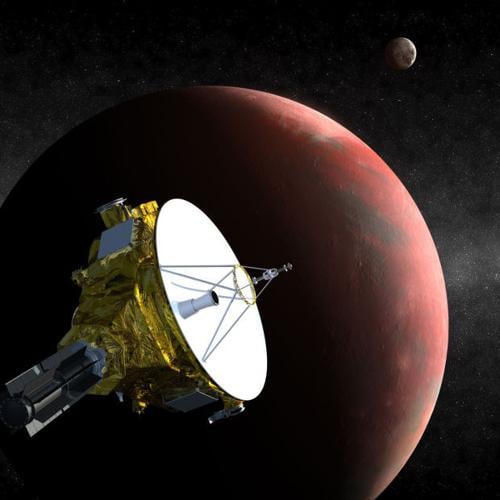
Pluto, a planet from 1930 to 2006, is the destination for NASA’s New Horizons spacecraft in July.
Ceres, considered a planet for about 50 years in the 19th Century, will be visited by NASA’s Dawn mission in April.
Planetary scientists say the two missions will spotlight public rejection of the 2006 demotion of Pluto to “dwarf planet.”
The International Astronomical Union voted in 2006 to define a planet as an object in orbit around the sun that has enough mass to be spherically shaped by gravity and has cleared its orbit of other objects. The third part of the new definition precluded Pluto from planet status.
People are also reading…
But if you put the matter to a vote, as a forum at the Harvard-Smithsonian Center for Astrophysics did this month, it remains a planet in the public mind.
The coming year should produce even more enthusiasm for the planet — especially in Arizona. Pluto was discovered in 1930 from Lowell Observatory in Flagstaff by astronomer Clyde Tombaugh.
New Horizons will bring us closer to Tombaugh’s baby than we’ve ever been. We’re going to see Pluto up close and it’s going to look just like a planet, said Mark Sykes, director of the Planetary Science Institute.
oh, to be a planet
Sykes has been a consistently insistent voice against Pluto’s demotion from planetary status.
So has Owen Gingerich, the Harvard science historian who chaired the International Astronomical Union panel that redefined planet. He objected to the final form of the resolution, which made Pluto a “dwarf planet.”
Gingerich participated in the recent Harvard-Smithsonian debate and said by phone Thursday that he considers Pluto a planet in the classical sense of that word. He said during the debate that “the International Astronomical Union does not own the word ‘planet.’”
NASA, on its “Solar System Exploration” website, concludes: “The lively planethood debate continues.”
The website for NASA’s New Horizons Mission, scheduled to fly by Pluto this summer, is less equivocal.
The mission’s principal investigator, Alan Stern, considers this a planetary mission — one that will complete NASA’s exploration of all nine planets in our solar system.
Pluto is the only one of the “classical planets” not yet visited by a NASA spacecraft.
New Horizons will fly about 10,000 kilometers above the icy planet on July 14. At that altitude, said Stern, the spacecraft’s telescopic camera will be able to map its terrain.
If you were flying by New York City at the same altitude, he said, you would be able to count the ponds in Central Park.
Before it gets that close, New Horizons will send images that will allow us to see Pluto, basically for the first time, along with its giant moon Charon and at least four other satellites.
in the spotlight
Pluto, for much of the 84 years we have known of its existence, has been a dimly shining, moving object in the sky. The biggest telescopes on Earth could do little more than enlarge the tiny dot of light.
The Hubble Space Telescope gave us a better image — a bronze planet, perfectly round, with some fuzzily defined features.
New Horizons will take close-up portraits.
“That’s the point where geology turns on,” said Sykes. “When we send a spacecraft to Pluto, what we’re planning on studying there are atmospheric and geological processes analogous to what we see on Earth.”
Sykes predicted that the planet debate will heat up in April, when NASA’s Dawn mission makes its encounter with Ceres, the giant asteroid that makes up 25 percent of the mass in the asteroid belt between the orbits of Jupiter and Mars.
Sykes is one of three Planetary Science Institute scientists involved in that mission.
ceres on the surface
Ceres was called a planet shortly after its discovery in 1801, but demoted as more and more objects were found in its vicinity.
The International Astronomical Union now calls it a dwarf planet, the only one of five dwarfs that doesn’t make its home with Pluto in the Kuiper Belt of icy objects beyond Neptune.
Ceres is thought to have a rocky mantle, an icy crust and a subsurface ocean.
Astronomers using the European Space Agency’s Herschel Observatory reported water vapor spewing from its surface in a paper earlier this year.
That, said Sykes, makes it a prime target for investigations of life or its precursors.
Nobody complains about calling Ceres a “dwarf planet.” It was actually a promotion from “big asteroid.”
Gingerich said he would have no problem calling Pluto a “dwarf planet” as a subset of the category “planet.”
We call Earth, Mercury, Mars and Venus “rocky planets” and refer to Saturn, Jupiter, Uranus and Neptune as “gas giants.” But we also call them planets, he said.
Dimitar Sasselov, director of Harvard’s Origins of Life Initiative, argued in the Harvard-Smithsonian debate that we call a lot of things planets these days, if you include the thousands of exoplanets being discovered.
“What we think of as planets are a very, very diverse lot.” There are binary planets, big planets that orbit tiny stars, planets that orbit two stars, free-floating planets that orbit nothing, lava planets, super-Earths, water-worlds.
“Planet,” said Gingerich, “is a culturally defined word that has changed its meaning over and over again. The IAU should not have attempted to define the word.”


