

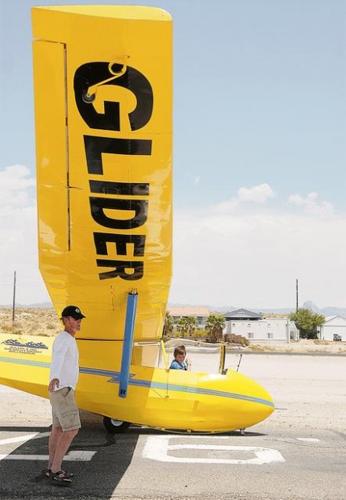
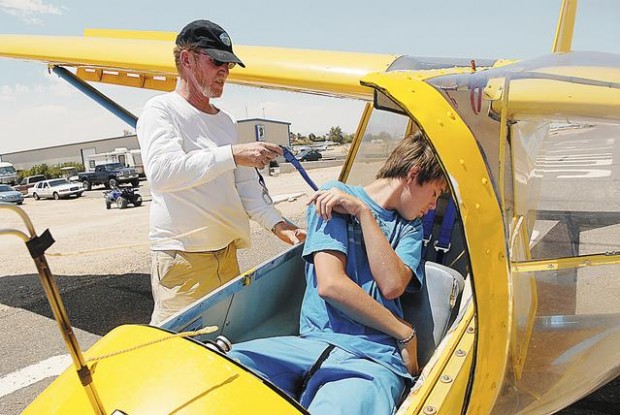
BULLHEAD CITY — Soaring 3,000 feet above Sun Valley Airport, Joseph Sheble's glider is a yellow dot in the sky.
The 14-year-old is flying solo. No engine. Just gravity working its way down through wind and masses of air.
With 3 1/2 hours of flight time already under his belt, Joseph is hoping to earn a private pilot glider license by the time he turns 16. In addition to the 10 required hours of flight time, he'll have to pass a written test and a Federal Aviation Administration flight test.
"This has kind of been a dream of mine, to teach my son to fly — and I want him to outdo me," said Joe Sheble, owner of Sheble Aviation, a flight school based in Kingman, and Sea, Sail & Tail in Fort Mojave.
Joseph and his 8-year-old brother, Jacob, are the youngest generation in a line of pilots that goes back to their grandfather — also named Joseph Sheble — who started the business to fulfill a dream.
People are also reading…
Sheble said he worries more when his son is quad racing than when he's flying the 1968 Schwiezer 233 glider. "I trust his skills and his instincts."
The basic concept behind gliding is a combination of gravity and weight propelling the engineless plane in a forward motion, Sheble explained. Towed by a powered airplane, the glider rises slowly to an altitude of several thousand feet. Once released, the pilot navigates back down using wind power and rising and sinking columns of air to his advantage.
"Glider pilots exploit the weather — that's our engine," he said. The mechanism of gliders works a lot like bird flight — you can see it especially in soaring turkey vultures.
"It's really working the same concept that Mother Nature designed a long time ago."
At around 4,000 feet above ground the temperature is a comfortable 76 degrees compared with the 110 degrees below. And it's that difference in temperature and rising columns of air that enable the glider to stay up.
"Once you get up there, it's easier to stay up," Sheble said, "because you just chase the clouds around."
Gliding began with the Wright brothers' first flight at Kitty Hawk, N.C., in 1903.
"That was the original goal of the Wright brothers — to sustain flight without an engine," said Tom Allen, flight instructor at the school. "All those guys in the early days, they all observed birds."
About 20 minutes after Joseph took off in the glider, Allen, Sheble, and wife, Valerie, gather outside to see him land.
Once he's descended to about 1,000 feet, he'll have to make a decision.
"All right, he's committed now to landing, he's entered the downwind," Sheble said, watching his son maneuver the glider. "That's gonna be perfect."
Back on the ground, Joseph said flying is pretty easy, the only scary part being when you catch a drift during takeoff and the glider's wing goes down.
"Once it gets going, you don't have to worry," he said.
The photographs he snapped on his cell phone look as distant as satellite images, with the Colorado River cutting a dark line through the green and brown blocks of land.
"When I see people, it looks like an ant — literally," he said.
He likes looking around when he's up there, spotting new places to ride his quad and noticing things others can't, like the fact so many houses have pools, but there's no one swimming in them.
It's freedom, he said. "You can go wherever you want, when you want."


