

ALBANY – Calling for “a better, fairer, more inclusive” version of the American dream, Gov. Kathy Hochul on Wednesday laid out an ambitious and expensive agenda for 2022 that includes tax cuts for businesses and homeowners, additional attention on homelessness, poverty and the incarcerated, new transportation projects and added state funding for health care and human services workers especially hard hit during the Covid-19 pandemic.
The Democratic governor's remarks laid out her plans during her first State of the State since taking office in August, and were provided to a Covid-19 capacity-restricted audience of 50 people in the state Assembly chamber while several hundred demonstrators rallied outside the Capitol against vaccine and other Covid-19 mandates.

For Gov. Kathy Hochul, her State of the State speech Wednesday represents more than just a longstanding tradition of the state's chief executive. It represents the beginning of the most consequential year of her political life.
As Covid-19 hospitalizations this week hit their highest level since early May of 2020, Hochul sought to project a confident image about New York’s future, both from a public health and economic standpoint. But she said a host of new initiatives is needed by state government to deal with societal issues that existed long before the pandemic.
People are also reading…
More than once, Hochul talked of Franklin Roosevelt and his New Deal programs that helped lift the nation out of the Great Depression.
“The pandemic did not create all the problems we are facing today. It simply forced us to hold up a mirror and see the cracks in our society that had been too easy to ignore before. This crisis has created an opportunity to redefine ourselves – and we must embrace it," she said.
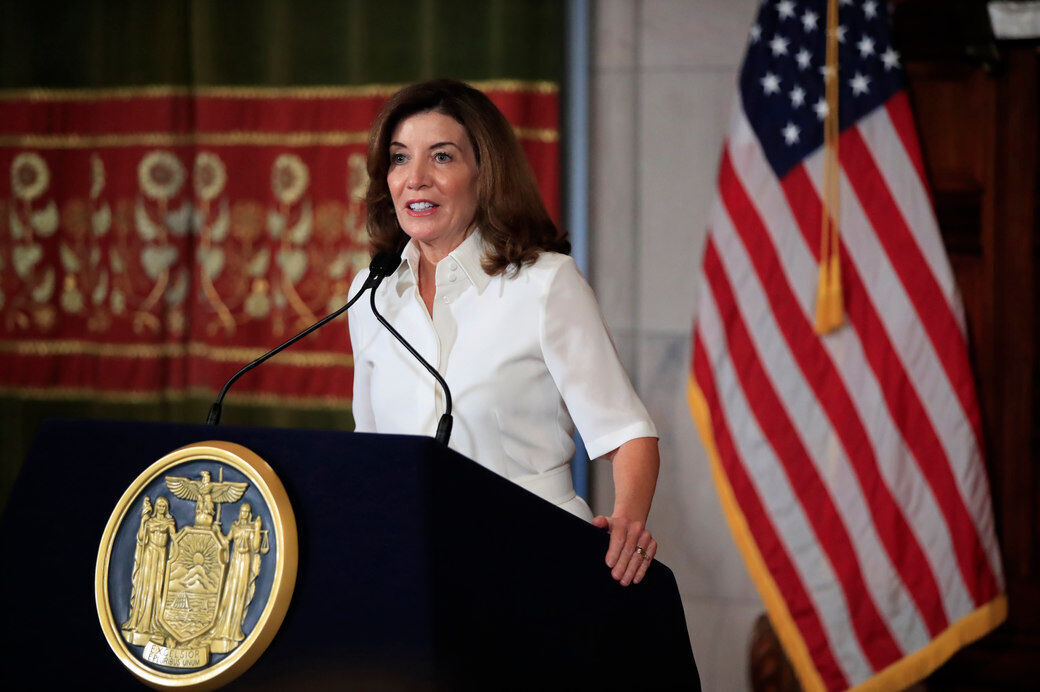
New York's rookie governor, after unexpectedly assuming Albany's top job last August, takes the state's biggest stage Wednesday with her first State of the State address.
Not in the room: Assembly Speaker Carl Heastie, who – 10 minutes before the scheduled start of the speech – revealed he was isolated at his Albany apartment after two rapid Covid-19 tests earlier in the morning came back inconclusive about whether he has, again, contracted the virus.
The governor’s plans included calls for free tuition for certain high-demand health care jobs, multi-year programs aimed at affordable housing, roads and transit systems and climate change programs.
Unlike other governors’ State of the State addresses, Hochul wasn’t interrupted once by applause as she read through her prepared remarks in 34 minutes. The one plan that got some audible reaction from some audience members was her call to make permanent an emergency rule permitting bars and restaurants to sell alcohol to go. That rule expired last year.
Hochul promised major new investments in public schools – without specifics – as well as the state university system, and said she will propose a $10 billion program to help deal with a staffing crisis in the state’s health care system exacerbated by Covid-19.
Hochul sought to deliver a hopeful message on the pandemic, even as cases, deaths and hospitalizations are rising, and vowed a new cooperative spirit with state lawmakers after years of ugly battles that saw previous governors try to diminish the role of legislators in the business of state government.

"We simply do not have enough health care workers in our hospitals, or in our long-term care facilities, in our ambulances, or in the homes of our loved ones," Hochul said in her State of the State address on Wednesday.
She acknowledged the many problems facing the state, not the least of which was the more than 300,000 New Yorkers who last year left for other locations – more than any state in the nation. One way to help, she said, especially with inflation rising and the pandemic’s economic effects still underway, will be a $1 billion property tax rebate program for more than 2 million low- and middle-class New Yorkers. Details were not provided.
Hochul’s speech started shortly after 1 p.m. with many lawmakers watching remotely from their offices or apartments or hotel rooms.
The spending proposals by Hochul, who is running for a full term this fall, were massive in scope – and come courtesy of billions in extra money Albany has on hand for the time being in federal Covid-19 bailout funds and higher-than-expected state tax revenues.
The proposals, spread across 236 pages, include:
• $500 million for cost-of-living wage adjustments for human services workers at state-funded private agencies and added funding for a range of mental health programs.
• Accelerating an income tax rebate program for middle-class families to drive more tax savings in the coming year.
• A $100 million tax break for 195,000 small businesses, an array of financial help for farmers and the resumption of to-go alcohol sales by restaurants and bars.
• Tripling resources for law enforcement illegal gun tracing efforts.
• Expanding the Tuition Assistance Program to benefit 75,000 part-time public college students and, for the first time since 1995, restoring TAP for prison inmates who take college courses behind bars.

Hochul said in her State of the State address she will revive the policy allowing off-premises consumption that was in effect from March 2020 to last June
The governor said her administration will create the “most business-friendly and worker-friendly state in the nation," a challenging pledge for any New York governor.
Hochul said the state would also press ahead with new climate change initiatives, including accelerating adoption of clean energy technologies for buildings, truck fleets, state agencies and state agencies that, she said, would make New York “the renewable energy capital of the nation.”
She floated dozens of local projects around the state, such as reconnecting east-west neighborhoods in Buffalo disrupted by the decades’ old Kensington Expressway, as well as a $120 million new academic building for the engineering school at the University at Buffalo and money for “high impact” projects in Niagara Falls to improve access to the waterfront. And she talked of designating UB and SUNY Stony Brook as SUNY’s “flagship” institutions as a way to drive more research dollars and other benefits to the two campuses.
Some groups were not waiting to see the details in Hochul’s upcoming budget before pronouncing major victories on Wednesday. The New York Farm Bureau called her plans to assist farms “sweeping.”
A downstate hospital trade group called her proposed health spending plans “spectacular” and “dizzying.”
Human service providers, who have seen their staffing hit by low reimbursement levels for work they provide on behalf of the state, praised Hochul’s plan for bonuses and pay hikes for low-paid front-line workers. Rhonda Frederick, president of People Inc. and the Developmental Disabilities Alliance of WNY, said: “She promised to listen to and prioritize individuals with intellectual and developmental disabilities, and she kept it.”
Republicans offered a range of criticisms and a wait-and-see attitude until the Hochul budget comes out in a couple of weeks. Sen. Patrick Gallivan, an Elma Republican, said he was disappointed Hochul failed to address the state’s controversial 2020 law that ended bail requirements for people arrested of many crimes.
“We need to restore judicial discretion and policies that protect law-abiding citizens," he said.
State Conservative Party Chairman Gerrard Kasser called Hochul’s plans “simply retreads of old, unaffordable proposals, and double-downs on failed policies implemented by her former partner Governor Andrew Cuomo.”
But Senator Tim Kennedy, a Buffalo Democrat who chairs the Senate transportation committee, said her Kensington Expressway funding commitment is a “massive win” for the city, while $2 billion over five years for road and bridge repairs “is a monumental investment” by the state.
Upstate United, a business trade group, commended Hochul “for recognizing and addressing New York’s extraordinary economic challenges.”
Assemblyman Richard Gottfried, a Manhattan Democrat first elected in 1970, tweeted that Hochul’s address was the best of 52 State of the State speeches he’s heard.
The governor began her written message to lawmakers noting the history she made last August.
“As I stand before you, I am well aware of the significance of this moment: the first time in New York's history that a woman has delivered this annual address. But I didn't come here to make history. I came to make a difference," she said.


