

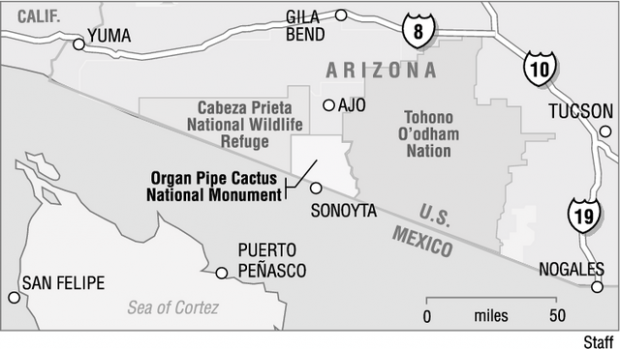
ORGAN PIPE CACTUS NATIONAL MONUMENT — Four years after drug smugglers fleeing Mexican police fatally shot park ranger Kris Eggle, an $18 million, 30-mile steel-and-concrete vehicle barrier has almost stopped such incursions at this desert park on the U.S. border.
But many other problems remain.
The national crackdown on the southern border after the Sept. 11, 2001, terrorist attacks has forced drug- and human- traffickers to find more rural entryways into Arizona.
Thousands of people cross through the park on foot, leaving piles of trash, building fires, damaging the park's famous cacti and creating unknown numbers of new trails.
Park staffers spend most of their time backing up Border Patrol officers and dealing with border issues. They are some of the new responsibilities national park officials across the country have taken on since Sept. 11.
People are also reading…
"This tears my heart out, seeing the impacts on this place," Organ Pipe Superintendent Kathy Billings says, surveying a fresh track through the coarse sand.
The problems aren't just on the border. New security measures have been added at national icons, such as the Washington Monument, Independence Hall and Mount Rushmore.
Since 2001, the Park Service has received an additional $35 million in recurring funding. The government also provided $91 million in one-time funding for icon parks and $18 million for the vehicle barrier at Organ Pipe.
But park superintendents and advocates say the costs are much higher.
As Americans gear up for summer visits to national parks, advocates say the parks are struggling to shoulder all of the expenses, compromising safety and visitors' enjoyment.
For example, Organ Pipe spends about $100,000 a year from its maintenance budget to repair the vehicle barrier and a road next to it, which is used almost exclusively by the Border Patrol.
"We'd like to see the Park Service reimbursed," said Blake Selzer of the National Parks Conservation Association, an advocacy group. "To truly address this issue, the amount of money is going to have to go up."
New priority
After the Sept. 11 attacks, the Interior Department suddenly realized its law enforcement and homeland security capabilities quickly needed strengthening in parks and other public lands, particularly along borders, said Deputy Interior Secretary Lynn Scarlett.
It was "a newly identified priority," she said in an interview. Interior officials acknowledged among themselves that, "Gee, this is a new or another area where we really need to give a shot in the arm of additional investment," she said.
The problems may be most acute at Organ Pipe.
The park, which gets its name from a rare, multipronged cactus resembling the vertical pipes of an organ, consists of rolling desert and boulder-encrusted hills.
In places, rugged rock outcroppings separate the United States and Mexico. There, the new vehicle barrier is built in double-crosses like those erected on the Normandy coast during World War II.
While Billings shows visitors the newly erected fence, the park is eerily quiet. She squints into the brown, rocky hills.
"Right now we're being watched by someone," she says, meaning either Border Patrol or a smuggler's scout. "That's life on the border."
In the last two years, Organ Pipe park rangers arrested 385 felony smugglers, seized 20 tons of marijuana and caught 3,800 migrants.
Several trails are closed to visitors and the staff indefinitely because they cross smugglers' paths. But visitors still come into contact with illegal immigrants.
Once, hikers discovered 10 backpacks of marijuana, each containing 50 or 60 pounds of drugs.
A trained biologist, Billings says she never thought she'd find herself in the business of fence repair and border protection.
Plan would shift security role
Sen. Craig Thomas, R-Wyo., offered an amendment to the immigration bill in April that would turn over the responsibility for security in parks to Customs and Border Protection.
The fate of the measure is unclear. The House and Senate still must reach a compromise this summer.
Thomas' amendment also provides unmanned aerial vehicles, remote video surveillance cameras and sensors along the border.
"While I understand that the Park Service law enforcement will inevitably play a role in border security, we need to keep their jobs focused on protecting the park, not our international borders," he said in a statement.
Billings says cameras would be especially useful in Organ Pipe, where smugglers already have tried to breach the vehicle barrier.
She says the damage to the Sonoran Desert has been hard to watch.
"I'm supposed to protect this place," she says. "The scars will be here for years and years and years."


