

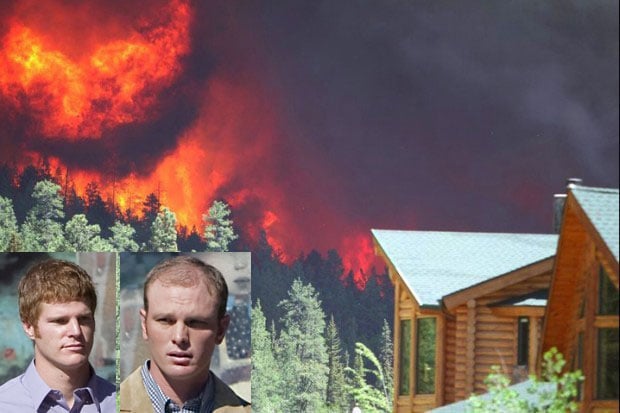
FLAGSTAFF - Two cousins charged with accidentally causing the largest wildfire in Arizona history pleaded guilty Tuesday to a pair of misdemeanor charges after reaching an agreement with prosecutors.
Caleb Malboeuf of Benson and David Malboeuf of Tucson each face up to a year in jail and a $10,000 fine after admitting in federal magistrate court to leaving a campfire unattended and building a campfire without clearing flammable material to prevent it from escaping.
The Malboeufs had each faced five charges and penalties that included more than two years behind bars and $30,000 in fines.
The cousins were camping in Eastern Arizona's Apache Sitgreaves National Forest last May when their campfire spread outside its ring. High winds whipped the blaze, later dubbed the Wallow Fire, which burned more than 538,000 acres in Arizona and parts of western New Mexico before it was fully contained on July 8.
People are also reading…
The Malboeufs told U.S. Magistrate Mark Aspey that they believed the campfire was out because they did not see any flames or any smoke rising hours after they had lit it to cook breakfast. But they conceded that they had not stirred the coals or felt them to ensure it was properly extinguished before they went for a hike.
They smelled and saw smoke near the campsite on their way back.
Investigators for the U.S. Forest Service found David Malboeuf's vehicle at a trailhead about two miles from where they believe the fire started, and the cousins' possessions were at the campsite.
Caleb Malboeuf's attorney, David Derickson, said he believes the cousins should be sentenced to probation instead of jail time.
"These are guys who are experienced campers, who spend 30 nights a year under the stars," he said. "They've started and extinguished thousands of fires. The lesson is, no matter how dead you think a campfire is, you've got to put your hands in there, you've got to pour water on it to make sure it's out."
Assistant U.S. Attorney Patrick Schneider said the plea agreement was a reasonable resolution to a case in which the men had cooperated with authorities and offered consistent accounts of the camping trip. He said he will be soliciting input from fire victims on restitution and sentencing in the coming months. Sentencing is scheduled for June 20.
The fire destroyed 32 homes and four rental cabins, and at one point, nearly 10,000 people were forced to evacuate. The firefighting effort cost more than $79 million.
"Everyone is affected differently by the fire, and there's probably a wide variety of opinions regarding what ought to happen," Schneider said.
Wildfire cases
Most wildfires are never investigated, a General Accounting Office report found last year, and charges are rare.
Investigations did, however, determine the causes of Arizona's most costly blazes in the past decade.
• A Tucson man who ultimately admitted smoking on a trail on Mount Lemmon the day of the 84,000-acre Aspen Fire in 2003 received a sentence of probation and 200 hours of community service in 2004 for initially lying about it.
Kenzo Butler, 23, was not charged with starting the fire, which destroyed most of the village of Summerhaven, burning more than 300 buildings.
• Two people were blamed for starting the fires that grew into the 2002 Rodeo-Chediski Fire, which burned more than 400 homes and 460,000 acres of forest in Arizona's White Mountains.
Leonard Gregg, a seasonal wildland firefighter, admitted setting the Rodeo portion of the blaze in an effort to get work. He was sentenced to 10 years in prison in 2004 and ordered to pay $26 million in restitution.
Valinda Jo Elliott, a stranded motorist who lit a fire to signal a passing helicopter, was not charged with setting the Chediski portion of the blaze because prosecutors could not prove intent.
- Tom Beal


