A dog in Southern Arizona was infected with a flesh-eating parasite that has been popping up in states along the U.S.-Mexico border, the Arizona Department of Agriculture confirmed Oct. 28.
It is the first case of New World screwworm in Arizona since the 1960s.
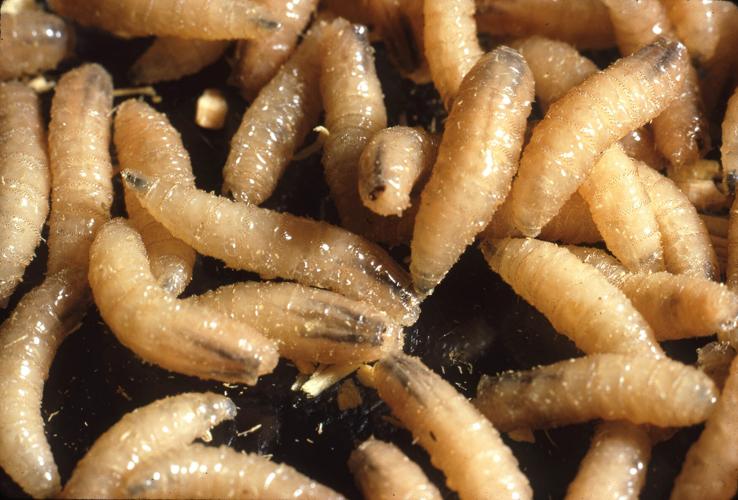
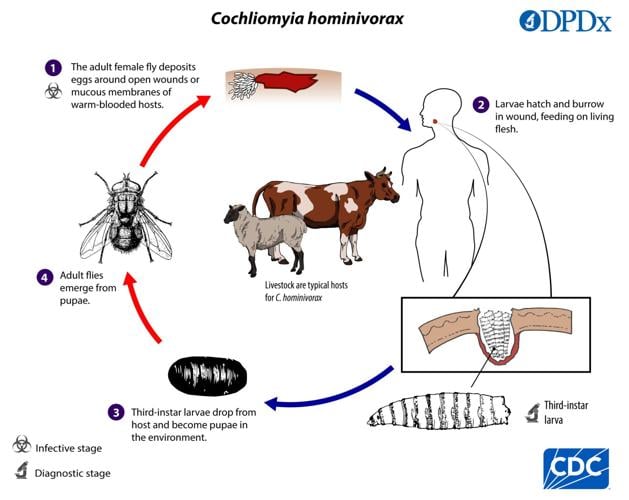
The New World screwworm is a parasitic fly that lays its eggs on the open wounds of warm-blooded animals, where the maggots then burrow and feed on live tissue. The parasite has been historically devastating for the cattle industry and was eradicated from North America decades ago.

Scientists begin work to eliminate screwworms by releasing sterilized male flies to mate with native flies, thereby interrupting the population cycle. Edward F. Knipling, an entomologist at BARC and other ARS laboratories, and fellow entomologist Raymond C. Bushland developed the framework of the sterile insect technique (SIT). By the 1980s, screwworms are eliminated from the United States. Research using SIT continues at ARS laboratories all around the country.
Arizona's first case comes after recent outbreaks in New Mexico and Texas. Dr. Ryan Wolker, the state veterinarian with the Department of Agriculture, said that over the last two years, the fly traveled north through South America, Central America and Mexico before landing in the U.S.
People are also reading…
Earlier this summer, Arizona halted cattle imports after larvae of screwworm were found in a calf in south Texas, but imports resumed two months later.
Wolker said Arizona's case is not particularly dangerous since the infection is not contagious. A New World screwworm fly has to lay eggs in an open wound in order to infect a warm-blooded animal.
"This is a pest, which is a good thing. It's treatable if caught early in domestic animals," he said. "The survivability is excellent."
He said in most cases, "you treat the wound and get rid of all the maggots and then work on healing the wound."
The dog was from a ranch in Cochise County, Wolker said. An infected wound was found on the animal on Oct. 27, and a lab at Iowa State University confirmed it on Oct. 28.
The dog has since recovered, he added.

Chart shows the lifecycle of the New World screwworm.
Wolker said there's other livestock in the area and that the department established an "infested zone" where authorities can monitor adult fly populations and contain the flesh-eating parasite.
The infested zone encompasses a 20-kilometer radius, while the surveillance area circles at least a 20-kilometer radius outside of the edge of the infested zone.
The zone is one part of a "robust" playbook toward eradicating the fly from the U.S., said Paul Brierley, the director of the Arizona Department of Agriculture.
"A lot of the infested zones in Texas and New Mexico that were the initial places with cases are now no longer active because of the process," he said.
What is New World screwworm?
According to the Centers for Disease Control and Prevention, New World screwworm is a parasitic fly that feeds on the flesh of warm-blooded animals, including humans.
It lays eggs in wounds or body openings where the eggs will hatch into maggots, or larvae, that eat live tissue.
The species is typically found in South America and parts of the Caribbean, according to the U.S. Department of Agriculture.
What are the symptoms?
Wolker said hallmark symptoms include a wound with a "significant odor (and) a significant cavitation."
He also said the maggots will align themselves in a vertical pattern within the wound, "kind of like if you're looking at the head of a sunflower."
The CDC said to watch out for:
— Feeling or seeing maggots (larvae) move in a skin wound or sore or in the ears, nose, eyes or mouth
— Painful skin wounds or sores that worsen within a few days
— A foul-smelling odor from the site of the infestation
— Bleeding from open sores
— New World screwworm infestations are treatable if caught early but can be deadly. It is not typically deadly in humans, though, according to the USDA.
Why is it here today?
Wolker said a long-standing biological buffer in Panama and Central America was breached in 2023. The flies then traveled north, whether flying themselves or on animals.
He also pointed to environmental factors, like increased moisture from Hurricane Rachel, as a possible reason for the spread of screwworm.
How do I protect myself and my pets?
While outside, make sure to watch for any flies or open wounds. The only way to be infected is for a New World screwworm to lay eggs in an open wound or other physical opening.
Ultimately, the infestation is treatable and not contagious. Officials with the USDA and Arizona Department of Agriculture are working to mitigate the spread of screwworm across the state and push it back to its home in South America.
"We would really ask that the livestock owners and pet owners and hunters really watch their animals, watch for these strange, unusual wounds that might smell," Brierley said. "We can treat it, we can do everything that's called for in the playbook."