Secretary for the Department of Agriculture Brooke Rollins, Rep. Juan Ciscomani and dozens of USDA officials gathered in Tucson Tuesday to officially open a 15,000-square-foot addition to the Southwest Watershed Research Center in Tucson on Tuesday.
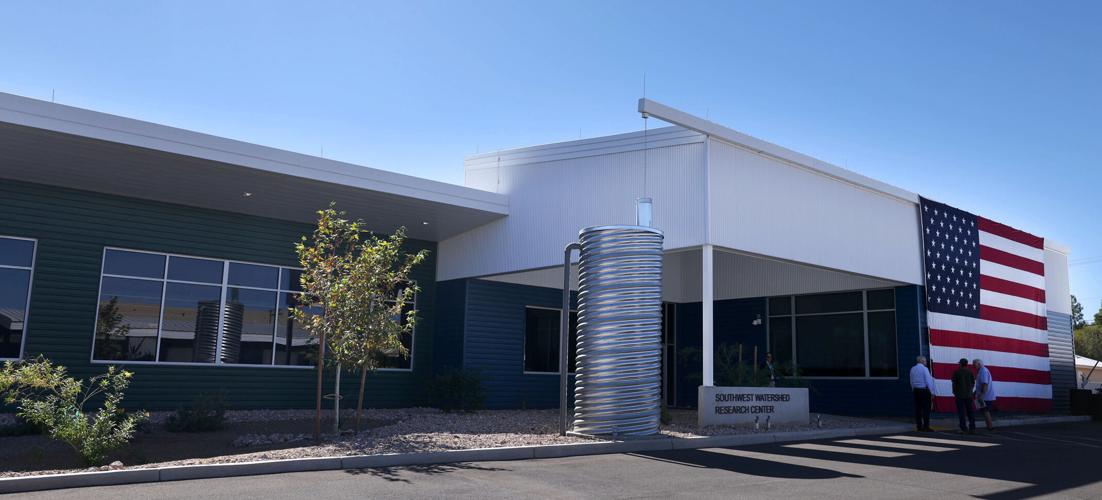
The center near North Campbell Avenue and East Prince Road houses 23 agricultural researchers studying weather patterns, runoff and snowpack, soil erosion, and other scientific areas that support farmers and ranchers, said Research Leader Phil Heilman.
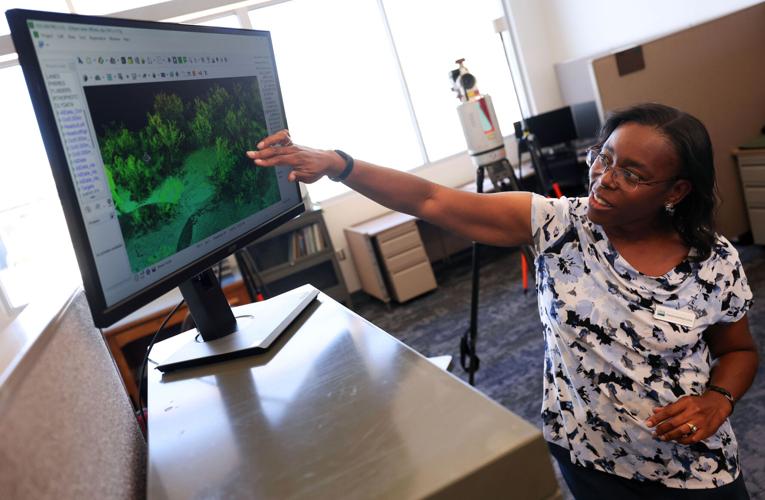
Chandra Holifield Collins studies how vegetation change impacts soil erosion using remote sensing cameras.

The Southwest Watershed Research Center near North Campbell Avenue and East Prince Road houses 23 agricultural researchers studying areas like weather patterns, runoff and snowpack, soil erosion.
“Remote sensing is simply being able to get information about an object or a surface without touching it,” she said.
360-degree cameras scan an area with a laser beam, which maps millions of points of light and displays them as a 3D image. For an area the quarter of a football field in size, about 20 million points of light are taken by the cameras.
People are also reading…

Chandra Holifield Collins, a scientist at USDA-ARS explains her work during a media tour Tuesday of the new Agricultural Research Service Southwest Watershed Research Center, 2000 E. Allen Road.
“That helps ranchers know what is happening on their landscapes, so that they can make good conservation management decisions,” Collins said.
Renovations started in 2019 and cost $12.4 million total. All the employees work for the Agricultural Research Service, the chief research agency within the USDA. The office serves as the laboratory for two field research sites in the region, the Walnut Gulch Experimental Watershed and the Santa Rita Experimental Range site.
The Walnut Gulch Watershed covers 58 square miles surrounding the city of Tombstone and is one of the most measured watersheds in the world, said retired researcher David Goodrich.
The organization has studied half a million precipitation events in the area since 1953, and data from that research has been used to inform the development of stormwater infrastructure.
“We’ve got a really good idea of where the rainfall goes, including groundwater recharge, which is one of the key components to water health in Arizona,” Goodrich said.
The renovations also include two new buildings for honeybee health and pollination studies.
The stop in Tucson by Rollins came on the same day President Trump announced plans to roll back regulations on methane emissions from oil and gas companies. Methane is about 28 times more potent at trapping heat in the atmosphere than carbon dioxide, according to the Environmental Protection Agency.
She downplayed the effects of climate change in a state where farmers are facing drought, extreme heat, water availability concerns and high fuel and fertilizer costs due to the war in Iran.
Rollins said the cuts to clean energy research and climate change were a recalibration from past priorities that weren’t “America First,” pointing to past projects that have been terminated for prioritizing diversity, equity and inclusion.
“I'm not making this up. “Studying food injustice for queer farmers in San Francisco,” and that's the name of the project. That's not me coming up with a name. ‘Looking at the menstrual cycles of transgender men as evidence through mice.’ ‘Looking at the racial injustice in the pest control system,’ she said.

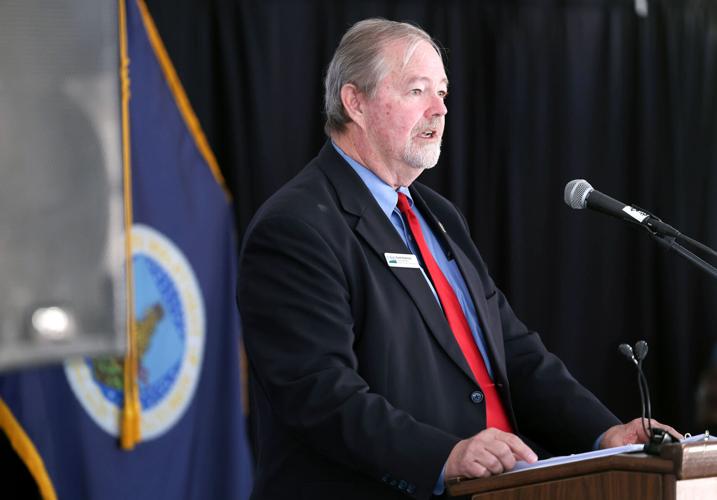
Scott Hutchins, under secretary for the USDA’s Research, Education, and Economics Mission speaks Tuesday at Southwest Watershed Research Center in Tucson.
As long as agricultural systems are durable, they can weather impacts from climate change, said Scott Hutchins, undersecretary for research, education and economics.
“Durability is a trait. Resilience is a state. So the more that we can build into our plants, our animals, and our cropping systems and our soil systems durability for all conditions, whether they're one-time effects or whether they're gradual changes, we're going to be successful in agriculture,” he said.
The USDA has also been coordinating with the state agencies to track cases of the New World Screwworm, a parasitic fly that feeds on livestock. On Oct. 15, New Mexico officials confirmed two new cases of the screwworm in southwestern New Mexico, about 10 miles from the Arizona-New Mexico border. Much of Las Cruces, New Mexico’s second-largest city, is now considered part of an “infested zone,” according to the Santa Fe New Mexican.
One of the USDA priorities is keeping the US free from invasive species and pests, Rollins said.
“That's a daily effort and one that's really working incredibly successfully at this point in time,” she said of the screwworm.
There are currently 66 cases of the screwworm in Texas and New Mexico. Rollins applauded the number of cases, comparing them to a record high of 90,000 during the country’s worst outbreak in 1971.
There are currently no reported cases in Arizona, but state officials are urging farmers with livestock to know the symptoms and to report any potential cases to the state veterinarian.
Chandra Holifield Collins, a scientist at USDA-ARS explains her work during a media tour Tuesday of the new Agricultural Research Service Southwest Watershed Research Center, 2000 E. Allen Road.
Hannah Cree covers local government for the Star. Reach her at hcree@tucson.com.

Hannah Cree
Government Reporter