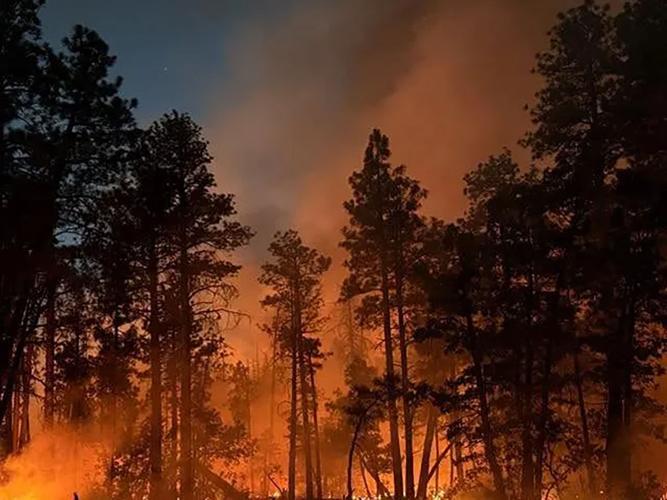
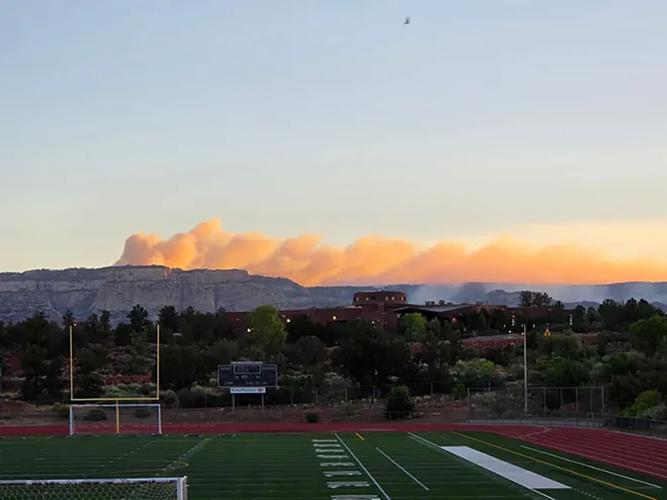
OAK CREEK CANYON — Jenny Kittredge bypassed the road closure separating Sedona from Oak Creek Canyon and drove 10 miles to the wooded resort she owns off Highway 89A. The road was empty.
“It was like a ghost town,” she said.
A few miles west, a cloud of smoke cloaked red rocks at the canyon’s rim.
On June 19, the Pocket Fire ignited seven miles outside of Sedona, prompting evacuations and sending Kittredge into a panic. The wildfire was edging closer and closer to the place where she lived, worked and grew up.
More than a month after the fire started, crews finally contained it completely. By then it had burned over 27,000 acres, an area larger than Sedona itself. Natural wildfires, those not started by humans, in northern Arizona are ecologically beneficial. But the landscapes they're native to are changing.
People are also reading…
Over the last decade, drought has dried out forests. A century of fire suppression has crowded them with vegetation. Stands of ponderosa pine have become matchstick forests. As a result, the amount of land that fires burn up every year is growing in the West, though the actual number of wildfires remains consistent. All the while, development is encroaching on those forests, exposing more people to the threat of severe wildfire.
For many living in the wildland-urban interface, where human development and forests meet, wildfire is driving up the cost of living. As the hazard mounts, insurance companies are raising rates on homeowner premiums or pulling out of communities altogether, leaving residents without coverage and vulnerable to the debilitating costs of natural disaster.
That risk is increasingly affecting business owners like Kittredge. Three years ago, she opened her mailbox and pulled out a letter she wasn’t expecting: a notice of nonrenewal from her insurance company dropping the resort completely from its property insurance plan. The company’s reasoning? Wildfire.
In 2022, 642 homeowners insurance policyholders were issued non-renewals in Coconino County, according to a Senate committee investigation published in 2024. Not all of the non-renewals can be attributed to decisions made by companies to drop customers. But the data revealed that climate change-related natural disasters are driving rising non-renewal rates from Florida to California, making living and working in forested areas more risky and less affordable.
“Because of that,” Kittredge said, “we are in a much more difficult situation right now.”

In this June 2026 file photo, smoke rises above the Pocket Fire near Sedona. Climate change-related natural disasters are driving rising non-renewal rates from Florida to California, making living and working in forested areas more risky and less affordable, a Senate committee investigation published in 2024 says.
How natural disasters drive up insurance costs
Oak Creek Canyon has a wildfire risk higher than 99% of other communities in the country. Just as in other parts of the region, though, that risk has evolved over the last few decades.
There are three main drivers of fire activity today, according to Justin Angle, a professor at The University of Montana and co-author of “This is Wildfire: How to Protect Yourself, Your Home, and Your Community in the Age of Heat.”
“The first and the most significant is the effect of climate change,” he said.
The conditions that make up fire weather — a volatile combination of temperature, heat and wind — align more often. Hotter temperatures suck water out of the atmosphere, sapping humidity levels and drying out plants. Since 1973, the number of fire weather days per year in northeast Arizona has increased by 58, according to Climate Central, a research and news nonprofit.
Today’s wildfires are also made worse by a legacy of fire suppression. During much of the 20th century, forest managers waged a war on wildfire. Instead of allowing some fires to burn for the ecological benefit they provide, officials extinguished them. Over time, that allowed fuels, like dead plant debris, to build up, Angle said.
But even as forests become more flammable, more and more people are moving into the wildland-urban interface.
“Homes are being built in places intermixed with forests which puts more structures in proximity to stuff that can burn,” he said.
Since 1990, the number of houses across Arizona in the wildland-urban interface has increased exponentially. In Coconino County, where Kittredge lives, that number went up 70% between 1990 and 2020, according to an Arizona Department of Forestry and Fire Management report.
That means insurance companies are contending with more risk — and climate-oriented risks are correlated, Angle said. When the likelihood of wildfire goes up, so does the likelihood of flooding.
Natural catastrophe is driving insurance losses worldwide. In North America, losses caused by wildfires are rising by more than 14% every year. A majority of that increase is because of population growth in high-risk areas and changing fire weather patterns, according to Swiss Re, a major reinsurer.
The Southwest accounted for the most structures destroyed by wildfire in the country in 2024, according to the Insurance Information Institute, largely due to wildfires in Arizona and New Mexico.
In response, companies have raised the price of property insurance premiums. Between 2018 and 2022, homeowners insurance premiums across Arizona went up by 20%, according to a 2025 report from the state’s Resiliency and Mitigation Council. That uptick is less than in neighboring states like California, where premiums have increased by nearly 40%, but still amounts to a significant change for homeowners.
To quantify wildfire risk, insurance companies typically use a scale that ranks communities based on their fire prevention and suppression capabilities, like risk reduction efforts, fire department proximity, water resources and road access. Under the Insurance Services Office’s Public Protection Classification system, that scale runs from one (the best) to 10 (the worst).
Usually, private companies won’t insure communities classified as 10s, according to the Arizona Department of Insurance and Financial Institutions. Thirty-eight communities in the state rank 8 or worse. Parts of northern Arizona near Sedona and Flagstaff rank 10.
In Arizona, 2020 and 2021 were big years for wildfires. Nearly a million acres burned in 2020 and over 500,000 burned in 2021. In the aftermath, non-renewals in certain counties climbed, including Coconino, Greenlee and Navajo County, according to a University of Arizona analysis.
“The other piece of the puzzle here is that insurance markets are highly regulated,” Angle said. When states put limits on how much providers can raise prices, many companies respond by pulling out of at-risk areas altogether, leaving families like Kittredge’s without options. The trend is clearest in California, where over 11 major companies pulled out of the state or reduced their coverage as of 2025.

After fires, insurance 'is just impossible'
In 1930, Kittredge’s grandfather, Robert Sr., bought a plot of land in Oak Creek Canyon and began building what would become her family’s legacy: a cabin-style resort nestled among the ponderosa pine, Douglas fir and sycamore trees.
“He envisioned an artist's citadel in the woods,” she said. He was a sculptor, as was her grandmother, Mary. A framed photo in the hotel office shows a young Robert Sr. and Mary in wide-brimmed cowboy hats. Over the course of 50 years, the family built 16 structures weaving along a cobbled road on the south side of the creek. Not all of them were originally meant to be cabins. In the early days, one was a barn for Percheron horses Robert Sr. borrowed from a lumber mill in Flagstaff, now called "the barn house." Over time, each was renovated or built anew and rented out.
Eventually, the business was passed down to Kittredge’s father and, most recently, to Kittredge herself.
She's learned from her predecessors about tending to the land and withstanding wildfire. But growing up on the property, she’s also witnessed firsthand how the forests are changing.
“Listening to my parents talk about their experiences, it seems like wildfire was a much less common occurrence that they had to deal with,” Kittredge said. “It's something that I’ll have to deal with more and more.”
In the 40 years that her mom has lived in the canyon, she remembers only three fires that forced the family to evacuate, all of them in the last decade or so. One of those, the Slide Fire, burned right up to their property line. Kittredge was studying abroad in Greece when she got a call from her mom.
“They are letting us back in for five minutes,” she remembered her mom saying, “do you want me to grab anything for you?” They thought the Slide Fire would take everything they had. It didn’t, but smoke swallowed the resort, seeping into the walls.
Property insurance enabled them to restore the damage caused by smoke without paying out of pocket. For businesses like Forest Houses Resort, insurance helps cover the costs of any kind of damage caused to structures by wildfire, storms, flooding or accidents. After the Slide Fire, her parents were reimbursed for loss of income, which meant they were able to pay their staff while the resort was closed for repairs.
The Pocket Fire was the first major wildfire Kittredge has dealt with as owner and manager of the resort, and unlike her parents and grandparents, she’s doing it without that crucial safety net. After the resort was dropped from its property insurance, Kittredge talked with agents in Arizona and around the country looking for a solution.
“All of the insurance agents came back saying the same thing to me,” she said. “That it's just impossible right now.” No insurance carriers would offer her a quote. Even if a company did, she said it would likely be too expensive. “We couldn't even afford it if we wanted to.”
One agent told her that her only option was to save up enough money to deal with the potential costs on her own — essentially to “self-insure.”
“That’s impossible,” she said.
This summer, the resort closed for nearly an entire month during one of its busiest seasons while the Pocket Fire burned. “It was really stressful for me to try to figure out how to keep my employees paid while we were closed, how to keep the property safe with just the resources we have,” Kittredge said.
Losing their property insurance means that events unrelated to wildfire, like roof damage from hail, are also no longer covered.
“It's become really apparent that we need to be ready for anything,” she said. “We have no backup. We just have to be able to rely on ourselves.”
Thirty-three U.S. states offer state-managed “last resort” plans for property owners who are unable to get insurance through private companies. The so-called FAIR plans are “like catchalls,” said Dennis Riccio, president of Central Arizona Association of Realtors. Arizona doesn’t have one.
The state plans aren’t perfect, but they’re “better than nothing,” Angle said. Generally, the plans are more affordable, but the coverage isn’t as comprehensive.
“The state governments are taking on a lot of risk, and that means the taxpayers are taking on a lot of risk,” he said. “You might be able to buy a house and prove that you have insurance, but when your house burns, you might not get a claim for what you think the house is worth.”
If enough houses in a state go up in flames, and enough claims are made, the state could face a real financial crisis, he said.
Kittredge is hopeful Arizona will implement some kind of FAIR plan. As of now, if a fire were to burn through the 20 acres where Forest Houses Resort sits, she said her family would lose everything.
“What would we do? Would we just walk away? Is there any way we could rebuild? It’s a constant worry,” she said. “Everything that we've worked for and loved for the last nearly a century could be gone in an instant without any hope of rebuilding.”
At an individual level, there are ways property owners can make their homes and businesses more resilient to wildfire, Angle said. It’s called fire-hardening, and it includes anything from cleaning out gutters to replacing wooden roofs with metal ones. Those individual efforts compound to make more fire-resilient communities.
Every year Kittredge works to clear invasive and highly flammable cheatgrass from her property. Every year it grows back. She clears other kinds of vegetation away from the cabins, too, and updates roofs with fire-proof materials. She’s always thinking about what more she can do to protect the hotel.
Insurance companies pay attention to fire-hardening investments, sometimes giving people coverage where they wouldn’t otherwise or adjusting rates.
So far, for Kittredge, her efforts haven't made a difference in the eyes of insurers.
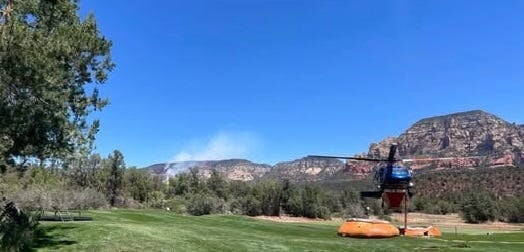
In June, the Pocket Fire was burning about seven miles north of Sedona in the Oak Creek Canyon area.
Tourist businesses struggle after fires
Over a decade ago, during my first visit to the Grand Canyon, my family and I stayed at the Butterfly Garden Inn (since renamed and under new ownership) in Oak Creek Canyon. At twelve years old, I walked around the hotel property captivated by the bright green leaves and striated red rock, so different from the Florida swamplands I grew up in.
All year, tourists from around the country, like my family, flock to the Grand Canyon and Arizona's other natural wonders. Visitors stop, shop and stay in nature's gateway cities like Flagstaff and Sedona. They descend into the cool canopies of Oak Creek Canyon and splash around at Slide Rock State Park.
But when wildfires ignite, tourism slows. Fires shut down highways, burn through hiking trails and send plumes of smoke into the air. For places that depend on outdoor recreation, lingering smoke from even a distant wildfire can deter visitors.
When it comes to wildfire, there are direct and indirect consequences, said Melanie Colavito, the Deputy Director of the Ecological Restoration Institute at Northern Arizona University. Indirect effects of wildfire can include everything from structural damage to post-fire flooding.
“Then there’s business disruption,” she said. “ Lost wages, lost income, lost revenue.”
This summer, State Route 89A into Oak Creek Canyon was closed to visitors for nearly a month, as were many of the businesses along the route, including Forest Houses. Over 14 popular trails were closed at least through July. On Sept. 17, U.S. Forest Service officials finally reopened Oak Creek recreation spots and some trails around the canyon.
Others, including major attractions like the Slide Rock swim area, remained closed until Oct. 1. Fire damage and flood risk during the height of monsoon season made burned areas more hazardous, the Forest Service said. Recent flooding at the Grand Canyon shows how big wildfires can put hikers at risk a year later.
“We’re sending up the message that it’s absolutely safe to come; Sedona itself is not on fire,” Sedona Lodging Council President Debra Shinn told Red Rock News in July. “But the big story is the pace is down, the future bookings are way down.”
A recent preliminary study from researchers at the University of Colorado, Boulder examined how severe wildfires can impact visitation at national parks for years afterward. Researchers found that the average wildfire diminished visitation at burned sites in Colorado national parks by 8% in the year of the fire. Those declines never bounced back to pre-fire levels over the next five years. After more severe fires, visitation toppled by as much as 15%. The effects of wildfire on visitation were more obvious in forested ecosystems, as opposed to grasslands. A separate 2020 San Francisco State University analysis of fire and tourism in the Sierra Nevada showed that after a 2018 fire that shut down Yosemite National Park during peak tourism season, nearby Mariposa County saw a $46 million decrease in visitor spending.
But fire isn't all bad.
”Sometimes wildfires make communities safer,” Colavito said. There are benefits to wildfires, which have burned through Arizona’s ponderosa pine forests at regular intervals for millennia. Fire reduces fuel load and revitalizes ecosystems. Over time, in fire-adapted landscapes, frequent small fires can help protect communities from the large-scale wildfires that debilitate them.
Closures are a hardship for business owners, Kittredge said. During the Pocket Fire, there were 120 cancellations at Forest Houses Resort. In the aftermath, 10 more guests canceled stays because of post-fire flooding concerns.
“On top of that," she said, "if businesses can't get insurance, that's a further hardship.” Not everyone has the resources to self-insure. She predicts that climate change will make it harder for people to start and maintain businesses in high wildfire risk places like Oak Creek Canyon.
She worries that without property insurance, small business owners could be essentially priced out of the wildland-urban interface, and that only big corporations will be able to take on the financial risk of wildfire, changing the character of places like Oak Creek Canyon entirely.
“This is something that we're going to see the effects of for many years as the business recovers from the debt we took on this summer,” Kittredge said.
Long after the flames have been extinguished and the smoke has dissipated, the repercussions of wildfire linger. Every summer she feels like she's living in limbo, preparing for a disaster that might not come.
“There’s such value in these beautiful places that bring a lot of revenue to the state," she said. More than that, she knows places like Oak Creek Canyon have become part of the fabric of a wilder imagination. "They mean so much to everyone in the West."
And especially to her family, who nearly 100 years ago staked their futures in its forests.