Across Arizona’s high country, mountain streams are getting a little busier as wildlife crews return Gila trout to their native waters. In October, the Arizona Game and Fish Department and its partners stocked the threatened fish in Chase and Bonita creeks along the Mogollon Rim to support the species’ recovery.
The fish were supplied by the Mora National Fish Hatchery in New Mexico, operated by the U.S. Fish and Wildlife Service, which has been breeding and raising Gila trout since 1999, according to the Game and Fish Department. The effort is part of a broader campaign to rebuild populations of Gila trout, which remain classified as threatened under the Endangered Species Act of 1973.
In 2006, the USFWS reclassified Gila Trout from endangered to threatened and allowed recreational fishing of the trout in Arizona and New Mexico in areas that would not hurt the species’ recovery.
People are also reading…

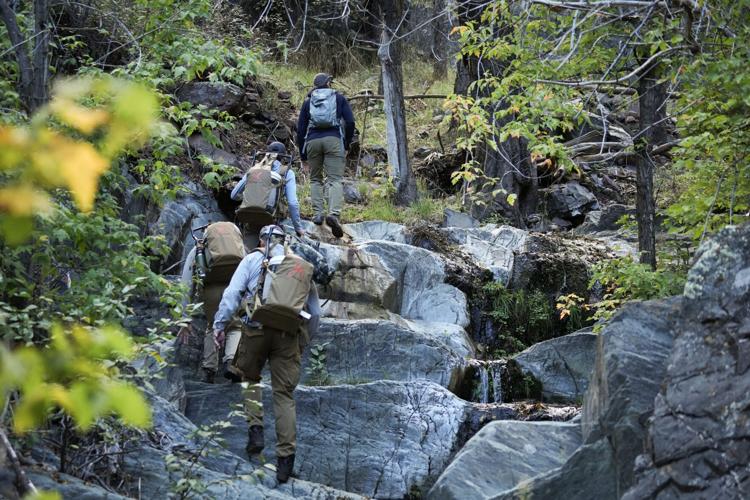
Arizona Game and Fish Department staff make their way up to Grapevine Creek in the Bradshaw Mountains to release Gila trout, as part of conservation efforts to increase the species of fish.
Twenty years later, the work continues to reintroduce Gila trout back into streams, but before that can happen, each fish is documented.
Each individual trout was measured and implanted with a microchip tag before release so an AZGFD biologist can track how the fish grow, survive and disperse throughout the watershed over time. Not all streams are created equal, as careful selection of streams and watersheds is necessary for the Gila trout’s survival.
Alex Loubere, AZGFD biologist, described how locations are selected: “We identify recovery streams based on whether they have suitable characteristics to hold trout, for one, and then for another, for a stream be a Gila trout recovery stream, it also has to fall within Gila trout’s historic native range.”
Loubere said there are only a handful of populations left, which were primarily in New Mexico, adding that historical data helps biologists determine the Gila trout’s native ranges in Arizona that lend themselves to being suitable for trout to inhabit.
Overfishing, drought, wildfire threaten Gila trout
Historical declines of the Gila trout were attributed to land use practices and direct harvest by settlers who relied on the fish for subsistence, but the threats persist through competition and interbreeding with nonnative trout, along with habitat degradation, which all contributed to their decline.
Today, drought, wildfire and the debris-laden runoff that follows a fire complicate efforts to maintain healthy populations. Protecting the Gila trout requires more than stocking streams; it requires a suitable habitat, monitoring, and watersheds capable of holding water through dry periods.
Before introducing Gila trout, AZGFD biologists determine whether a stream falls within the species’ historic native range and offers a suitable habitat

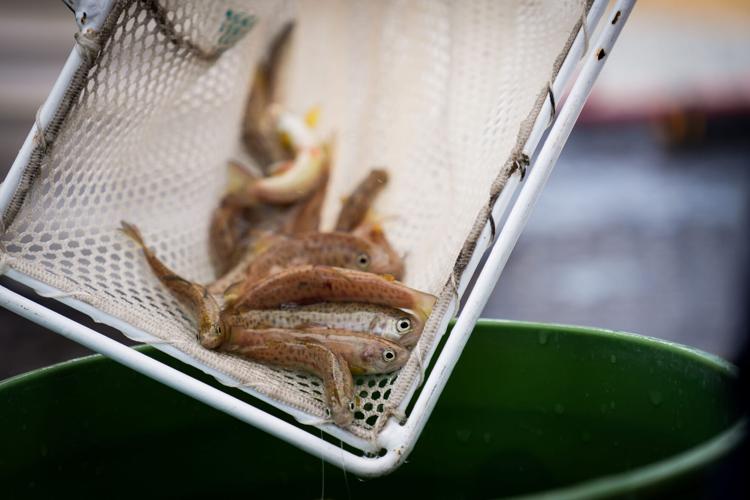
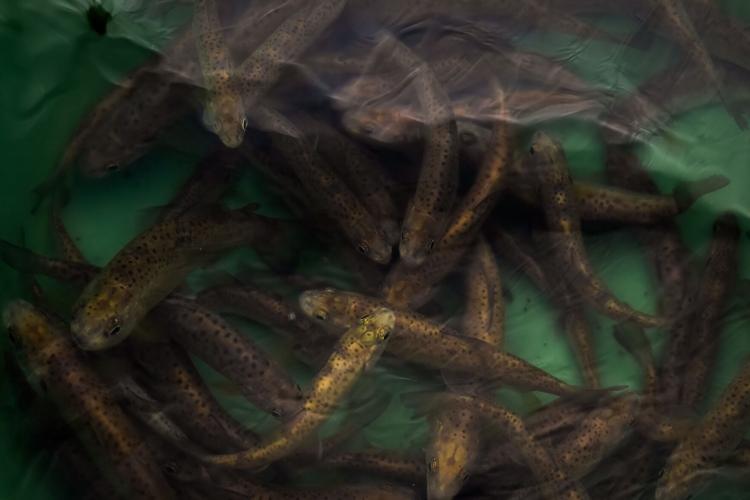
Gila trout are placed into a bucket before being transported to their new habitat by the Arizona Game and Fish Department.
They evaluate water availability, temperatures, nonnative trout and the genetic lineages represented in existing recovery populations. They also consider the distance between populations to reduce the likelihood that a single wildfire could affect multiple recovery sites.
The 2017 Goodwin Fire eliminated the Gila trout population that was introduced to the area in 2009. AZGFD restarted the population in 2019 through three stockings involving fingerlings and eggs. Grapevine Creek has received recent additions of Gila trout from other creeks.
“All of that burned debris washes into the stream and that chokes out the stream and can actually kill the fish that way,” Loubere said, explaining how wildfires strip away vegetation and destabilize soil, leading to the death of the Gila trout.
Restoring watersheds after wildfires
Trout Unlimited, a non-profit conservation organization, said their work is to restore watersheds, working on project planning, engineering, fundraising, and volunteer participation. Together with tribal and federal partners, their work addresses both trout and the conditions they need to survive.
“The type of work that we do ... goes from wildfire mitigation and prevention all the way to mining reclamation to native trout recovery and habitat restoration,” said Nate Gann, Trout Unlimited's Southwest communications director.
According to Gann, Trout Unlimited restores headwaters of major river systems, including the Salt and Colorado rivers, by reconnecting streams with wet meadows and floodplains. Those connections allow snowmelt, storm runoff, and monsoon season flow to spread across the landscape and soak into the soil rather than rush downstream carrying sediment.
Wildfires can disrupt that connection by stripping away vegetation and increasing runoff. Those changes can accelerate downcutting, a process in which soil erosion deepens stream channels and separates them from surrounding floodplains.
Nate Rees, Trout Unlimited's Arizona state director, described how the 2011 Wallow Fire, a blaze that consumed 538,049 acres of the Apache-Sitgreaves National Forest, damaged these systems, where powerful flows deepened stream channels, carried away sediment, and degraded meadow systems.
“We’re trying to restore those, and so when we talk about a wet meadow sponge, we’re trying to bring it back to what it was, even pre-settlement, a couple of hundred years ago and how they function when you have a stream that’s connected to its floodplain,” Rees said.
Rees said Trout Unlimited has 14 restoration projects in Arizona, mostly in the Apache-Sitgreaves and Tonto National Forests, underscoring a broader restoration effort to restore the state’s streams.
Working with anglers to track the trout
Their conservation work extends beyond stocking fish and restoring habitats to engaging volunteers and educating students. Through "Trout in the Classroom," a partnership with AZGFD, students in about 45 classrooms statewide raise trout from eggs to fingerlings while learning watershed health.
“With my work with Game and Fish, that’s basically what we’re doing… trying to come up with new ways to get fishing and conservation out to the public,” Alec said. “That’s the kind of goal, just more education, more opportunities for them to join in what we’re doing,”
AZFGD's trout challenge encourages fishing participation and collects angler-reported information about catches. “There are two trout challenges, one that deals specifically with wild, naturally reproducing populations of tout and the one that’s more for including restocked populations,” said Loubere.
The challenge encourages anglers to explore the state’s trout waters while supporting conservation. An interactive map on the department’s website helps anglers find specific species and check for special fishing regulations.

Gila trout have been listed as threatened under the Endangered Species Act since 2006, but efforts by the Arizona Game and Fish Department have help raise the population in the Bradshaw Mountains.
Loubere said anglers help biologists by reporting their fishing experiences through online surveys for Gila and Apache trout. Their feedback helps the department understand how anglers use streams and guide management decisions.
The department also provides cards with a QR code linking to a survey where anglers can report the species they caught, including location.
“It gives us not only a sense what people are catching, but just how many people are out there fishing for Apache and Gila trout on specific waters,” Loubere said.
The long-term goal is to restore suitable habitats to support resilient Gila trout populations and eventually remove it from the threatened species list. Reaching that point means pairing fish management with habitat protection, selecting appropriate streams, preserving genetic lineages, tracking populations and restoring the land’s ability to hold water Gila trout depend on.
Environmental coverage on azcentral.com and in The Arizona Republic is supported by a grant from the Nina Mason Pulliam Charitable Trust.


 Coral research with Tucson ties shows El Niño growing stronger as planet warms