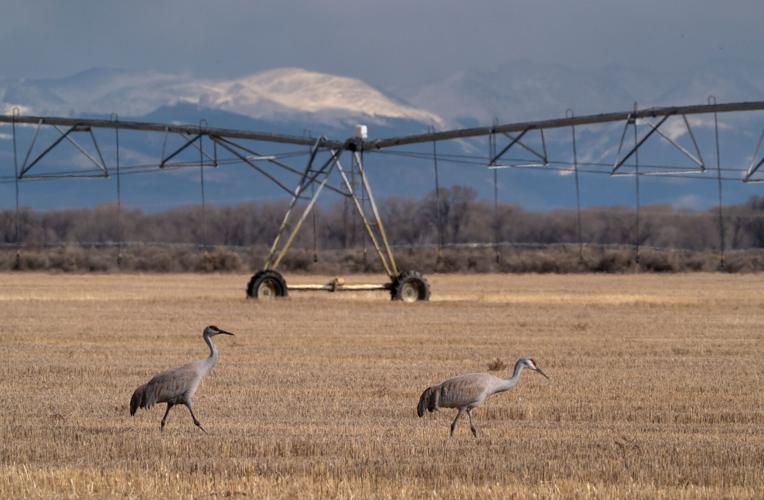
SAN LUIS VALLEY, CO — At twilight, birders gathered in freezing fog on the outskirts of a farm field, binoculars at the ready. They huddled behind cameras with two-foot-long lenses and kept their eyes carefully trained on the horizon. The sun rose, illuminating the snow-capped Sangre de Cristo Mountains at the eastern edge of the valley.
And the sky erupted.
Thousands of sandhill cranes woke from a soggy slumber in the wetlands on the Monte Vista Wildlife Refuge. Ribbons of birds broke off from the mass, streaking in every direction.
A few hundred descended on the field in front of the spectators, where the birds went scavenging for their breakfast: bugs and barley.
Every spring and fall, Rocky Mountain sandhill cranes, a sub-population of the greater sandhill crane, migrate across the West from the southern reaches of Arizona and New Mexico to the northern Rockies, for which they’re named. Throughout the journey, the red-capped cranes depend on a network of wetland oases and rich agricultural fields in otherwise dry deserts.
People are also reading…
The San Luis Valley is one of those junctures, a critical rest stop that nearly the entire population of 25,000 travels through before dispersing to their breeding or wintering grounds.
“It’s a real linchpin for this population,” said Jenny Nehring, a wildlife and wetlands biologist. “They absolutely depend on the valley for resources during migration.”
But water resources in the region are increasingly strained, like they are across the West. Over a century of groundwater pumping has depleted the valley's aquifers, and a decades-long drought is doing little to ease the shortage. Drier and warmer winters are delivering less snow to the San Juan Mountains that supply the Rio Grande River, causing a domino effect of downstream consequences for agricultural producers and wildlife: Natural riparian areas are drying up, managed wetlands are on life support, flood-irrigated ranches are facing water restrictions and farmers are fallowing their land.

Sandhill cranes dance in a barley fielding March at the Monte Vista Refuge National Wildlife Refuge, north of Monte Vista, Colorado.
Cranes are taking notice. Already, some are forgoing their full winter migration to Arizona and New Mexico, instead choosing to stay north when warmer conditions allow.
The places where people manage water are often the most resilient because they serve a dual purpose, said Erica Hansen, a water and wetlands coordinator for Intermountain West Joint Venture.
“It benefits the producers, it benefits the cranes,” she said. The future of Rocky Mountain sandhill cranes’ ancient migration is inextricably linked to the future of water in the West and to the farmers and ranchers who’ve worked the land for generations. But scientists wonder if climate change could decouple that ecological partnership and fragment the flyways cranes have used for 2.5 million years.
“If we start to see those places dry up,” she said, “it will become increasingly difficult for cranes to complete their annual migrations and more difficult for them to find appropriate breeding habitat across the Intermountain West because that habitat is so rare.”
Cranes swap wetlands for farmlands
In Monte Vista, sandhill cranes are a big deal. Visitors pose in front of crane murals, buy crane-themed merch and wake up at dawn to marvel at the birds’ morning ritual. It’s one of several stops on the cranes’ annual tour that draws crowds from all over the country. Every year, hundreds of avian enthusiasts travel to festivals in Arizona, New Mexico and Colorado to celebrate their arrival.
“There’s something very archaic and haunting about their call,” Nehring said. “People really connect with it.”
Millions of years ago, the five-foot-tall cranes existed alongside other prehistoric megafauna like saber-tooth tigers and mastodons. They are one of the oldest living bird species — a “living dinosaur" — and they haven’t changed much, though the world they inhabit certainly has.
Historically, cranes roosted in wetlands created by seasonal flooding along rivers across the West, feasting on tubers, frogs and seeds. During spring, snowmelt would surge into rivers like the Rio Grande, sending shallow floods across their valleys.
“In Albuquerque, they used to describe the Rio Grande as being a mile wide and an inch deep,” said Tucker Davidson, a senior associate of water conservation at Audubon Southwest. It spawned a marshy mix of plants and bountiful sandhill crane roosting grounds.
In deserts, humans also flocked to those valleys where water was more abundant.
As the landscape changed, sandhill cranes learned to take advantage of new resources. When large-scale agriculture spread across the West in the 19th and 20th centuries, cranes came to enjoy snacking on grains leftover from harvest season and roosting in flooded meadows where ranchers grew hay and other crops.
Today, that “ribbon of green” that makes up the Rio Grande floodplain is mostly in private hands, said Nehring.
“Those lands are flood-irrigated — meaning that water is withdrawn from the river and spread over ditches across the landscape,” she said.
Over 90% of wetland habitat that sandhill cranes use is on private lands. Called “working wetlands,” they mimic natural hydrologic cycles and are part of the cranes’ critical flyway.
It’s an unlikely symbiosis — one that cranes have come to depend on, researchers say.
But the amount of available wetlands in the West used by sandhill cranes is shrinking. A 2021 study found that between 1988 and 2019, they declined by 18%.
In the San Luis Valley, one of two essential rest-stops during their migration, it’s happening rapidly, said Patrick Donnelly, a research scientist and faculty affiliate in the University of Montana's Wildlife Biology Program who worked on the 2021 study.
”There are different types of wetlands that all make up different parts of the sandhill cranes’ ecology,” Donnelly said. “They're all declining equally at high rates within the San Luis Valley.”

Sandhill cranes take flight in March at Colorado's Monte Vista National Wildlife Refuge.
Traditionally, agricultural practices support migratory bird networks. Ranch land was flooded in the fall, frozen in the winter and thawed in the spring, providing habitat to cranes flying in from the south.
But water conflict in the valley resulted in new regulations meant to inspire sustainability. Under mounting pressure, producers are shifting away from flood irrigation, looking for ways to conserve — which could mean losing more crane habitat and a system that serves an ecological dual purpose.
“Flood irrigation isn’t wasting water," Donnelly said. Eventually that water seeps into the ground, replenishing the aquifer, supporting wetlands and improving biodiversity.
“ We don't want that piece to be lost in these larger conversations about water and drought,” Hansen said.
Worsening drought threatens rural areas
In Hooper Junction, Colo., a town of 76 people, the Beiriger brothers sat around a table at Ruby Rose Cafe sharing a pot of coffee. Outside, the sky littered flurries of snow across straw-colored fields.
Jim, Mark and Dennis Beiriger are fourth-generation farmers. They've been working what used to be their father’s land since 1998. The water in the valley runs in their blood just as it does in their potato fields — at least, it used to.
Almost anyone in the San Luis Valley will report that the unconfined aquifer below their boots used to be so plentiful that they could stick a pipe in the ground and water would spout out of it.
The water table should be right underfoot, said Laura Cusick, the executive director of the Rio Grande Headwaters Land Trust. These days, not so much.
At 7,600 feet above sea level, the valley is the highest alpine desert in the United States. Every year it gets about 7 inches of precipitation, according to the National Weather Service — even less than places like Willcox in southern Arizona.
Mostly, it relies on winter snowfall in the surrounding mountains to replenish the Rio Grande and bring water downstream. For over 100 years, farmers and ranchers have relied on that surface water to irrigate their fields, where they grow barley, alfalfa and potatoes. (The San Luis Valley is the biggest producer of potatoes outside Idaho, and there’s a good chance the six-pack of Coors at your local gas station was made with its barley.)
Following droughts in the 1930s and 50s, farmers turned to the abundant groundwater from two underground aquifers. Groundwater use soared, though few laws existed to regulate it. The same is true across the Southwest. The Willcox Basin, the underground aquifer that supports the wetlands where Rocky Mountain cranes roost in Arizona, has been regulated only since 2024.
From 1950 to 1959, nearly 2,000 wells were dug in the San Luis Valley, according to a 2025 report. Farms without surface water rights relied solely on groundwater.
“We were just poking holes down all over in this valley, making wells and pumping water,” said Rob Jones, a third-generation potato farmer.
In the mid-20th century, Colorado was also using “the lion’s share” of the Rio Grande’s water, he said. The headwaters of the river start in the San Juan Mountains and flow through nearly 2,000 miles of desertland to the Gulf of Mexico. But not enough water was making it across the border to New Mexico and Texas.
“Whiskey is for drinking, water is for fighting over,” Jones said. “It’s an old saying, but it’s true.”

Sandhill cranes feed in a barley field on the Merdith farm north of Monte Vista, Colorado.
In 1938, the three states signed the Rio Grande River Compact, which allocated water for the river’s downstream beneficiaries.
More recently, the valley’s climate has been changing. In the last two decades, precipitation levels veered downward, and the hydrologic calendar has shifted, said Sally Wier, a groundwater conservation project manager at Colorado Open Lands.
The irrigation season, when producers are allowed to start tapping into their water rights, is starting earlier and earlier so that landowners can make use of what little water melts down the mountains during unseasonable spring heatwaves. This year it started two weeks ahead of schedule, on March 16.
“Our snowpack regime has been shifting,” Wier said. Snow provides the majority of water to the Rio Grande, but the volume it receives is declining — since 2000, by 17%.
Today, the Rio Grande’s average flow is only 85% of what it was in the 1930s. Scientists say it could shrink even further. With less available surface water, more strain is put on the aquifers. Since the turn of the century, the valley’s unconfined aquifer has lost one million acre feet of water.
“ We just don't get snowpack and run off and recharge like we used to,” said Cleave Simpson, a Colorado State Senator from the San Luis Valley. “ This aridification, this drying, has the potential to just destroy rural Colorado.”
Some cranes skip winters in Arizona
Rocky Mountain sandhill cranes are feeling the loss. Their population remains stable for now, but their migration patterns are shifting, creating challenges for wildlife officials who manage wetlands along their path.
“Water scarcity and changing water use policy in the San Luis Valley are reconstructing wetland distributions and cranes are changing their distributions in kind,” Donnelly said.
Those distributions have been constantly changing over time, said Jim Gammonley, an avian researcher with Colorado Parks and Wildlife. But a few things have been constant. The majority of the population summer up in the northern Rocky Mountain states, virtually the entire population migrates through the San Luis Valley in the spring and the fall, and then they move down to traditional wintering areas in New Mexico and Arizona.
“Their decisions about where to move, when to move and how far to move are, are flexible,” he said, determined by the conditions that they're facing.
Call them lazy or call them efficient, Donnelly said — they are big birds, and when they fly, they lose a lot of calories, so they try to minimize movement.
Now, they are curtailing their seasonal journeys in favor of climate convenience.
About 5,000 members of the Rocky Mountain population have historically used stopover sites in western Colorado near the Gunnison River when migrating from their summer stays to their winter ones in Arizona and New Mexico, Gammonley said. But they’ve started spending longer periods in their northern summer range and stopped journeying all the way to Arizona and New Mexico for winter.
“That's a pretty big change in a fairly small population of a pretty significant portion of the birds that are doing something different than they did, say, 30 years ago,” he said.
Another group of about 100 to 300, are spending the whole winter in the San Luis Valley, Nehring said, slashing hundreds of miles off their usual migration route.
“As our winters become more mild, wildlife adjusts,” she said.
The changes have implications for how wildlife refuges manage their wetlands.
“You have to make sure the wetlands are available where the birds are,” Gammonley said. That gets more difficult if their patterns are shifting, and adjusting those management schedules can be fraught with water politics.
Water use in the West comes down to a series of questions, said Mike Oldham, refuge manager at the Monte Vista National Wildlife Refuge in Colorado: Who gets what, how much they get, where to conserve, and how to conserve.
As the refuge’s manager, he’s dealing with water shortages firsthand. The refuge has rights to pump groundwater outside the irrigation season. That means they provide some of the only roosting habitat for cranes in the spring during the three weeks they visit.
Wildlife refuges provide reliable wetlands for sandhill cranes — at least for now — but Oldham says the landscape is changing. He’s not sure what it could look like 75 years from now.
“We simply can’t provide the amount of wetlands that we did before,” he said.
In Arizona’s Willcox basin, fissures crack the earth’s surface where the ground is literally sinking because of over-pumping and drought. When summer monsoon storms or fall rains don’t flood Whitewater Draw Wildlife Area, managers also have to pump groundwater to keep the wetlands wet, according to Mark Frieberg, a public affairs liaison at the Arizona Game and Fish Department.
At Bosque del Apache National Wildlife Refuge in New Mexico, where water scarcity has resulted in the loss of 36% of farmland in the Middle Rio Grande River Valley, employees keep “moist soil units” that are seasonally flooded for the cranes.
Sandhill cranes have been around a long time. Researchers agree that they are an adaptable and resilient species. But Oldham wonders if this drought could have longer-lasting implications.
”If there's no water, well, then what are you gonna do?” he said. “There is no mitigation and that’s the hard reality.”
Adapting as water supplies dwindle
Jones, the potato farmer from the San Luis Valley, was born during a harvest in September; come fall, this will be his 70th. Alongside his son, Michael, and daughter-in-law, Sarah, he grows a medley of grains and potatoes in complementary colors.
In the last decade, the Jones family has had to get creative — experimenting with crops that use less water but that still have human and avian appeal. The valley’s heritage crops like potatoes, barley and alfalfa are water-intensive. But barley is also a crane favorite.
After a record-setting drought in 2002, irrigators in the San Luis Valley worried about the future of available water and decided to take action. Now, six subdistricts govern groundwater use, charging increasing premiums to discourage pumping and, hopefully, recharge the aquifer.
Jones calls it a penance system.
“ You're paying to sin, and so nobody stops sinning,” he said.
Some landowners are willing to pay the price, though it’s becoming increasingly untenable — in Subdistrict 1, well owners might soon get charged $500 per acre-foot if they use more than their allotted amount.
“Every farm has a balance sheet,” Jones said. Whatever a producer brings in via surface water flows, he said, they can’t pump any more than that.
Overall, the number of irrigated acres in the valley has decreased steadily since the 1990s. Alamosa County, for example, saw a 60% decrease between 1997 and 2022, according to USDA census data.
”We're farming at a really reduced rate of water usage,” Jones said.
Still, he thinks that farming in the valley is sustainable because he believes in intelligent design. In the Garden of Eden, everything worked, he said; farmers just have to adapt.
Even with its mosaic of grasslands, snow-capped mountains and sand dunes — once described by 19th century explorer Zebulon Pike as “terrestrial paradise” — the San Luis Valley is far from that proverbial garden. It’s one of the poorest regions in the state. In many of the counties that make up the valley floor, nearly 20% of the population is living below the poverty line.
Because a majority of the farms in the valley are family-owned, a change in operations means a personal investment in new equipment and significant financial risk.
“Change is very hard,” Jones said. He’s trying to make it work without relying on water from the aquifer that exceeds what he gets from surface flows.
“We might as well find out if we can survive with our (surface) water or not,” he said. He’s started diversifying with less water-intensive crops like rye, millet and buckwheat.
“Have you ever heard of buckwheat pancakes or waffles?” he said, cracking open a buckwheat shell with his fingernail. In the palm of his hand, they look like tiny chocolate chips. Inside, their endosperm is starchy and white.
The market for specialty grains is smaller but versatile — think whiskey, beer, waffles, cookies. Jones’ daughter-in-law, Sarah, has gone all-in. In 2024, she started the Rye Resurgence Project, a local initiative to jump-start demand for the grain so the risk farmers take on is cushioned by an existing market.
Sandhill cranes like rye, too.
“ Agriculture is a really important part of why the cranes choose to come here,” said Jocelyn Catterson, community engagement director for the Rio Grande Headwaters Land Trust, which works with producers in the valley to conserve land and water resources.
This year, one of their partners retired a groundwater well on a field where they’d been growing barley. The property didn’t have surface water rights. It depended solely on groundwater, which became infeasible as the price per acre foot rose.
“They couldn't afford to keep farming this property,” Cusick said. But under the well retirement plan, they’ll have just enough water left to establish a native cover crop. Instead of fallowing the land and leaving it vulnerable to dust storms, they are revegetating the plot with grasses and grains that will require less water. At least that’s the hope.
The project is also about supporting hungry cranes.
“The Rocky Mountain cranes have been in the valley longer than agriculture has,” Cusick said. “Part of the experiment is trying to figure out what native plants and grains keep wildlife, like the cranes, coming back.”
Cranes are like 'the soul of the Rio Grande'
A field full of sandhill cranes sounds a lot like a school cafeteria the day before summer break. There’s dancing, jumping, singing — sounds and movements suspended in chilly morning air.
At Bosque del Apache National Wildlife Refuge, thousands huddle in shallow water in November, chattering to one another in a trilling birdcall that can be heard a mile away. It’s a sound that brings a sense of hope for Davidson.
“Each year they come back,” he said, like a kind of promise. Their sound is a heralding of spring along the Rio Grande. In La Joya, Corrales and Albuquerque, people listen for their call.
“We aren't as connected to the natural world anymore but it's hard to ignore some big squawking flocks of cranes over your head,” Davidson said.
They are a reminder of our place in the natural world. In the San Luis Valley, Sen. Simpson sits on his back porch in the mornings with a cup of coffee, watching the cranes in shifting arrows overhead. At Whitewater Draw, Jennie MacFarland, the director of bird conservation at Tucson Bird Alliance, helps organize the Wings Over Willcox crane festival, shepherding excited birders out to the wetlands.
Cranes are like a charismatic ambassador for conversations around water conservation in the West, Hansen said. They reveal the ways that our own lives intersect with wildlife in both beneficial and detrimental ways — flood irrigation provides critical crane habitat in some places, while overpumping and drought are draining their natural wetlands in others.
“We could see fewer cranes if we can’t come up with creative solutions for making the most out of the diminishing water resources we have,” said Davidson. “That would be a shame. Cranes are like the soul of the Rio Grande.”
In all the 40 years it’s been running, Jones hasn’t been to the Monte Vista Crane Festival.
“I never have. That’s funny,” he said, standing in the doorway of his barn while a trio of flying cranes croaked overhead.