One more dry winter in the West is likely to drain the Colorado River reservoirs to the point where they can provide little more than the amount of water the river would have delivered if the U.S. had never invested in the region’s massive dams, a team of researchers found.
A winter more like the wettest in recent years — 2023 — would only stall such an outcome for less than two years under current water usage rates, according to the analysis, published jointly by experts at Arizona State, Colorado, New Mexico and Utah State universities and a retired general manager from western Colorado’s largest water district.
“We really have to address the underlying problem that we are using more water than Mother Nature is providing,” said Kathryn Sorensen, research director at ASU’s Kyl Center for Water Policy and a co-author of the report.
The report updates one that the same experts released last fall, before one of the driest winters on record worsened the outlook. “As we recommended then, and now re-emphasize with greater urgency,” they wrote, “immediate steps must be taken to significantly reduce consumptive uses” in every state and in Mexico.
People are also reading…
Their June 1 analysis, entitled “Colorado River Basin Storage Continues Slide Toward Crash,” is the latest warning that it’s time to accelerate water conservation, especially on farms.

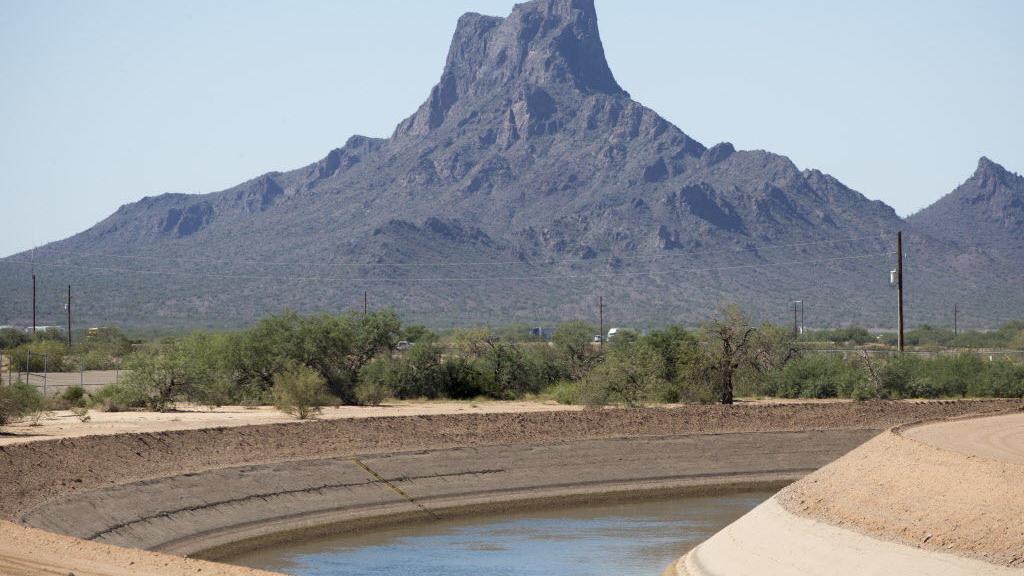
A new analysis of the Colorado River is the latest warning that it’s time to accelerate water conservation, especially on farms, experts say.
“Given that agriculture is responsible for more than half of the consumptive use of water in the Colorado Basin while municipal, commercial and industrial uses comprise only 18%,” the researchers wrote, “strategies for substantially reducing agricultural water use should be a major focus of the discussion.”
How?
“That’s the million-dollar question,” Sorensen said. It may, in fact, be the billion-dollar question, as the federal government has put billions toward paying farmers to leave water in Lake Mead, and is expected to continue funding similar efforts.
'The status quo is failing'
It may take bold actions along the lines of what the government did during the 20th century Dust Bowl when it bought out Great Plains farms to create national grasslands, Sorensen said, acknowledging that that’s a politically fraught idea in the rural West. Whatever the solution, she said, the status quo is failing.
“We have to question whether Congress is going to be willing to continue to pay the Southwest not to use water,” she said.
Fixing the imbalance in the longer term might require Congress to step in, and either change the way water is prioritized for those who first claimed it or allow those with rights in one state to market their water to users who need it in another, one of Sorensen’s co-authors told the Arizona Republic in April, before the study’s release.
“We need a functional Congress,” said Jack Schmidt, director of Utah State University's Center for Colorado River Studies.
“There’s no possible way that we can continue in the next 50 years in a world in which more than half the water is used for livestock feed,” said Schmidt, who previously led the federal Grand Canyon Monitoring and Research Center. “I mean, that just can’t be.”
A huge water deficit possible
The new analysis comes as federal dam managers are preparing to release proposed shortage guidelines to govern the river and its use for the next decade or longer.
The researchers contrasted two potential scenarios for next winter. One considers a winter like that of 2024-25 — relatively dry, but not as severe as last winter. The other considers a year like 2022-23, the third-wettest so far in an increasingly dry 21st century.
In both situations, they calculated the likely remaining “reasonably accessible storage” of water, as opposed to the total water that the dams would still hold back, much of it below the hydropower turbine intakes. The reasonably accessible figure denotes what would be available to release to water users downstream of Hoover Dam without damaging it and Glen Canyon Dam and their hydroelectric plants.
Under the relatively dry scenario, the team calculated a deficit of 2.59 million acre-feet across the river’s three largest reservoirs, which are expected to start with just 6.22 million of reasonably accessible water heading into winter.
That projected deficit assumes that the Upper Basin states above Arizona cut back uses to the same as in their lowest year to date, while Arizona and its Lower Basin neighbors and Mexico reach new lows, so that consumptive use across the entire river is 11.79 million acre-feet.
That compares to the 15 million-acre-foot supply that negotiators of the Colorado River Compact allocated in 1922, plus 1.5 million that the U.S. later awarded Mexico by treaty. (Each acre-foot equals roughly 326,000 gallons and is about what three households require for a year.)
The 2.59 million-acre-foot gap would require a collective drawdown from Lake Mead, Lake Powell and Flaming Gorge Reservoir that would leave only 3.63 million acre-feet of reasonably accessible water heading into the following winter's snow accumulation.
Going that low, the authors say, would force the U.S. Bureau of Reclamation to operate Glen Canyon as a "run-of-river dam," letting out only what comes in during the following year. It would require almost the same operation at Hoover. The result would likely force drastic reductions on farms and other users in the Southwest. Sorensen called that outcome “devastating.”
“It’s just a river system at that point,” she said, and not what the government intended when it built dams to hold back multiple years’ worth of supply while powering millions of homes. “It’s really that infrastructure that is the foundation of the prosperity of the Southwestern United States.”
Strong El Niño 'might buy us some time'
The likely economic devastation does not mean that residents of Arizona cities would soon lose access to tap water, she said. Phoenix and its neighbors have been drilling wells and swinging deals locally to augment supplies from the Salt River watershed. They are positioned to keep water flowing, but it is likely to cost more, and it will speed up groundwater depletion. City regulations restricting outdoor watering would likely follow, she said.
Such little storage also calls into question whether water that the Southwest’s various users have previously left in Lake Mead for later use — effectively lending the reservoir their water under a system called Intentionally Created Surplus — would be readily available at the same time as all users call for their normal allocations.
Leaving so little water behind the dams would, according to the researchers, create “conflicting political pressure from all directions” to refill Flaming Gorge, keep Lake Powell operating safely, send a normal volume downstream from Powell to Mead and prevent a major drawdown of Mead.
“Obviously,” they wrote, “not all of these outcomes can be achieved simultaneously.”
In the second scenario, the one contemplating a mercifully wet winter like the one that supplied the river in 2023, more than twice as much new water would flow as in the dry scenario. Usage would also rise as, for instance, states in the Upper Basin would not have to curtail as many farmers as they must in dry years. Still, the river would provide more than what’s needed next year. Instead of the 2.59 million-acre-foot gap opened by a dry winter, the region would enjoy a 4.83 million-acre-foot surplus.
Nonetheless, the researchers said, that surplus would last less than two years under the existing supply-and-demand imbalance.
“The lesson,” they wrote, “is that even a relatively wet year provides merely a short reprieve from crisis if the pattern seen in the 21st century of multiple, consecutive dry years following individual wet years continues.”
It’s possible that a developing shift in cyclical ocean patterns toward a “super El Niño” could dampen the region even more than 2023 did, Sorensen said. But El Niño's regional effects are unpredictable and won't provide a long-term solution, she said.
“If we get lucky, it might buy us some time.”
Sorensen and Schmidt’s colleagues on the project include a list of experts who, like themselves, have tracked and worked on the Colorado River crisis for years: Anne Caste of the University of Colorado; Eric Kuhn, formerly of the Colorado River Water Conservation District; and Katherine Tara of the University of New Mexico.