PHOENIX — Arizona State University is ending its attempt to seize a 124-year-old historic downtown Phoenix home, which means the Louis Emerson house will remain where it is.
ASU confirmed Friday it will withdraw its court case against Emerson House owner Robert Young and his tenant Barry Schwartz. ASU was trying to use eminent domain to take the property. Eminent domain refers to the government's right to take possession of private property for valid public use, even if the owner objects, though the owner must receive "just" compensation.
"There are a lot of positives to this. I think it's a celebration of a love for Phoenix," Young told The Arizona Republic Friday.

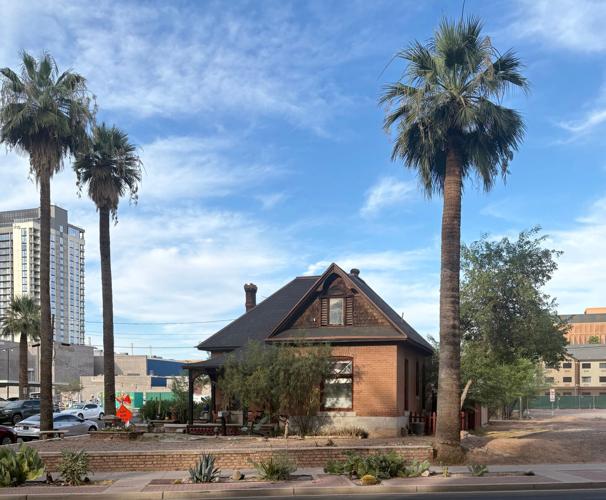
The Louis Emerson House in downtown Phoenix was built in 1902. Arizona State University wanted the property as part of plans to build a facility that will house its new medical school.
Country singer John Rich, recently named by President Donald Trump as Special Envoy for American Landowners, said in a social media post that he had convinced ASU president Michael Crow to drop the case and called it a "big win for American landowners." ASU officials did not confirm whether Rich played a role in ending the case, but Young said he believes Rich was the catalyst.
People are also reading…
Instead, the university provided an emailed statement.
"ASU has been working toward a resolution with the Emerson House in downtown Phoenix, a house that sits next to land being developed for the headquarters of ASU Health," ASU spokesperson Jerry Gonzalez wrote in an email to The Arizona Republic.
"To honor the homeowner’s desires, the university has agreed to withdraw its court proceedings and allow the house to remain. The plans for the ASU Health site will be revised accordingly.”

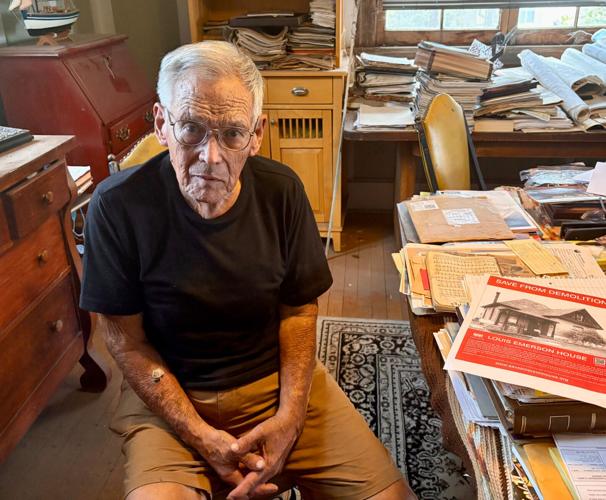
Retired attorney Robert Young has owned the historic Louis Emerson House in downtown Phoenix since 1975. He refused Arizona State University's offers to buy it.
Had ASU not withdrawn the lawsuit, Young said he was going to insist on a jury trial.
"I wasn't going to settle this case," he said.
Trump special envoy thanks ASU president
The university had wanted to seize the 833-square-foot home, which sits on a 4,672 square-foot lot (slightly more than one-tenth of an acre), in order to build its new medical school. It is named for its first owner, a butcher named Louis Emerson who lived in the home with his family between 1902 and the early 1930s.
Opponents of the project had noted that the medical school is expected to be nearly 178,000 square feet and that the Emerson House comprised only a tiny corner of the property where it will be located. They had urged ASU to incorporate the 1902 home into its plans.
In his social media post, Rich thanked Crow for having "a heart and a soul," and seeing the situation from Young's perspective. He said he also encouraged Crow to reimburse Young's legal expenses.
"Mr. Young, congratulations sir. You can keep your home right where it's at," Rich said.
"These are the kinds of things I do with this position that president Trump gave me as special envoy for American landowners. There's no situation too big and there's no situation too small. If you are an American landowner, you have rights."
Home's owner had refused ASU's purchase offers
Young, an 89-year-old retired Phoenix lawyer who has owned the home since 1975, has refused ASU's offers to purchase it, including options to move the house. ASU's April 21, 2026, offer of $815,000 is part of the court filing.
The ASU Health Building will act as headquarters for a collection of health disciplines, including the ASU John Shufeldt School of Medicine and Medical Engineering, and is expected to open in 2028. Construction was slated to begin in July.
Schwartz, a Phoenix performance artist who has rented the home for the past eight years, started a Change.org petition to save the house. As of Friday, the petition had collected nearly 12,000 signatures.
Supporters of preserving the home have said too much of Phoenix has already been torn down, including the downtown Fox Theater, which was built in 1931 and torn down in 1978 to make way for Phoenix's downtown bus terminal, and the Fleming Building on the northwest corner of First Avenue and Washington Street, which was completed in 1883, held the first elevator in the Arizona Territory and was torn down nearly 100 years later.
'The house has found its home and it's very happy'
When it was built, the Louis Emerson House was along the Brill Line of the old Phoenix Street Railway, which was a streetcar that ran through the city from 1888 through the 1940s.
"It's one of a very small group of properties representing the earliest residential subdivisions outside the Phoenix townsite," said Roger Brevoort, a board member of the nonprofit Preserve Phoenix organization, told the Republic in June, explaining that the house is in the Churchill Addition, outside the original, 320-acre Phoenix townsite.
The two-story house was added to the Phoenix Historic Property Register in 1990. It has Victorian-era Queen Anne and Eastlake styles of architecture, but it's more modest than many other homes in that style from the turn of the 20th Century because its first owner was a working man: Louis Emerson, a Phoenix butcher who lived in the home with his family and remained until his death in the 1930s.
The house was already moved 44 feet east in 1990 to make room for the Arizona Center and Young, who got married on the front steps of the home in 1976, has said it should stay where it is.
"I don't want it moved. It's a beautiful site," he told the Republic in June "It's just gorgeous at around 5 p.m. The porch is illuminated with sunshine. ... The house has found its home and it's very happy."