


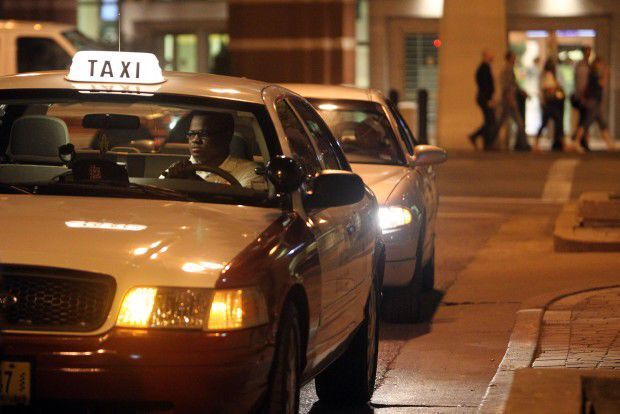
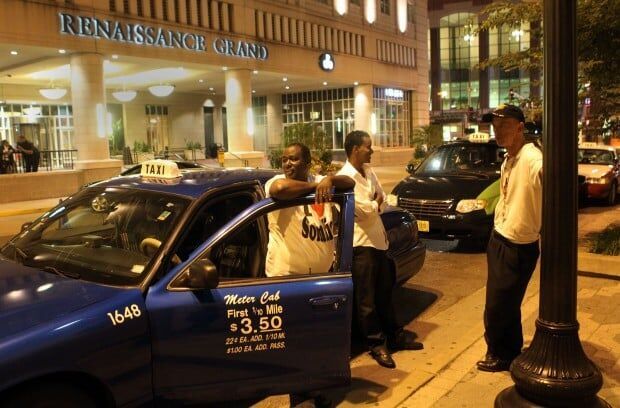
ST. LOUIS • A taxicab passenger got billed for a $200 vomit cleanup fee by a cabdriver-turned-back seat janitorial service.
The passenger disputed the charge and reported it to the St. Louis Metropolitan Taxicab Commission, which has authorized cabdrivers to charge for cleaning up after drunken passengers who get sick enough to knock a cab out of commission.
But that’s only if there is a commission-approved sign notifying passengers that they can be on the hook for such a cleanup. Taxicab operators can charge up to $200 to clean a mess someone leaves inside a cab.
Since the Taxicab Commission authorized the fees in late August, only one company — Laclede Cab — has posted signs showing an intent to charge for cleanup. That company’s fee is $50, said Ron Klein, the commission’s executive director.
People are also reading…
The recent fee dispute didn’t involve a Laclede cab. Klein said the cabdriver in question got a warning about the unauthorized cleanup fee; it appears the passenger disputed the charge with her credit card carrier and as of last week had not been charged.
These types of events illustrate the messy risk drivers take when picking up drunken passengers. It is why the taxicab commission joined a small group of U.S. cities that charge similar cleanup fees.
The problem, in a nutshell, is that cabdrivers provide an important service when they pick up passengers who have had too much to drink at a restaurant or bar. But all it takes is one sickening mess to knock a taxicab out of commission while the driver cleans and disinfects the passenger compartment.
Last summer, some drivers acknowledged that they carry the functional equivalent of an air-sickness bag in their cabs.
Chicago and Austin, Texas, are among the cities that charge modest cleanup fees.
Klein said the St. Louis Taxicab Commission capped the fee at $200 after taking an unofficial poll of cab companies and drivers who attended the August meeting.
“We took a neutral position,” he said. “If a cab company wants to allow it, we will allow up to a $200 cleanup fee.”
If the cab owner elects to charge the fee, then the “amount and conditions of such charge must (be) displayed prominently in the passenger compartment of the vehicle where it is easily in view of the passengers,” the commission rules state.
To which we can only reply: Yuck.
GAME-DAY CLOSURE OF BROADWAY
Stepped-up security measures have forced the closure of the Broadway ramp from Interstate 70 in the hours leading up to St. Louis Rams home games this season.
The ramp closure is the latest in a gradual series of security buildups aimed at complying with the NFL’s post-Sept. 11 security mandates. The NFL wants stadium operators to maintain a 100-foot buffer to prevent any potential “Vehicle Borne Improvised Explosive Device” near the venue.
Previous efforts to meet the NFL directive have included lining yellow school buses on Broadway and erecting a series of concrete Jersey barriers near the Edward Jones Dome.
“Those methods did not provide the required 100-foot perimeter,” said Bob Calderon, director of public safety for America’s Center.
Calderon said the Broadway ramp and Broadway itself, between Cole Street and Convention Plaza, close 2½ hours before kickoff and reopen within an hour of the game’s final play.
Two weeks ago, the Missouri Department of Transportation opened the Tucker Boulevard ramp off eastbound I-70. That has given Rams fans another option to get to parking lots near the Dome.
The Rams will be back in town for a Monday night game against the Seattle Seahawks on Oct. 28, so consider the new Tucker ramp if you need to use Broadway that night.
NO MORE PENNIES
Just a reminder to Metro bus passengers: The St. Louis transit agency will no longer accept pennies beginning on Monday.
The agency already began phasing out 50-cent coins and $2 bills. But Metro reminds riders that its bus fare boxes will still accept nickels, dimes, quarters and $1 coins. Bus passengers also can use $1, $5, $10 and $20 bills.
Metro officials say the new fare boxes will replace aging fare-collection equipment that had grown expensive to repair.
ROCKY PAVEMENT
In its latest report, “Bumpy Roads Ahead: America’s Roughest Rides and Strategies to Make Our Roads Smoother,” the transportation research group TRIP warns that about one-fourth of the nation’s most heavily used pavement is in substandard or poor condition.
And the problem can be a costly one for drivers.
St. Louisans can expect to pay $365 a year in additional maintenance costs because of rough pavement, ranking 59th among urban areas with more than 500,000 people. Rough rides took the heaviest tolls on Los Angeles drivers, who have to shell out an extra $832 a year, the report found.
Funding to keep major roads smooth and pothole free is starting to evaporate at all levels, the report found. So expect the ride to get bumpier.
Ken Leiser is the transportation writer at the Post-Dispatch. Read his Along for the Ride column online and every Sunday in the newspaper.


