

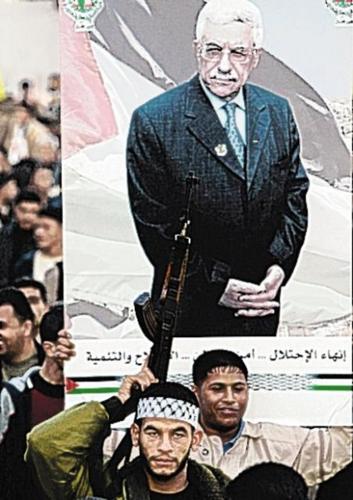
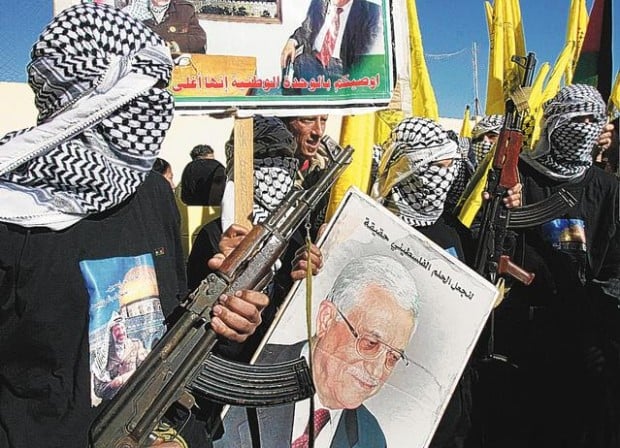
GAZA CITY, Gaza Strip — Palestinian gunmen waged a street battle outside President Mahmoud Abbas' residence around dawn today, dashing hopes that an hours-old truce would bring quiet to the Gaza Strip.
Rival factions Hamas and Fatah are fighting for control over the Palestinian government, and the volatile coastal territory was rocked by violence all day Sunday. Three Palestinians were killed in the fighting.
The fighting came after the factions reached a tentative cease-fire Sunday to end days of bloody fighting that had raised tensions in the Gaza Strip to their highest point in a decade, mediators said.
The daylong wave of factional violence killed three people. Armed militants continued to patrol the streets after the truce was announced.
In the earlier violence, gunmen fired on the Palestinian foreign minister's convoy on Sunday and militants launched mortar shells at President Mahmoud Abbas' office.
People are also reading…
Prime Minister Ismail Haniyeh accused his rival, Abbas, of inflaming the political crisis by calling for early elections and said his Hamas group would boycott the poll. Abbas, a moderate from Fatah, called Saturday for new elections to resolve the political deadlock that has paralyzed the Palestinian government since the hardline Hamas militants won January parliamentary elections.
Representatives of Fatah and Hamas did not appear at the press conference, leaving the cease-fire announcement to Rabbah Muhanna, a senior official in the small Popular Front for the Liberation of Palestine. "Both sides are serious about the agreement," Muhanna assured reporters.
Fatah urged its fighters to show restraint on Sunday but in the same statement accused Hamas of trying to overthrow Abbas.
Hamas' electoral victory split the Palestinian government, with Abbas seeking peace with Israel and Hamas refusing to even recognize the Jewish state's existence. The political tensions have repeatedly turned violent, and the chaos has spiraled out of control since unknown gunmen killed the three young sons of a Fatah-allied security chief last week.
On Sunday, Foreign Minister Mahmoud Zahar's motorcade came under fire as it drove near the foreign ministry in Gaza City. Zahar was unharmed, but the attack unleashed a ferocious gunbattle that raged for more than an hour, the worst fighting since unity government talks broke down late last month.
Several mortars launched
Sporadic fighting erupted into the evening. Hamas gunmen opened fire at a demonstration of tens of thousands of Fatah supporters in northern Gaza, wounding at least one person, and unknown militants fired at least two mortars at Abbas' office in Gaza City. Hours later, they launched another mortar shell.
Five pro-Fatah security men and a 45-year-old woman were wounded, officials said. Abbas was in the West Bank at the time.
In an earlier attack blamed on Hamas, dozens of gunmen raided a training camp of Abbas' Presidential Guard near the president's residence, killing a member of the elite force.
Col. Adnan Rahmi, a top security officer affiliated with Fatah disappeared — then, several hours later, after nightfall, his bullet-riddled body was discovered in northern Gaza, Palestinian medical officials and his family said. No group took responsibility, but Rahmi's family blamed Hamas for the killing.
In an apparent effort to restrain its supporters, Fatah issued a statement late Sunday calling on its fighters not to fire unless their lives are threatened.
Abbas on Sunday briefed Secretary of State Condoleezza Rice on the situation and his efforts to resolve it, said Nabil Abu Rdeneh, an Abbas spokesman.
Despite the violence, the Palestinian president signaled he was determined to push ahead with new elections.
He met with members of the Central Election Commission at his headquarters Sunday to discuss a possible date. The head of the panel said it would take at least three months to prepare new presidential and parliamentary elections.
"The message of the meeting is that he is serious, that he is saying 'don't doubt my words.' " said a top aide, Saeb Erekat, who added that he expected elections to be held around June.
Haniyeh rejected the call for new elections.
"We confirm that the Palestinian government refuses the invitation to early elections because it is unconstitutional and could cause tension among Palestinians," Haniyeh said.
Gamble could backfire
Abbas' gamble, after months of indecision, could easily backfire, driving the Palestinians toward all-out civil war or giving Hamas the opportunity to win control of the presidency as well as the parliament and Cabinet it now controls.
But the deadlock in the Palestinian Authority, and the increasing poverty and violence it has caused, may have given Abbas little choice.
On StarNet: View several multimedia features about the turmoil in the Middle East at azstarnet.com/mideast


