

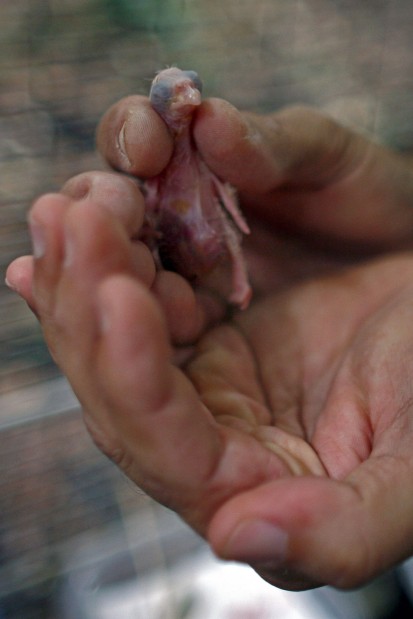
EL YUNQUE NATIONAL FOREST, Puerto Rico - Deep amid the dense greenery of a rain forest, down an unmarked road, behind a barbed-wire fence in a low-slung compound monitored by security cameras, government scientists are nursing a special patient back to health.
The patient is on pain medication but is lucid enough to ruffle his emerald green feathers and fill the room with angry squawks when a biologist removes him from an incubator. It is a Puerto Rican parrot with a broken leg.
In the past, the prognosis would have been grim. "That probably would have been a dead bird," said Jafet Velez, a biologist who manages the Puerto Rican parrot breeding center in the El Yunque National Forest.
The injured bird, a 2-month-old faces an extended stay in the avian equivalent of intensive care and may need surgery. But it is likely to survive.
People are also reading…
"Everything is moving in a positive direction," said Tom White, a Fish and Wildlife biologist who helps manage the island's wild parrot populations.
It is difficult to pinpoint the number of birds because they are elusive and not all have functioning radio collars. But White said there are 20 to 25 in El Yunque, east of San Juan, and 40 to 70 in Rio Abajo Nature Preserve.
There are now about 150 birds each in the two captive breeding centers, in El Yunque and in Rio Abajo. Both breeding centers report a record year for new chicks, about 40 each.
Puerto Rican parrots are one of about 34 species of Amazon parrots found in the Americas.
In pre-colonial times, there were an estimated 1 million of the birds spread across Puerto Rico. Intensive agriculture, particularly the massive clearing of forests for sugar cane, coffee and citrus, and a series of devastating hurricanes destroyed most of their prime habitat. By the late 1960s, they had disappeared from the entire island, except a few dozen in El Yunque.
The captive breeding program began in 1972, but there wasn't much hope. "They thought the species is going to be extinct, so we need to keep in captivity a representation of what was a Puerto Rican parrot," said Velez, who has worked for the program for 21 years. "But the species really showed resilience."


