

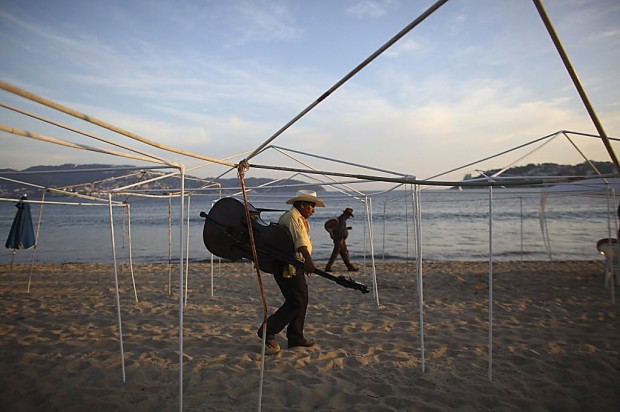
ACAPULCO, Mexico - Acapulco long ago lost the international popularity contest to Cancun.
Yet one of Mexico's oldest resort cities endures, despite a ruinous swine-flu outbreak in 2009 and now drug-gang beheadings and massacres.
Acapulco, a drug-trafficking hot spot of endless turf battles between Mexico's ever-shifting cartels, has for years drawn mostly national tourists, especially from Mexico City, who only have a four-hour drive down a winding but well-kept high-speed toll road.
Those tourists are still drawn by the famous glittering bay and death-defying cliff divers. It doesn't seem to matter that daylight shootouts have broken out along the main coastal highway, forcing souvenir vendors to dive for cover, or that bodies are hung from bridges and dumped on the road leading into the city.
Or that 20 working-class Mexican men, some of them related, were kidnapped while visiting Acapulco in September. The bodies of 18 of the men were found in a mass grave outside the city a month later. Investigators believe local drug traffickers mistook them for rivals.
People are also reading…
Over Christmas, 94 percent of hotel rooms in the city were booked, as good as any other year, said Jose Cedano, president of the Acapulco Association of Tourism Professionals. And that's not counting those who stayed at the many high-rise apartment buildings and hillside weekend homes that are continually being constructed. Those provide an estimated 40,000 extra rooms in Acapulco, which has 28,000 hotel rooms, Cedano said.
Mexico City residents seem unwilling to allow drug-gang violence to ruin their plans.
"Residents from the capital are very special. They don't pay attention much to the violence," Cedano said. "It's thanks to national tourism that Acapulco has survived."
The toll has been in international tourism.
Acapulco may never be what it once was: a glamorous mid-20th-century Hollywood playground where Elizabeth Taylor held one of her many weddings and John Wayne and "Tarzan" star Johnny Weissmuller threw lavish parties at the Los Flamingos Hotel.
Until five years ago, an average of 25,000 U.S. spring breakers chose the Pacific resort each year, lured away from Cancun by a marketing push offering cheap rates, Cedano said
Last year, there were fewer than 6,000 spring breakers. This year, Cedano said, travel agents have so far only booked about 1,000.
"We do have a crisis when it comes to international tourism," he said. "Everyday we get fewer international tourists."
Claris Ashley Smith, an 85-year-old retired army officer who lives in the suburbs of Washington, D.C., is one foreigner who thinks Acapulco hasn't lost its shine. He has been coming here for 30 years, and isn't thinking about stopping.
"I'd spend the rest of my life here, if I could get away with it," Smith said. "I'd just as soon die here."
"We see the 'federales' riding around with machine guns, but we have not been directly affected by it," he said of the violence.
His advice? "Come on down."


