

Forget the federal loan-modification program, which has struggled to get much done.
Apparently the easiest way to get a loan modification these days is to have a news reporter make a call for you.
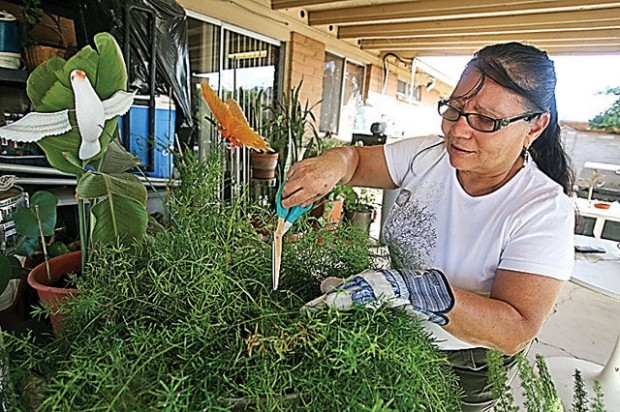
That seems to have been the case for Maria C. Nido, a friendly and humble 55-year-old housecleaner who had struggled with the payments on the southwest side home where she has lived for more than 20 years.
With the help of Southern Arizona Legal Aid, Nido was seeking a loan modification with her servicer, Utah-based Select Portfolio Servicing.
Mortgage services are not lenders, but are essentially middlemen between homeowners and investors that have purchased mortgages. The servicer collects the checks and disburses payments for property tax and insurance. So they play a key role in any modification.
People are also reading…
Nido had an interest rate of 9.38 percent and monthly payments of $663.68. But Nido’s attorney, Beverly Parker, said talks were going nowhere. Instead of working out a deal, Select Portfolio Servicing was tacking on thousands of dollars to Nido’s balance in fees simply labeled “Expenses Paid By Servicer.”
It was also unclear how much Nido was supposed to be paying each month because Select Portfolio Servicing didn’t appear to be crediting Nido with her insurance payments. Depending on whom Parker talked to, Nido was supposed to be paying as much as $788.10 a month or as little as $663.68.
In an interview several weeks ago, Parker said she thought Select Portfolio Servicing was piling on the fees and trying to make the monthly payments seem higher to force Nido into foreclosure. Nido owed about $46,000 on her loan, but her house was worth more than that. A foreclosure made good business sense for the servicer and the lender.
“They can get their money out, and they don’t have to worry about collections and probably make some additional profit by these other things that they are tacking on,” Parker said of the prospect of a foreclosure. “It makes sense. This is a good business decision. It just doesn’t take into account that this is a homeowner who has been there more than 20 years.”
I liked Nido when I met her a few weeks ago for an interview at Southern Arizona Legal Aid. She was a quiet, kind woman who had a hesitant good nature about her. She cried when talking about losing her home, a possibility she said she had kept hidden from her adult children until a few months ago.
“I didn’t want them to be worried about the problems,” Nido said. “I never wanted them to worry. I wanted them to finish their school and everything. I didn’t want to be weak.”
When the interview wrapped up, she tried to clean up the coffee mugs on the table until Parker told her not to because she was a guest. Nido struck me as the kind of person who holds doors for others or serves herself last.
But that doesn’t necessarily make her a good borrower. And the truth is, I wasn’t sold on doing a story about her situation.
The interest rate of 9.38 percent was high, and the more than $4,000 in mysterious fees was eye-catching, but I wasn’t sure if Nido really should get a modification. She had refinanced for $64,000 in 2001 to make some home improvements.
She then filed for bankruptcy in 2004 to avoid a foreclosure, and she is making only about $550 a month with her housecleaning. She didn’t seem like a strong borrower even though her adult kids were offering to help support her income.
But I made a call to Select Portfolio Servicing anyway and left a message. A staffer called back, but only to ask what the questions were and to relay them to a higher-up.
Shortly after that, Nido’s attorney sent me an e-mail.
“I don’t know what you did but I’ve got an offer from SPS (Select Portfolio Servicing),” Parker wrote.
Because of a confidentiality agreement Parker couldn’t describe the terms of the modification, but she said they were good for Nido.
“It’s a modification she can afford,” Parker said. “It’s not going to be fluctuating, and it allows her to keep her home.”
All of which raises the question: Did Nido suddenly become a good borrower worthy of a modification simply because a reporter called?
That’s hard to say for sure, but it sure seems that way. Select Portfolio Servicing never did an interview. Meanwhile, Phoenix attorney Matthew Silverman, who represented Select Portfolio in the Nido case, said the phone message played no role in the modification, but he wouldn’t say anything further.
“They’ve actually gone out of their way in this case to try to get it resolved,” Silverman said of Select Portfolio Servicing. To see a connection between the reporter’s call and the modification would be inaccurate, he said, but then he wouldn’t say why.
Meanwhile, Parker saw a big connection between the message and the modification.
“It shouldn’t work that way,” she said. “It really shouldn’t, but I can’t complain.”
The point of all of this isn’t about the message and whether it played a role in getting Nido a modification. It’s about the fact that there seems to be no rhyme or reason to the modification process, which has been woefully slow at modifying loans and keeping people in homes.
The federal Home Affordable Modification Program, which is designed to guide the modification process to the benefit of the lender (not the borrower), has helped 12 percent of a potential 3 million borrowers stay in their homes, recent reports have shown.
Select Portfolio Servicing is participating in the federal program.
“The results of the programs announced by the Obama administration, to be frank, have been disappointing,” said U.S. Rep. Raúl Grijalva, who represents Nido and much of Southern Arizona. Grijalva’s office gets flooded with calls from borrowers in trouble who are getting nowhere with loan services.
“I think Maria Nido’s case is a striking example, but only the tip of an iceberg,” Grijalva said. “Not everyone can get media attention to their case, and what we need is a reliable public-interest oversight of this whole process, which we unfortunately do not have today.”