

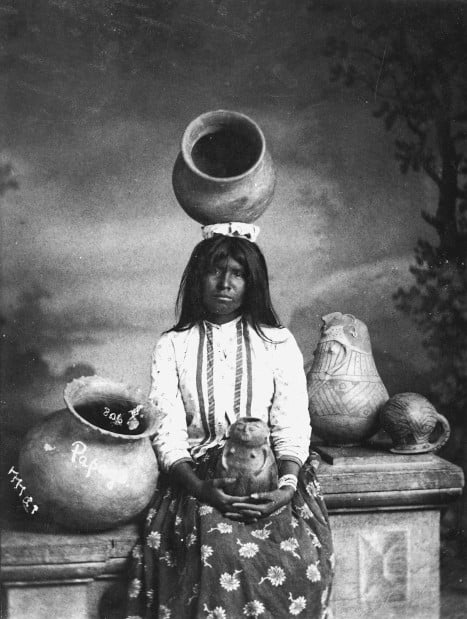
Read a general history of Arizona or watch a movie Western and you're sure to hear about Geronimo, Cochise and other Apaches.
You'll rarely find mention of the Tohono O'odham, the Desert People who have made their home in Southern Arizona for thousands of years.
"The O'odham caused the U.S. government almost no problems because they were industrious and peaceful, but their reward was to be treated as if they did not exist," Winston P. Erickson wrote in his book "Sharing the Desert: the Tohono O'odham in History."
The Tohono O'odham - or Papago, as settlers called them at the time of statehood - historically lived in a region that extended south into Mexico, north to about Phoenix, west to the Gulf of California and east to the San Pedro River. The Gadsden Purchase in 1854 left them with land on both sides of the U.S.-Mexico border.
People are also reading…
As miners, ranchers and farmers came onto their U.S. homelands, especially near water sources, the Tohono O'odham generally retreated farther into the western deserts. They hadn't recorded their land ownership, Erickson explained, "because Indians usually did not consider land as an item of individual possession."
The federal government set aside land for O'odham at San Xavier del Bac in 1874 and created the main reservation in 1916. However, its size was cut by half the next year after Arizonans complained. The Star, then owned by a mining company, was a leading protester, arguing that valuable mining land had been taken away.
Despite the government's neglect and poor treatment, O'odham fought for the United States in both world wars. (Two hundred fifty served and 18 died in World War II). The first war ended before Native Americans were awarded U.S. citizenship, and Arizona did not grant them voting rights until after World War II.
Today there are more than 24,000 O'odham and the Tohono O'odham Nation's 4,350 workers make it Southern Arizona's 13th largest employer.
They gave Arizona its name
A place called "Arizonac" appears in Sonoran records during the Spanish rule of Mexico. It became part of the U.S. after the Gadsden Purchase. "Arizonac" is derived from the Tohono O'odham words "ali" (small) and "shonak" (place of the spring.). Or more succinctly, a place with little water.
"Tucson" is also an O'odham word, Chuk Shon, in reference to the community's establishment at the base of a mountain ("A" Mountain, as we know it) with a black base.
- Source, "Arizona Place Names"