

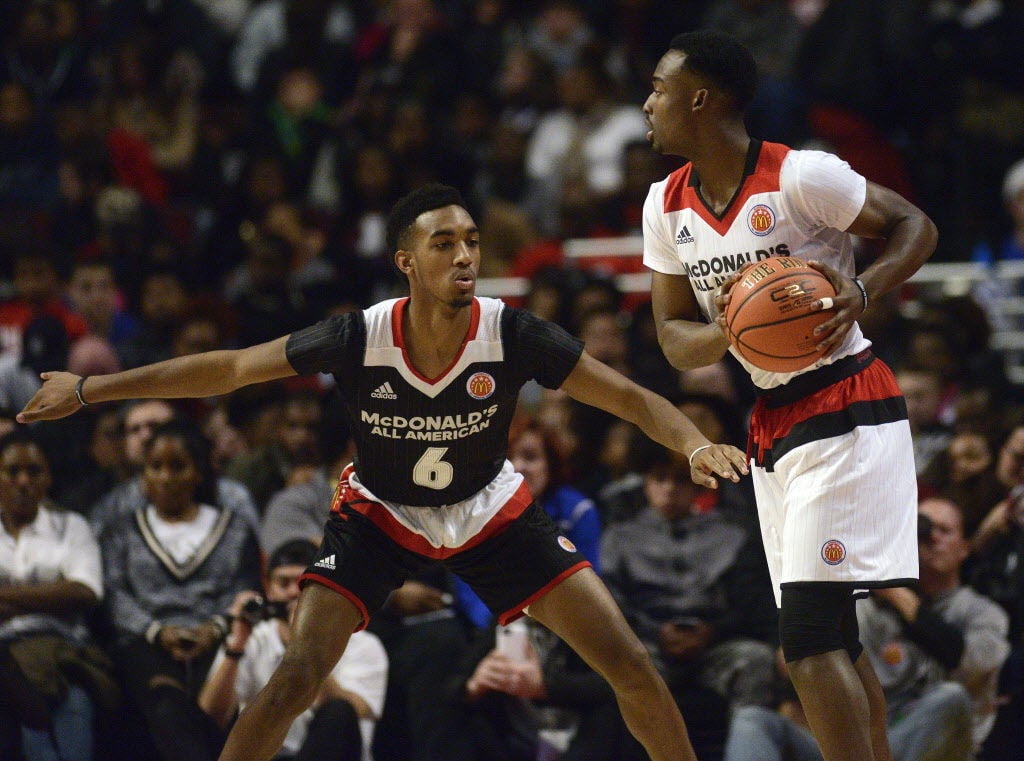
When Southern California playmaker Brandon Jennings opted out of his Arizona letter-of-intent to play professionally in Italy in 2008, he was heralded as a trailblazer in some circles.
He was the first U.S. prep star to circumvent an NBA rule that disallows players from entering the league straight out of high school starting by playing professionally elsewhere for a year.
And he was rewarded handsomely for it: Jennings signed a $1.2 million contract with Lottomatica Virtus Roma and a $2 million endorsement deal with Under Armour, all just a year out of high school.
More players were expected to follow. Maybe even a flood.
“I think we’re going to have a revolution, and Brandon Jennings, a kid from Compton, is going to start it,” Sonny Vaccaro, the longtime shoe magnate who arranged Jennings’ deal, told the New York Times.
People are also reading…
But was it? Certainly for the Arizona Wildcats, it might seem that way. The Wildcats not only lost Jennings back in 2008, but they also lost their top player in the 2016 recruiting class when Terrance Ferguson opted to turn pro in Australia earlier this month.
Overall, though, there have still been only a handful of elite U.S. high school players who have avoided college and nearly all of them have had eligibility concerns looming around their decisions.
Ferguson attended Advanced Preparatory Institute of Dallas, which had the same principal and basketball coach as the now-defunct Prime Prep, where Emmanuel Mudiay starred in 2013-14 before he opted to play in China amid reported eligibility concerns. (Mudiay, who was admitted to SMU, denied eligibility concerns were a factor in the decision).
In April, the NCAA ruled that it would not accept any courses from API, meaning Ferguson’s senior year may have been all but thrown out. He agreed to play in Australia before his eligibility status was finalized.
Two highly rated UA targets in the class of 2017, Trevon Duval and Billy Preston, could also face eligibility issues after attending API last season.
But both appear to be headed to different high schools next season, possibly as a result. Duval said at the Fab 48 tournament in Las Vegas earlier this month that he is not sure where he will go, while Preston has transferred to Oak Hill Academy.
“I’m good,” Preston said of his future eligibility, after a Fab 48 game. “We’re not worried.”
That their former API teammate, Ferguson, opted to go pro was a move that neither Preston nor Duval said they expected.
Ferguson’s future always appeared fuzzy: He committed to Alabama last August, decommitted in March, committed to Arizona in April and signed scholarship papers in May.
“It did kind of surprise me,” Duval said. “But I guess he had to do what he had to do for his family, so I’m happy for him.”
That was pretty much how Ferguson described it. In an article posted in The Players Tribune earlier this month, Ferguson spoke of how his mother worked two jobs and had to constantly deal with layoffs, about hard times growing up that will now end.
“I mean, think about it, I’m going to be a professional basketball player!” Ferguson wrote. “I get to take care of my family! My mom doesn’t have to work anymore! That’s every kid’s dream. I’m smiling right now as I write this!”
But it wasn’t just about money, Ferguson said. It was also about development. Ferguson wrote that he was intrigued after the 36ers approached him at the Hoop Summit game in April and told him how they could help him grow.
“In terms of development, players from overseas are further along than players here,” Ferguson wrote.
“Just look at the last NBA Draft. In college, you have time limits on your workouts, you have class, you have so many other things taking up your time. Overseas, you’re on your own, playing in a grown man’s league. You’re working out twice a day, just focusing on basketball.
“I’ve played against a lot of guys from overseas, and I’ve heard about how many hours they put in. If I get that many hours, with my talent, my athleticism, my game, my mindset, I can be one of the best players in the nation. I can be a top draft pick.”
It’s an argument that 24/7 Sports analyst Jerry Meyer puts some weight in, especially after the June NBA Draft. Eight of the 30 first-round picks in this year’s draft were directly chosen from international clubs or institutions, on top of foreign first-rounders such as Utah’s Jakob Poeltl who detoured through a U.S. college.
“I don’t think this year’s draft helped,” Meyer said.
“A lot of people saw how many foreign guys were getting drafted. I had AAU coaches texting me during the draft saying if you’re a top player, a draftable player coming out of high school, it looks like you’re better off going overseas.”
More evidence for that argument: Haiti’s Skal Labissiere was Scout’s No. 1 prospect in the class of 2015 (No. 2 by ESPN), chose to play in a proven lottery pick breeding ground at Kentucky … then nearly slipped out of the Draft’s first round, going No. 28 overall.
Did college hurt his draft status? Would his stock have stayed higher if he was playing professionally elsewhere and thus more of a mystery? Did he not get enough hours to practice?
Maybe. But college likely helped international draft picks such as Poeltl (who went No. 9 out of Utah), Ben Simmons (No. 1, LSU), Buddy Hield (6, Oklahoma) and Domantas Sabonis (11, Gonzaga).
Then there’s all those Americans, guys such as Brandon Ingram, the No. 3 player in the class of 2015 who went No. 2 overall in the NBA Draft after spending his freshman season at Duke.
Or Jaylen Brown, Scout’s No. 4 prospect in 2015 who struggled at times during a freshman year at Cal, yet still went No. 3 in the 2016 draft.
Didn’t hurt them.
“There’s a value in playing college in a high-profile, competitive program, even if it’s only for one year,” says longtime Southern California recruiting analyst Frank Burlison.
“You’re building your brand. Look at what it did for Brandon Ingram.”
Even though they may have to overcome their years at API to become eligible, Duval and Preston are aiming for college careers.
Duval’s father told Sports Illustrated that he was concerned about the NCAA’s ruling on API because “I have to look out for his brand,” while Preston said he and his family want him to go to college.
Preston may boost his eligibility chances at the well-established Oak Hill Academy, which produced Jennings but also a number of players who went on to become college and NBA stars.
“I like the idea of college,” Preston said. It’s because of the chance to be “coached by (Oak Hill coach Steve) Smith, one of the greatest coaches in the game and the background of the school. I’m going to stick with it mentally and physically, and being away from my parents, I think it‘ll be good.”
But heading even farther from home, against established pros and among foreign tongues, can also have a benefit.
“You’re playing against older guys, trying to take food off the table from them,” Meyer said.
Jennings was a guinea pig for that sort of baptism. He played sparingly for his team in Rome, was the youngest player on the roster by five years, and was overseen by a well-regarded but hard-nosed veteran coach.
But while watching him during that 2008-09 season, Draft Express president Jonathan Givony saw an undisputable growth in Jennings, who went on to become the No. 10 in the 2009 NBA Draft.
“Gone is the brash, arrogant teenager with the Kid ’N Play-style flat-top who dominated the ball in absolute fashion and looked first and foremost for his own shot, his stats and the ultimate highlight play,” Givony wrote.
“In his place is a much more mature, respectful young man, always cheering on his teammates, showing great body language and painstakingly trying to do what his coaches ask of him, almost to a fault at times.”
So, at least in part, maybe it comes down to this: Building a brand in college, or getting some hard knocks far away from U.S. eyes?
“What’s more important: Be drafted higher or be a better player?” Meyer said. “I don’t know.”
There aren’t enough examples yet of players who have gone the foreign route, Meyer said, to know what works better.
But now, Ferguson will be one.
After his year Down Under, Ferguson will become another data point, another potential trailblazer down a road that still isn’t paved.