The final step took four months, but the Big 12's groundbreaking foray into private capital became official last week with the expected pillars:
– RedBird Capital Partners will provide the conference office with $12.5 million to fuel revenue-generating opportunities.
– Each of the 16 schools has the option to accept a line of credit up to $30 million.
– The Big 12, RedBird and a third partner, Weatherford Capital, will work together on strategic endeavors.
The deal doesn't include an equity sale of the conference and, in that regard, is markedly different from the Big Ten's since-aborted attempt to sell 10% of future revenue to an outside investor.
The latest move on commissioner Brett Yormark's chessboard is a screaming deal for the conference, unless the schools accept the $30 million, in which case it morphs into a fireable offense for the approving university presidents.
People are also reading…
RedBird's credit line comes with a significant interest rate (reportedly close to 10%). Schools in dire need of cash would have far better and cheaper options elsewhere — for instance, Russian oligarchs.
So far, a handful of Big 12 schools have indicated they won't take the cash (Arizona, BYU, Houston and UCF, to name four), while none have confirmed they will.
If that holds, then the agreement is reduced to two components: $12.5 million for the conference office to deploy for revenue-generating endeavors; and the strategic partnership with RedBird, a private investment firm with about $14 billion in assets and a portfolio that spans the sports, media and entertainment industries.
And that, folks, is where the Big 12 stands to benefit from the partnership.

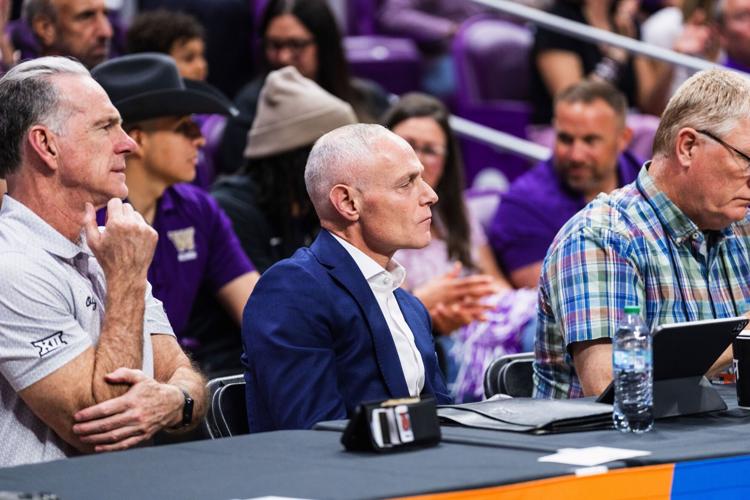
The Big 12's private capital deal is a long-game play by commissioner Brett Yormark (center).
The move makes perfect sense when cast against Yormark's broader strategy to position the conference for the 2030s.
One of RedBird's clients in the media space happens to be Paramount, which owns CBS and just took control of Warner Bros Discovery, which includes TNT.
Guess which networks have forged linear broadcast deals with the Big 12?
Yep, TNT has the rights to 13 football and 15 basketball games annually, while CBS platforms have 26 basketball games. Both deals are through sub-licensing agreements with ESPN.
So if you're scoring at home, the Big 12 counts ESPN and Fox as its primary media partners and TNT, CBS and Peacock, the digital arm of NBC, as secondary partners through sub-licensing deals.
Those platforms are owned by Disney, Fox, Paramount and Comcast, the four major linear broadcast and cable media companies — all of which have something else in common: broadcast rights to the NFL.
If you hadn't heard, the NFL is attempting to renegotiate its media rights deals, which pay roughly $11 billion annually, before the current contract cycle expires at the turn of the decade.
Commissioner Roger Goodell and the owners are reportedly seeking 50% increases in rights fees, or $5.5 billion per year.
Because losing NFL inventory is an existential threat for the linear networks, we expect one of two outcomes to the NFL's power play:
– The networks will pay now, thereby limiting the cash available for college football media rights in the next contract cycle.
– The networks will pay later, thereby limiting the cash available for college football media rights in the next contract cycle.
The situation is mildly concerning for the SEC and Big Ten but deeply worrisome for the Big 12, ACC and Group of Six conferences.
If cash is tight and tough decisions are required, the networks will pay what's required for the Big Ten and SEC because the big brands generate massive ratings which, in turn, produce cash for the networks through ad sales and retransmission fees.
But no Big 12 schools are considered must-haves. (There were two, Texas and Oklahoma, but they left for the SEC during the last realignment wave.)
Any moves Yormark can make today that strengthen relationships with as many linear networks as possible could benefit the Big 12 in a crisis situation five years from now.

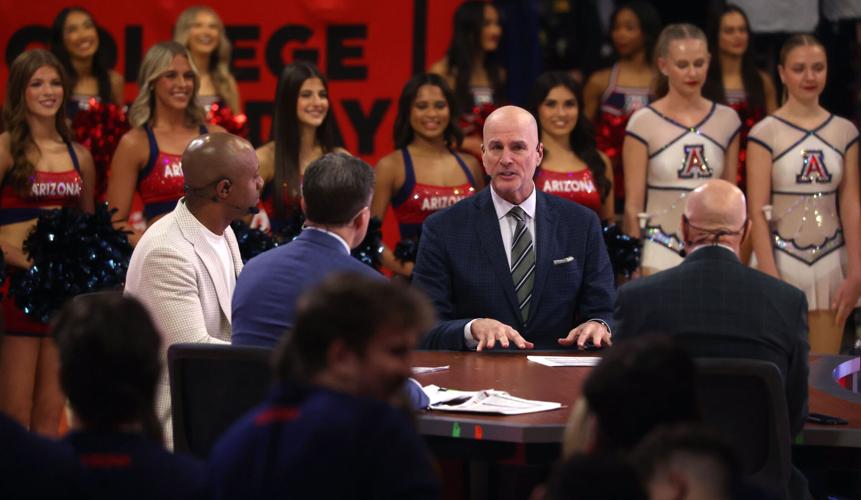
Jay Bilas, right, talks to his co-hosts during ESPN's "College GameDay," at McKale Center, Feb. 14, 2026.
That toolkit includes the strategic partnership with RedBird, which has a stake in Paramount, which owns CBS and TNT.
Connections equate to optionality, and optionality leads to survival in a sports media ecosystem that could be stripped of cash by the NFL.
It's a shrewd plan unless, of course, the schools undercut their own financial futures by actually accepting the $30 million loans.
Sure, they need cash to fund rosters and compete for titles and relevance on a competitive landscape that tilts heavily toward the Big Ten and SEC. But there are more efficient, responsible options. (Most universities make internal loans available, for example.)
If the schools sell their souls at 10% interest (approximately), the benefits of the strategic partnership with RedBird evaporate.
The highest-profile aspect of the Big 12's plunge into private capital is the piece that should be completely ignored.