The last season extended all the way until April, and exhibition games started half a world away in August, effectively compressing Tommy Lloyd’s offseason to about three months.
During that time, the sixth-year Arizona coach picked up accolades and awards, watched three of his players become NBA Draft picks, and started to figure out a way to replace six of the rotation players that helped lift Arizona into its first Final Four in a quarter-century.
Then he began preparing the Wildcats for their August exhibition tour of Lithuania and a new season was beginning all over again.
Yet to hear the ever-broad-minded Arizona men’s basketball coach describe it, everything went down like a long summer at the beach, probably somewhere off the coast of Spain.
“Really long and slow, but it was awesome,” Lloyd said. “I like long and slow. I love long days. Isn't it great when, like, you get home at like four and you think, man, it feels like eight o'clock right now? And then at nine, you're like, ‘Man, it feels like midnight.’ I love that.”
People are also reading…
All that ended in Lithuania.
The Wildcats suffered a humbling loss in their first game to the Lithuanian national “B” team, then returned stateside to rising expectations all around them: They were picked to win the Big 12, where center Motiejus Krivas was named preseason Player of the Year, and voted fifth in the Associated Press Top 25 preseason poll.
Like most coaches, Lloyd says he doesn’t make much of the external expectations around the new season, but he didn't have to even try to deal with as many of them a year ago.
Before winning the Big 12 regular-season and tournament titles last season, and the NCAA Tournament West Region, Arizona was picked 13th in the Associated Press preseason Top 25 and just fourth in the Big 12 preseason poll.
This season the Wildcats face higher expectations despite having just two returning rotation players, center Motiejus Krivas and forward Ivan Kharchenkov.
Why? Maybe the Wildcats’ most veteran player, walk-on guard Addison Arnold, should explain.
“This team is as talented as ever,” said Arnold, who joined the program during Lloyd’s first UA season of 2021-22, before leaving on an LDS mission. “We’ve got a bunch of talented young guys and some key returners.
“So the goal is the same as it was last year — to go win championships. And I think we have the correct personnel to do it.”
It just all has to come together, probably differently, than it did a year ago.
Here are five things the Wildcats probably must do to meet their goals, the outside expectations, and maybe even return to another Final Four.
1. Develop new leadership
While so much focus entering last season was on five-star freshmen Brayden Burries and Koa Peat, along with the indisputable potential of the 7-2 Krivas, point guard Jaden Bradley was the Wildcats’ heart and soul, and a clutch performer when needed.
It was Bradley who picked up the Wildcats in big early wins over Florida, UCLA and UConn as Burries struggled, and it was Bradley who hit a game-winner to beat Iowa State in the Big 12 Tournament semifinals. It was also Bradley whose smooth, almost understated, confidence and communication kept the Wildcats together.
Kept off a preseason watch list for the top point guards in college basketball — a decision that prompted Lloyd’s criticism — Bradley turned into the Big 12’s Player of the Year and an NBA Draft pick now playing with the Toronto Raptors.
In short, Bradley is the kind of guy who isn’t easily replaced. But Lloyd brought in a pair of second-year collegians to run the point — North Carolina transfer Derek Dixon and Washington transfer JJ Mandaquit — while Kharchenkov’s outgoing personality and infectious enthusiasm make him a natural to carry the Wildcats along the way.
All sophomores, they’ll all have to step quickly into the leadership void that Bradley left after four years as a collegian, though they all have high-level college experience — especially Kharchenkov, who not only started for the Wildcats last season but also took on more of a go-to role when Peat was out for four games late last season.

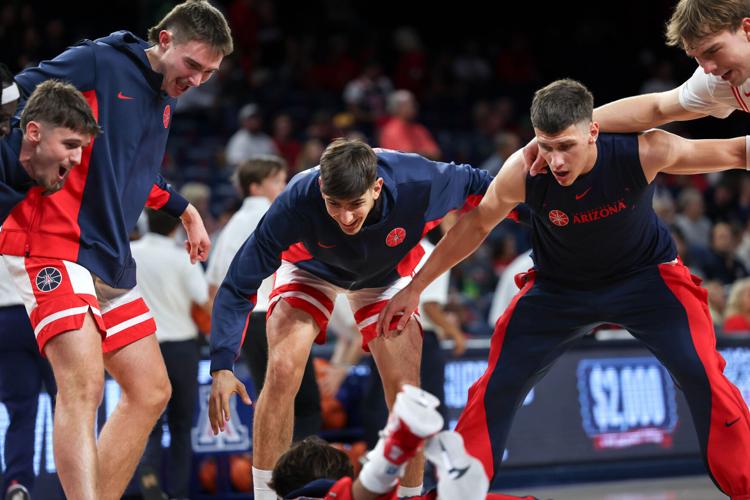
Arizona’s Addison Arnold (22), Evan Otten (30), Maksim Brnovic (35), Ivan Kharchenkov (8), and Motiejus Krivas (13) get ready to face San Diego State, McKale Center at Alkeme Arena, Oct. 16, 2026.
“He played an awesome role on a Final Four team, and he had his moments where he was massive for us in our success,” UA assistant coach TJ Benson said. “There's just so many things that he does at a high level ... and a lot of our young guys look up to him.
“It’s sometimes crazy to say a freshman would be looking up to a sophomore, but he was a freshman on a Final Four team and there's a lot of weight with that. He's had a lot of great basketball experiences.”
Kharchenkov said Krivas will also provide leadership in his quieter way, as did Dixon, who is also expected to lead the Wildcats because he’ll often be on the ball.
“Mo's a quieter guy,” Dixon says. “So when he says something, everybody listens, and Ivan is experienced. Both of them have a lot of good insights for us.”
2. Retool the rotation
Despite the modest expectations around them entering last season, the Wildcats were actually enjoying an unusual amount of top-shelf retention by today’s standards with four returning starters.
Then they added so much talent — and also received Krivas back from a foot injury — that two of those starters, post player Tobe Awaka and wing Anthony Dell’Orso, moved to the bench.
This time, Arizona returns only Krivas and Kharchenkov from its 2025-26 starting lineup and virtually everybody in the new rotation will be assuming a new role: Krivas will be alone as the Wildcats’ dominant post threat, without the departed Peat and Awaka around him, while Kharchenkov will be more of an all-around go-to threat … and everyone else is brand new.
That includes three freshmen in the rotation: Holt, wing Cameron Holmes and forward Maksim Brnovic — while Dixon and Mandaquit will have to adapt to new cultures.
The challenge was significant enough that even after having three bonus exhibitions in August during a tour of Lithuania, and the allowable 10 practices beforehand, Lloyd still fretted that he was “always amazed at how you have to start over every single time.”
In Lithuania, and during the Wildcats’ three McKale Center exhibitions, Lloyd experimented considerably with his rotation. He started a projected reserve guard, Bryce James, saying that helped keep strength coming off the bench, and Lloyd said he liked playing Mandaquit and Dixon together in the backcourt when possible.

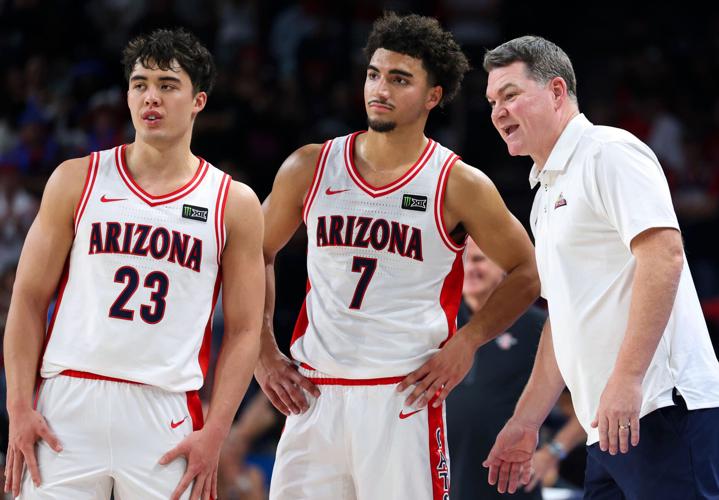
Arizona head coach Tommy Lloyd talks with guards Derek Dixon (7) and JJ Mandaquit (23) during the second half against San Diego State in an exhibition game at McKale Center on Oct. 16, 2026.
But Lloyd also tried playing backup centers Ugnius Jarusevicius and Evan Otten together during the Wildcats’ final exhibition game against Eastern Washington, and said he wasn’t impressed, though he did note the Wildcats had plenty of issues during their exhibitions a year ago before their Final Four run.
“The work’s going to be painful,” Lloyd said. “There’s going to be some tough moments. There’s going to be some growing pains.”
3. Go with Mo
Not long after he arrived at Arizona as a freshman in 2023, Lithuanian center Motiejus Krivas was already projected as a first-round NBA Draft pick the following spring.
That didn’t happen right away. Krivas played behind Oumar Ballo as a freshman and then suffered a foot/ankle injury that torpedoed his sophomore season, but his immense potential became clear last season.
At full health and able to play in all of UA’s 39 games, Krivas began using his 7-2 frame effectively to dominate both ends of the court. He shot 58.4% from two-point range and was unusually accurate from the free-throw line as a 7-footer at 78.0%, while grabbing 14.4% of his offensive rebounding opportunities and 19.8% of his defensive rebounding opportunities.
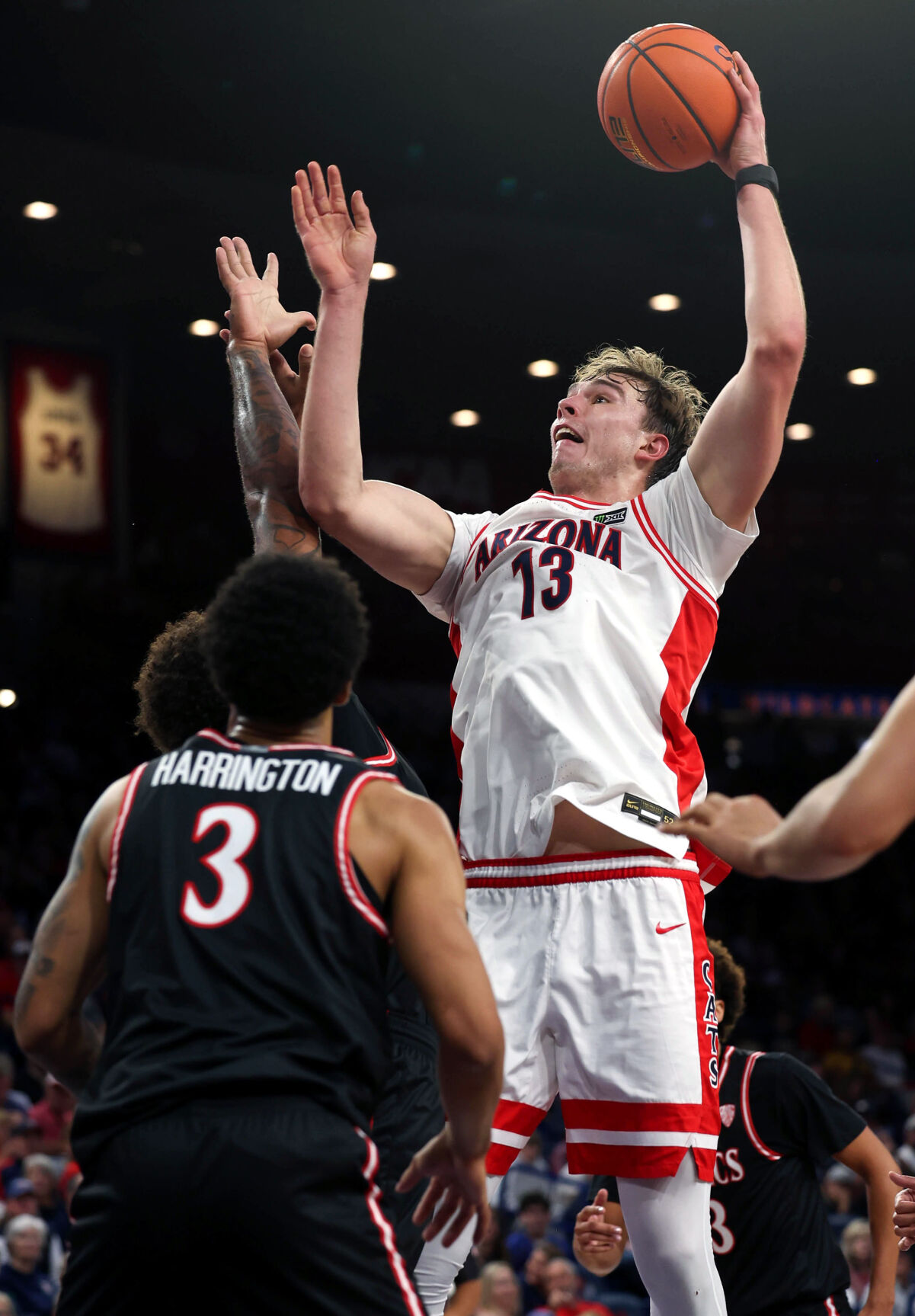
Arizona center Motiejus Krivas shoots the ball over San Diego State defenders in Tucson on Oct. 16, 2026.
He was, simply, almost automatic.
“Coach asked me if I only threw the ball to Mo because he told me to, or because I'm just a good player and see it,” Kharchenkov said. “I’m like, ‘It’s tough to not to see a 7-2 big guy being in front of a 6-9 big guy.’ I just read the game, and he seems to be open all the time.”
Kharchenkov said the Wildcats actually could pass the ball to Krivas “just a little bit more” because he never takes plays off, and always ducks in or seals off his defenders.
“If you have a player that is the best at his position in the country, we should use that to our advantage,” Kharchenkov said.
Defensively last season, Krivas blocked 7.5% of opponents’ two-point shots when he was on the floor, the 60th highest block percentage in the country, and changed countless other shots. He was a big reason the Wildcats finished second in defensive efficiency and are expected to be difficult to score on again this season.
Even in the Wildcats’ highest-level and most difficult exhibition game at McKale, against San Diego State, Krivas had 17 points, 15 rebounds, four blocks and two steals, moving confidently all over the court.
“He’s just got more experience now and had more success, which comes with more confidence,” Lloyd said. “And this team needs that out of him. We’re going to need him to be a double-double guy on a nightly basis.”
4. Bolt with Holt
Despite entering Arizona as a projected lottery pick and a five-star recruit who played in the McDonald’s All-American Game, Burries struggled during the first month of last season before he turned into the Wildcats’ leading scorer and, yes, a lottery pick.
There are reasons to believe Holt might not even need that much adjustment.
Arriving at UA with the same sort of credentials that Burries had, Holt also has the experience of winning three gold medals with USA Basketball teams, including the U19 World Cup bunch that Lloyd coached in 2025. Also, Holt won three different high school championships in Alabama and Georgia before playing on a high-level national circuit at Prolific Prep as a senior last season.
Holt did shoot just 29.5% from the field during the Wildcats’ Lithuania tour, but has shown signs of dominance during UA’s three October exhibitions at McKale Center.
Holt had 15 points, 7 rebounds and three steals against San Diego State, then 21 points on 8-for-11 shooting, five rebounds and three steals against Eastern Washington. His main transgression against the Eagles was having five turnovers, but that could also be viewed as a sign of aggression, the sort of problem a coach would prefer over passivity.
“Caleb's relentless and part of the deal when you have somebody like him who's so talented is you just kind of gotta ride some waves,” Lloyd said. “There's gonna be some aggressive plays, and there's gonna be some mistakes.
“But he's been a great student so far, and a big part of the development with him is teaching him what we do and why we do it. While that process is taking place, (it’s to) let him play with that that energy and effort and those natural instincts he came here with.”
While the 6-5, 215-pound Holt’s ability to get downhill is obvious, he also hit 2 of 6 3s against SDSU and 3 of 4 from long range against EWU. Combined with the shooting ability of Dixon (39.7% from 3 last season at North Carolina) and maybe Kharchenkov (31.7% from 3 last season but 40% in Lithuania), the Wildcats could have enough of a threat from distance to keep defenders from focusing too heavily on Krivas.

Arizona guard Caleb Holt celebrates draining a 3 in the early going against San Francisco in their exhibition game on Oct. 13.
“We have a whole bunch of guys from one through five who can shoot the ball,” Holt said. “I feel like everyone on the court feels like we can shoot the ball, even down to Mo Krivas. I feel like the 3-point makes us even more of a weapon more than our inside presence.”
5. Figure out the four
During an interview at the NBA Combine in May, Awaka told the Star that he never really thought high school graduates from 2022 such as himself would be able to play a fifth season in 2026-27 despite the NCAA’s new five-for-five rule.
“My sights were just kind of set on ‘What’s next?’ ” Awaka said then. “I heard a lot of noise about ‘Nobody’s being grandfathered in, and it just died.’ ”
So Awaka went on to sign a two-way contract with the Chicago Bulls, and when Peat stayed in the draft despite a poor Combine performance, the UA staff scrambled to find a replacement. They pulled in three centers to complement Krivas in Jarusevicius, Otten and Dutch freshman Endi Aiyamenkhue, but none are true power forwards.
Then UA found Clemson transfer RJ Godfrey, a proven power forward who was willing to spend a fifth season with the Wildcats… but was also in the exact same situation as Awaka: A high school graduate from 2022 who had played four college seasons, the exact sort of player the NCAA maintains is no longer eligible because of the rules that were in effect when they finished last season.
The noise Awaka had heard was true, or at least that's how the NCAA has been approaching court cases all over the country involving Godfrey and other high school class of 2022 players.
Godfrey remained ineligible as of late last week, having flipped from a Georgia court case to one in Texas in an effort to get a legal clearance. While last-minute moves still had the potential to clear Godfrey at any point, the Wildcats have to figure out what to do with him out or even if he’s available but hurt or in foul trouble.
In their six exhibitions so far, they have largely moved Kharchenkov from small to power forward and given freshman Maksim Brnovic minutes there while filling the perimeter with Holt, Holmes, Dixon and Mandaquit.
Fortunately for the Wildcats, Kharchenkov already proved capable at the four during the late-season stretch when they went without an injured Peat and during their exhibition games this fall.
“Even if I play the four, I’m not a big mismatch, so I don't have any problems playing it,” Kharchenkov said. “I just don't think we have the size this year like we did last year. We don't have three bigs.”
Brnovich arrived from Europe best known as a well-rounded “point forward” of sorts, and Lloyd praised his upside and strong perimeter skills after he was signed in June. But the UA coach was also optimistic after Brnovic had 10 points and four rebounds — but also five fouls- while facing physical San Diego State players as a power forward.

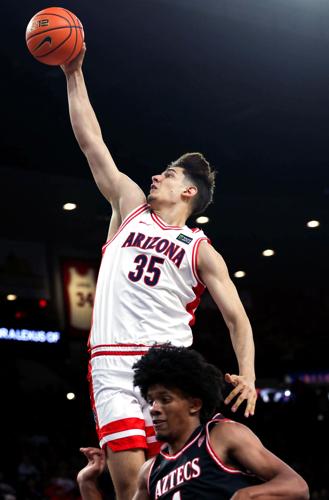
Arizona forward Maksim Brnovic dunks the ball over San Diego State guard Zach White during the first half inside McKale Center on Oct. 16, 2026.
“Maks has got a world of potential, and it'll be interesting to see how long it takes him to get closer to his ceiling,” Lloyd said. “It could take him a while, but he's showing that he's not scared out there, and he was able to make some critical plays in the game when we needed him. I’m really excited about the progress he's making.”
But time is moving quicker now. The Wildcats need potential to convert to production starting Monday in their season opener against UCLA if they are to create another historic season.
Another season that, if it comes together somehow, could rank among the best in Arizona basketball history.
The Final Four “seems so long ago that it's hard for me even to think about it,” Lloyd said. “So it's been a great offseason, but I'm also looking forward to this season.”
Contact sports reporter Bruce Pascoe at bpascoe@tucson.com. On X(Twitter): @brucepascoe
Bruce Pascoe
Reporter


 Arizona men’s basketball: 5 takeaways from UA’s season-opening loss to UCLA | Michael Lev